XOCHIACA, Mexico — The sound of hammers and chisels striking stone rings out on most Sundays in the cemetery of ancient Xochiaca, a village swallowed up decades ago by the urban sprawl of Mexico City.
It's the sound of the stone carvers of Chimalhuacan, as the borough is known, who still pursue a craft passed down for generations — even after the local source of quarry stone was exhausted.
Statues of saints fill the village cemetery, where men coax flowers and garlands out of blocks of stone.

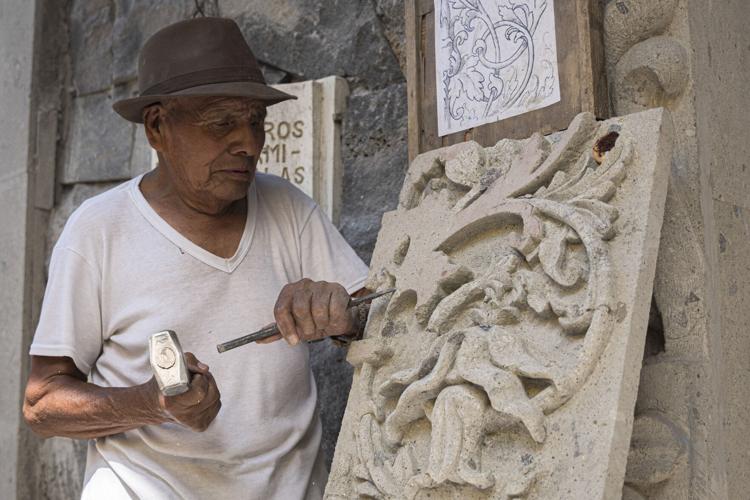
Tomás Ugarte carves stone July 2 at the cemetery in the Mexico City borough of Chilmalhuacan.
Stone carvers in Chimalhuacan, on Mexico's City's far east side, also created much of the stonework that adorns buildings and parks in the capital's downtown.
While carvers in other areas long ago turned to mechanical cutters and polishers, the craftsmen here use only hammers, mallets and a variety of chisels and gouges.
People are also reading…
Many are self-taught but some, like Tomás Ugarte, 86, learned in the traditional way handed down by fathers and grandfathers dating back about five generations.
The group skews to an older demographic these days. There were about 600 registered stone carvers a decade ago, but Carolina Montesinos Mendoza, director of the Mexico State office that supports artisans, said there are probably only about 300 now as carvers die off and their children generally don't want to take up the trade.

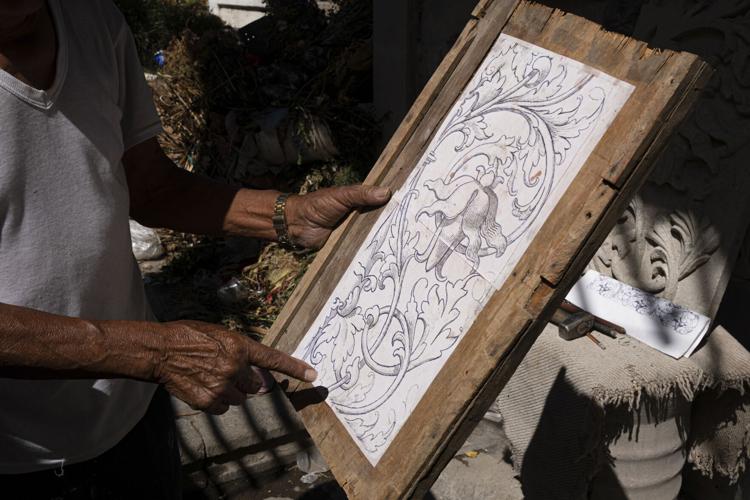
TOP LEFT: Master stone carver Tomás Ugarte shows his sketch as he works July 2 at the cemetery in the Mexico City borough of Chilmalhuacan.
With Xochiaca now lost in a labyrinth of city streets, the stone carvers keep the old traditions alive. Many residents use stone mortars and pestles made by the carvers. Known as "molcajetes" in Spanish, these bowl-like grinders are the basic tool for making salsas.
"They are the backbone of the community," said Rev. Alberto Sandoval, who has known the stone carvers since 1990, when he served as a parish priest in Xochiaca.
Most of the carvers have individual workshops at home, which provide them with some income. They sell carvings for prices ranging from $500 to $2,000, but they often don't sell much.
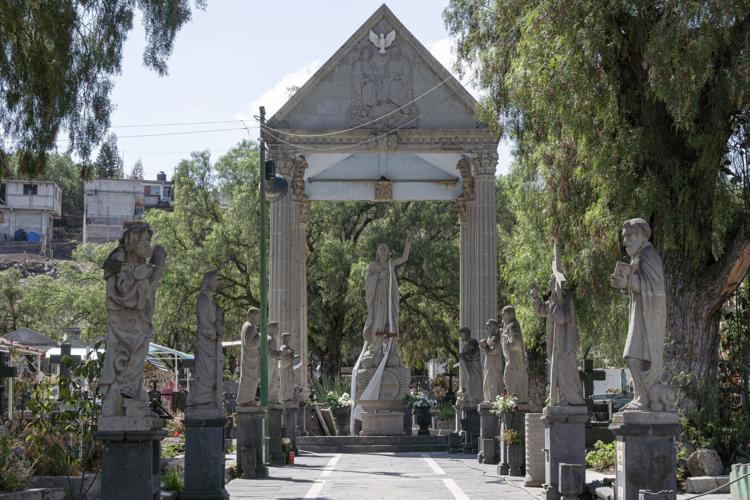
Unlike many craftspeople who want to see their works displayed in museums, the carvers here work free of charge to create and maintain carvings to decorate the local cemetery. Among those ornaments are an imposing, 20-foot stone Christ figure as well as European-inspired sculptures of the 12 apostles.

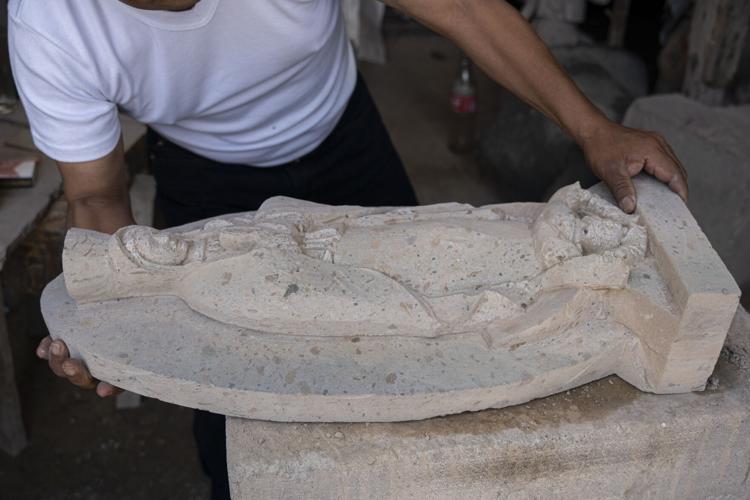
TOP LEFT: Master stone carver Tomás Ugarte shows his sketch as he works July 2 at the cemetery in the Mexico City borough of Chilmalhuacan. ABOVE: Sculptures made by stone carvers adorn the entrance of the cemetery July 2 in the Mexico City borough of Chilmalhuacan. RIGHT: Mario Olivares shows one of his stone carvings July 2 at the cemetery in the Mexico City borough of Chilmalhuacan.
The carvers also work for free decorating and maintaining the stonework at the 250-year-old parish church, Santa María de Guadalupe. They made altar screens, columns and the Christ and Virgin Mary statues that are 10 feet tall.
One of the earliest signs of their predecessors' work is a carved stone in the floor of the churchyard reading "Xochiaca, home of the stone carvers." It does not bear a date but refers to a time when the lake that once covered much of the valley still lapped at the shores of Xochiaca. Builders would come looking for carvings, and ship them to Mexico City on barges over the lake.
Juan Alfaro Bastidas, 75, is a carver, just as his father and grandfather were. He recalls going into the quarries by candlelight to get blocks of stone.
The quarries are just a memory now.
Largely played out, the land where they stood was sold for housing lots. Some newcomers considered it quaint and used the sides of the quarry as walls in their homes.

Mario Olivares shows one of his stone carvings July 2 at the cemetery in the Mexico City borough of Chilmalhuacan.
Now, the carvers truck in stone from other states to the north and west, but sometimes from as far away as the southern state of Yucatan.
They get some help from donations from the local government and residents.
"The neighbors have helped us out with donations of 100 or 200 pesos ($6 to $12). The people of the town buy the stone," Bastidas said.
Asked if the trade will survive, carver Mario Olivares recited a poem etched by the artisans in the church wall: "Your art, your tradition, your culture and the nobility of the people keep the soul of this town alive."
Mexico’s Magic Towns offer travelers wonderment, beauty
Cholula

This Magic Town, two hours from Mexico City, combines the history of a pre-Hispanic town with the architectural and cultural richness of colonial buildings. The Church of Los Remedios is the symbolic image of this syncretism. Built above an important pyramid of Cholulteca culture, the church dominates the view of this ancient valley of Mexico.
Cholula was named a Magic Town in 2012 because it was one of the most important cities of the pre-Hispanic period. According to the legend, there are 365 churches around the city, including the Temple of San Francisco, made with the traditional pottery of Talavera, in addition to the Franciscan Ex-convent of San Gabriel, one of the oldest in the American continent.
Tourists should not miss places besides the Holy Pre-Hispanic City, such as the Royal Chapel, the Regional Museum of Cholula, the Parish of San Pedro and Santa Maria de Tonantzintla, fabulous examples of the Spanish colonial Baroque.
Bacalar

Also called the Seven Colors Lagoon, Bacalar is ideal for diving and snorkeling lovers who enjoy the enormous animal and vegetable diversity of this lush jungle of Quintana Roo.
Bacalar is a city that was founded by the Mayan civilization under the name of Sian Ka'an Bakhalal. This is the gateway to the famous underwater caves of the Blue Cenote and many Mayan archaeological areas of great value that the lush jungle has covered.
The area's main attractions are, in addition to the lagoon and cenote, the Fort of San Felipe, the Museum of the Pirates, the Temple of San Joaquin and the town's Main Square, among others.
Isla Mujeres

This is one of the most beautiful places in the Mexican Caribbean. It is ideal for those looking to have close contact with nature and relax with stunning ocean views.
Its coral reefs, located to the west of the island, are perfect for diving and snorkeling lovers who can admire extraordinary biodiversity, including the whale shark, which visits from November to February.
One of the most popular places for visitors is El Farito, Contoy Island, and the underwater sculptures of Manchones Reef, in addition to the area's cliffs where visitors can swim with dolphins, bike, and climb, among other activities. In addition, the local communities offer excellent cuisine with dishes made from fish and other seafood, such as the traditional Tikinxik, a fish baked underground or cooked on the grill, seasoned with achiote (ancient pigment), as well as the famous snail ceviche.
Other places that visitors should not miss are Garrafón (for diving and snorkeling), Hacienda Mundaca, the Mangroves of Santa Paula and the Maya Observatory, to name a few.
Magdalena de Kino

This Magic Town, located in the state of Sonora, near the U.S. border, was founded by Father Kino in 1687. It is a picturesque town with historic landscapes and cobbled streets. It also has a first-class gastronomic offer in high-quality restaurants.
The village is inhabited by Tohono O'odham natives and the Pima Alto Indians, who revere the image of San Francisco Javier in the Temple of Santa Maria Magdalena, one of the top places to visit. Another of the emblematic places of Magdalena de Kino is the crypt of Father Kino, where the remains of essential missionaries from the time of the Spanish colony are located.
Among the most important and attractive places of Magdalena de Kino are the Religious Center of Our Lady of Mary Magdalene, the Cerro de la Virgen, the Colegio Coronel Fenochio, the Mission of San Ignacio Cabórica and the Museum Eusebio Francisco Kino.