

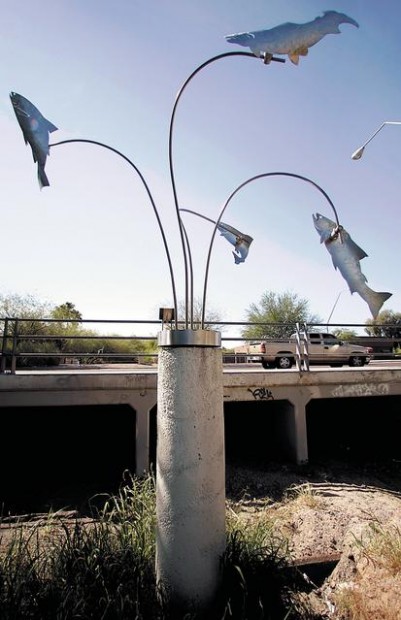
Santa Cruz sand trout an artistic inspiration
As the clouds begin to bubble up over the mountains around Tucson, talk of the monsoon and its propensity for wash-filling downpours spreads through the region.
So, too, do discussions of the impending rain's impact on the Santa Cruz sand trout, Southern Arizona's most reclusive life-form.
For those of you not familiar with it, the sand trout is the local version of a unicorn, a mythical creature whose legend has been passed down through generations via stories of its remarkable survivalism and adaptive nature.
"Endemic to the dry washes of Southern Arizona, this fish is able to withstand extreme heat and the absence of water," claims a plaque affixed to a bridge on East Tanque Verde Road near North Pima Street, where a pair of metal sculptures rising from the Rose Hill Wash honor the sand trout.
People are also reading…
The sculptures — which rotate when windy, a sort of aquatic weather vane — were designed by local architect Paul Edwards and local artist Chris Tanz for $25,000 in 1997 as part of a city-funded public-art piece.
The story of the sand trout goes back at least a hundred years, local folklore expert Jim Griffith told the Star in 1997.
As the story goes, the sand trout first lived in the Santa Cruz River and other Southern Arizona waterways back when the waterways still regularly had liquid in them. While the water isn't always there anymore, the sand trout is, having developed the ability to breathe air and live in the sand.
"As the last Ice Age ended and the climate of Southern Arizona warmed and dried out, the flows of the Santa Cruz River near Tucson became erratic and then vanished completely by the mid-1950s due to the construction of a series of cheap hotels on its banks," according to an entry on the trout on the Web site Bandersnatch.com, the online version of the satirical newspaper The Frumious Bandersnatch. "The native fish of that stretch of the river became extinct, with the exception of the Santa Cruz Sand Trout, which evolved a capability to live in an environment completely devoid of water."
Griffith's 1988 book titled "Southern Arizona Folk Arts" notes that sand trout is quite a delicacy. That is, if you can manage to bag one. "Once caught, they fought furiously," Griffith wrote. "However, if you were extremely hungry, you could use heavy line and haul your trout to shore, hand over hand. The friction of the sand would have it skinned and cooked by the time it landed."
