

SACRAMENTO, Calif. — Iris Ziroli's new beast seemed invincible: It could haul a trailer with 6,700 pounds of cargo, climb slopes at a 60-degree angle and zoom through water 20 inches deep without flinching. Or at least, that's what the pamphlets from her Southern California Hummer dealer promised.
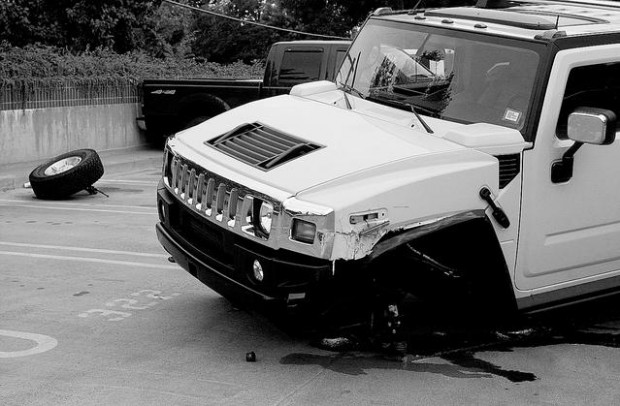
That's why the Murrieta real-estate agent was so bewildered when the front end of her pewter-colored Hummer H2 sport utility vehicle collapsed in February 2004, not during a wild off-road trek, but after she bumped a post in a fast-food restaurant's drive-through.
When it hit the ground, the undercarriage of her vehicle screeched almost as loudly as her 6-month-old daughter riding in a car seat.
"I thought I was so safe because the H2 is so huge and strong," Ziroli said. "The way that Hummer fell apart in that drive-through was uncalled for."
People are also reading…
Two years later, federal highway safety investigators are reviewing Ziroli's case and 25 complaints like it about Hummer H2s, according to government documents. Their review includes 20 cases involving 2003 model year vehicles, like Ziroli's.
Engineers at the National Highway Transportation Safety Administration are studying how a part called a steering knuckle fractured or failed in the incidents, causing H2 suspensions to collapse or their wheels to separate.
General Motors denies there is a safety problem with the metal part, which holds the steering arms in place near the front tires. It says that knuckle-related collapses and wheel-separation incidents are a consequence — not a cause — of H2 crashes and collisions.
But in June 2003, the automaker changed the steering-knuckle part starting with model year 2004. The older part remains in the 47,900 model year 2003s.
The change was made not because there was a problem with the part, according to GM product-safety spokesman Alan Adler, but because GM always wants to "improve its products."
NHTSA engineers also have gathered data about 61 steering-knuckle failures on three-quarter-ton GM Suburban and Avalanche pickup trucks that used the same part, according to documents the company submitted to the government as part of the safety probe.
Such probes can be precursors to recalls. NHTSA investigator Peter Kivett said he is trying to work with GM to pinpoint the cause of the failures.
"We're building a case, but GM is pushing back pretty hard," Kivett said.
A smaller, more luxurious version of the military Humvee, the H2s went on sale in late 2002 and quickly became beloved to a select group of affluent urban owners. California Gov. Arnold Schwarzenegger used to own one.
Assembled at a plant in Indiana, their base price is $53,800. More than 113,000 have been sold.
Gay Kent, GM's product-investigation director, declined an interview request. In a written reply to NHTSA investigators, Kent argued that the volume of the H2 steering-knuckle failures and wheel separations was "extremely low."
"Steering knuckles do not fracture unless they are overloaded in an impact," her report states.
That's not the way Jonathan Barksdale of Chester, Pa., remembers it. Barksdale bought an H2 from a Delaware dealer for $64,000 on Dec. 3, 2003.
Eight days later, with 381 miles on his odometer, according to documents filed in the Court of Common Pleas in Philadelphia County, "suddenly and without warning, the right front wheel of the vehicle flew off."
Since April, the NHTSA's Kivett has collected such statements from H2 owners and drivers, along with photographs of their accidents.
Mark Glover, the Sacramento Bee's auto editor, was the first person to report an H2 wheel separation to the federal government.
A test drive of a yellow 2003 H2 for his column ended abruptly when the vehicle veered suddenly to the left and crashed in the Bee's parking lot. Photos by a Bee photographer show a fractured steering knuckle, a scraped light pole and a wheel 15 feet away.