During California’s prolonged, wet winter, beekeeper Gene Brandi said he had to spend twice as much money on a sugary syrup to feed his honeybees and keep them alive.
That’s because the bees sent to pollinate blooming almond orchards took longer than usual to emerge from their hives due to chilly temperatures, wind and rain. Since the bees weren’t out gathering nectar and pollen for nourishment, the 71-year-old beekeeper provided sustenance for them.

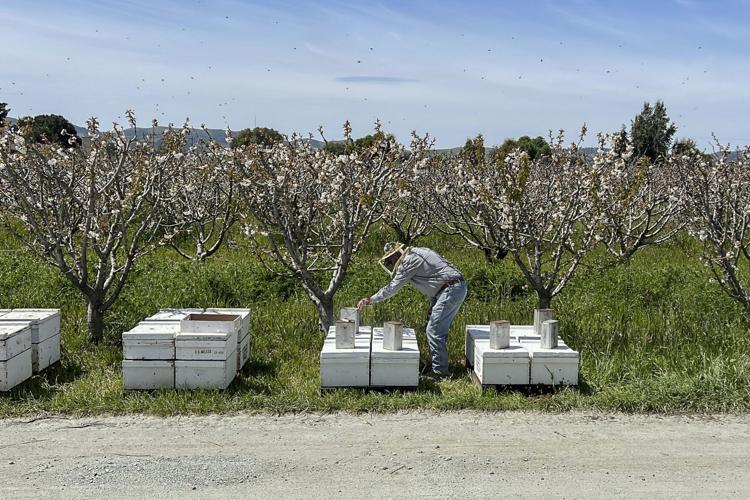
Beekeeper Gene Brandi tends to his hives at a cherry tree orchard April 6 in San Juan Bautista, Calif.
“We probably fed twice as much than we’ve fed in a normal year,” said Brandi, of the Central Valley community of Los Banos. “It’s expensive to feed, but it’s more expensive if the hive dies.”
The challenge is one of many faced by America’s beekeepers following the unusually wet winter that ravaged California’s farm country, which feeds much of the nation.
People are also reading…
Most commercial beekeepers send their bees to California early in the year to help pollinate its $5 billion-a-year almond crop, then move them elsewhere to pollinate commodities ranging from avocados to cherries or to the Midwest to produce honey.
The state was battered this winter by at least a dozen atmospheric rivers — long plumes of moisture from the Pacific Ocean — as well as powerful storms fueled by arctic air that produced blizzard conditions in mountainous areas. The wintry weather flooded homes, triggered power outages and brought much-needed rain to drought-parched agriculture, though in some cases, more water than the crops could withstand.
It also took a toll on bees, which were slow to emerge from their hives during the cold front and weeks of showers.

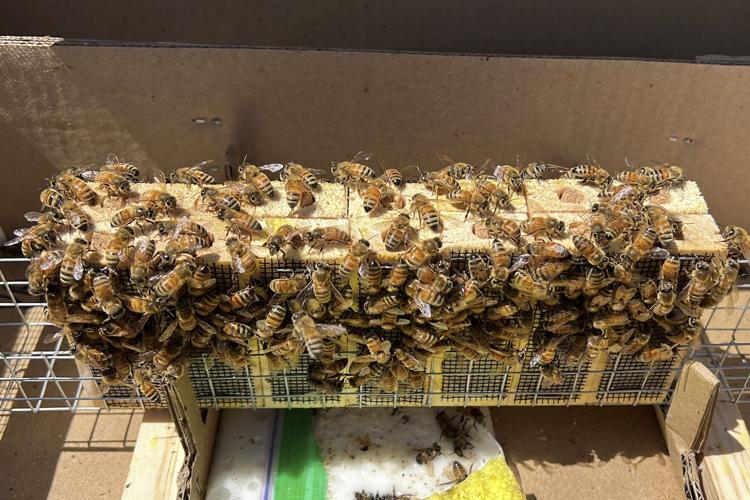
Beekeeper Gene Brandi's bees are cared for April 6 in San Juan Bautista, Calif.
Almond growers say it’s too soon to know if the delay in the bees’ emergence will hurt the state’s nut crop, which accounts for about 80% of the world’s almonds, according to the Almond Board of California.
With a slight reduction in almond acreage following three years of drought and the intense winter, it’s possible there will be fewer nuts this year than last, which was a boom year for the crop, said Rick Kushman, a spokesperson for the state Almond Board.
Almond trees depend on bees for cross-pollination, and bees in turn feed on almond pollen, which helps sustain the hives throughout the bloom.
While many people keep bees as a hobby, commercial beekeepers may have hundreds of hives and relocate their bees to pollinate various crops in distinct seasons.
Bryan Ashurst, who sends his bees north from California’s Imperial Valley to pollinate almond trees, said some hives were washed away by flooding. He said he sent six workers to try to feed his bees during the cold snap since they weren’t out flying — something he hasn’t done in at least two decades and that cost at least $45,000.
“In bees, margins are thin, so we are putting out huge amounts of money,” he said.

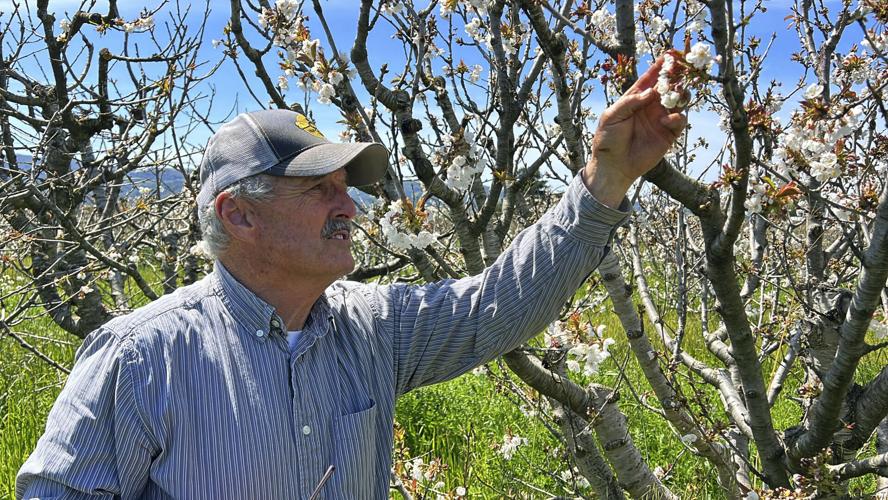
Beekeeper Gene Brandi examines a cherry tree at an orchard April 6 in San Juan Bautista, Calif.
Dan Winter, president of the American Beekeeping Federation, trucked his bees from Florida in late January to pollinate California’s almond orchards, which took longer than usual due to the weather. That delayed their return, so he said he now must hurry to get the hives ready to head to New York for apple tree pollination in less than a month.
“We’ve got to kick it in gear and work a little faster, a little harder,” Winter said. “It just costs a little bit.”
There may be a sweet spot for California beekeepers as the rain is expected to bring a burst of spring wildflowers, which could provide ample forage for bees and potentially translate into a good year for honey.
Brandi said he’ll take his hives to coastal areas this spring so the bees can forage on a native plant to make sage honey, a premium product that he can only make every few years when there’s ample rain.
“It is the finest honey we can make,” he said, adding that the last sage honey he has in his shop dates to 2019.
After that, Brandi, who sells honey to Bay Area buyers and a Midwest honey packer who supplies Costco, said his bees will head onward to feed on other plants and make more honey.
“We’ve been praying for rain for the last three dry years, and we finally have it,” he said. “It should be a wonderful spring once it warms up for the bees.”
6 surprising facts about bees
1. Bees like to 'waggle dance'

Bees can communicate and make decisions by dancing.
When a honeybee scouts out and inspects a new nest it uses a waggle dance to advertise and debate its merits. The better the site, the longer and harder the bee dances. If another bee bumps into a dancing bee, she will go off to inspect the site and if she likes it, she, too, will waggle.
Eventually, the dynamics of the waggle dancing causes about 20 to 30 bees to agree on the best nest site, and they communicate their decision to the rest of the swarm by making high-pitched sounds and by buzzing their wings among the other bees.
2. Bees can use tools

Honeybees in Vietnam and other parts of Asia are threatened by predatory species of giant hornet that attack bee colonies, killing the adults defending the nest and preying on the young bees. In particular, the voracious hornet species Vespa soror is capable of obliterating the hive within hours.
To ward off such attacks, the bees have been observed collecting fresh animal feces and smearing it around the entrance to their hive. The researchers, who published their findings last year, call it "fecal spotting." The study team believe the poop repels the predatory hornets (which are similar to murder hornets) from the nest by reducing time hornets spend attempting to breach the nest.
"Fecal spotting stands out as extraordinary for several reasons. It marks the first report of honey bees of any species foraging for materials that are not derived from plants or water-based fluids. It is also the first clear-cut example of honey bees using a tool in nature," the study said.
Honeybees also signal an imminent attack by making a chilling warning noise.
3. Bee poop nearly caused a Cold War confrontation

In the 1980s, "yellow rain" -- tiny splotches of yellow found on jungle foliage in Laos and Cambodia -- were thought to be the residue of chemical weapons. Refugees said that the yellow rain caused illness and death. The allegations prompted the United States to accuse what was then the Soviet Union and its allies of chemical warfare.
Bee experts later found that the yellow dots were excretions by massive swarms of wild honeybees.
4. Bumblebees get hangry

Plants produce dazzling flowers laden with nectar to attract pollinators but what's an impatient, hungry bumblebee to do when those flowers haven't yet bloomed?
When pollen is scarce, bumblebees damaged tomato and mustard plant leaves in a unique way that resulted in the plant flowering up to 30 days earlier than unnibbled plants, scientists in Switzerland and France found.
For bees, the pollen is a protein source they need to raise their young.
However, warmer temperatures as a result of the climate crisis means that bees are waking up earlier after hibernating for the winter to find the flowers they need for food haven't yet bloomed. Flowering time, which relies on exposure to light, is less affected by climate change. This creates a mismatch that can leaves bees short of food early in spring.
5. Humans have been exploiting honeybees for thousands of years

A cave painting in Spain thought to be 8,000 years old depicts a human gathering honey from a ladder. Traces of beeswax on pottery also suggest that early farmers kept bees 9,000 years ago. Honey has also been found in ancient Egyptian tombs.
Honey was likely a rare treat in a prehistoric diet that had few sweet foods, and it could have had medicinal uses. Beeswax could have been used to make pots waterproof or as a glue.
Today, honey may offer fresh hope in the fight against antibiotic resistance. It contains natural antibiotics to help the body battle infection. Scientists are working on ways to make the sticky substance easier to apply on wounds, and it could be used in surgery, war zones and our own homes.
6. Some bees eat meat

The vast majority of bees feed on pollen and nectar, but some species have evolved to feast on meat, substituting dead animal carcasses for flower meadows.
Vulture bees in Costa Rica have guts rich in acid-loving bacteria similar to those found in hyenas and other animals that feed on carrion, scientists at the University of California-Riverside, Columbia University and Cornell University discovered last year.
Their research involved setting up 16 traps baited with 50 grams (1.8 ounces) of raw chicken dangling from branches about 1.5 meters (4.9 feet) above the ground. Though vulture bees feed on flesh, their honey is still sweet and edible, the researchers said.