

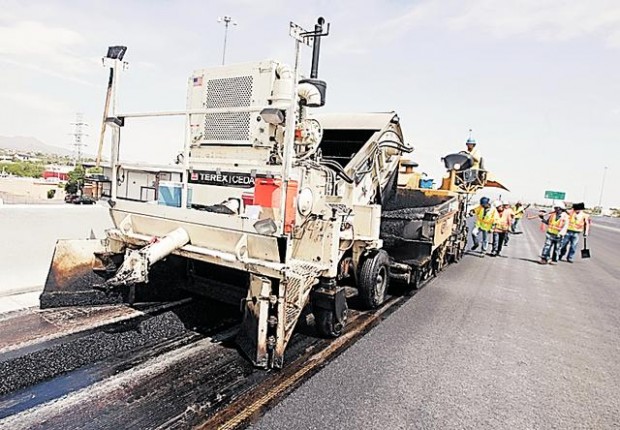
The summer rains in 2007 and 2008 seemed to pour at the worst times for concrete workers rebuilding Interstate 10.
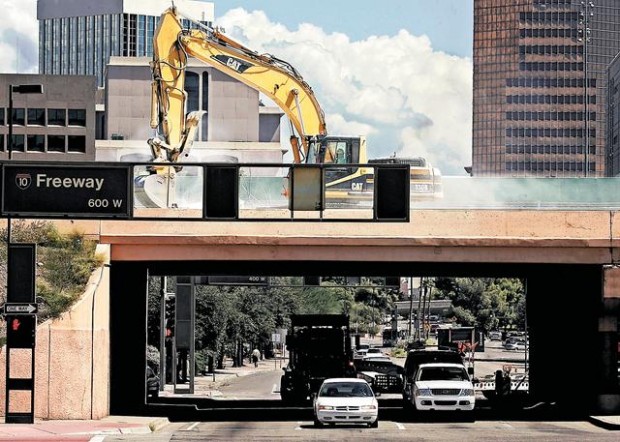
And equipment operators and other workers found it unexpectedly tough to rip out of the ground the big, rusted steel poles that supported the old bridges they were tearing down.
Nevertheless, the huge three-year Interstate 10 reconstruction and widening project through a five-mile stretch of metro Tucson is nearing completion several months ahead of schedule.
Had it come in late, the day-and-night job of replacing 16 bridges and building 10 lanes of highway at a cost of more than $200 million could have become a public relations nightmare for Sundt Construction and its joint venture partner, Kiewit Western Co.
Instead, Arizona transportation officials announced recently that they'll be opening all the long-closed freeway entrances and exits by the end of August, entitling the contractors to a $920,000 bonus. Rain could still delay the openings until September, they cautioned.
People are also reading…
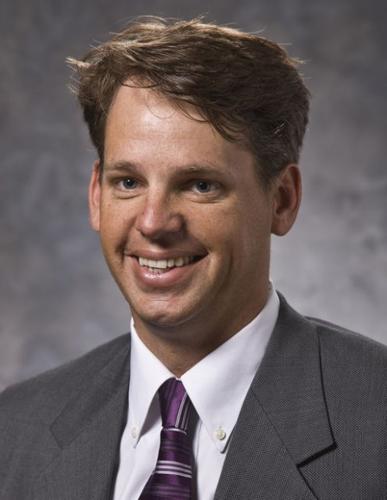
The Star spoke with Sundt Project Manager Steve Schmitt about overseeing the state's largest highway contract.
Q: The project started in January 2007 and was scheduled to be finished in April 2010. How did you finish so early?
A: First and foremost, we had a very talented craft work force on the project. These guys worked a lot of hours for us, a lot of nights.
Secondly, I'd say that we had a very experienced project owner. The Arizona Department of Transportation really understands the freeway business. And they had the technical expertise to work through a lot of the issues encountered during the job.
We were also able to make some fairly substantial changes to the original contract. Originally on the project there were really two friction points. One of them had to do with maintaining the connection to Interstate 19 on the south end of the project. The other one had to do with . . . a centerline shift on the new roadway versus the old roadway in the vicinity of St. Mary's Road.
And all that means . . . is the old center of the highway wasn't in the same place as the new center of the highway, and it transferred from the east side to the west side right around that same area. Under the original contract, they had some detours that they had shown to maintain that connection.
And through looking at the plans on the project we came up with an alternative detour system — and it was mostly composed of temporary asphalt pavement with striping — that allowed us to maintain those connections and also build the entire project without requiring additional phases. In the original contract there were nine individual contract phases, and on our new plan there were really just three distinct phases.
Q: What was the biggest traffic management issue and how did you deal with it?
A: One of the great things that ADOT did was how they set this project up. In the last decade they had worked to improve the frontage roads in preparation for this job.
And another important component is that as part of this contract during the first phase of it, we built something called the Interim Traffic Operation Center. This building is located underneath the I-19/I-10 interchange and it houses traffic engineers and technicians who monitor the traffic on the freeway corridor, on the frontage road. It's composed of CCTV, closed circuit television cameras, and what they really do all day is they optimize that signal through the corridor. So by setting that up before the project event started, it really set it up to be able to handle the traffic during construction.
Q: What went wrong with the project?
A: This monsoon season there hasn't been much to it, but in the last two monsoon seasons we took a lot of water. I remember there were a couple of areas where we were pouring retaining walls and box culverts, and as soon as we'd get the area dried out and ready for concrete and placed the concrete order, it'd start raining again on us.
There were some tricky parts with a lot of the old structures that we tore down and redid, like the bridges. They were built clear back in the 1950s and they were all supported on old steel piling. And those old steel piles were in conflict with the new drilled shafts of the new bridge, and we had to remove these drilled steel piles and they were upwards of 60 years old, rusted, and they were 60 feet into the ground. And that was some tough work. It took a long time... . You'd pull them apart and they'd break. And a lot of that happened at night. . . . It was frustrating.
Q: What were some of the challenges of working with such a massive project?
A: There was a lot of supportive earthwork. . . . You really had to plan out what you'd do just from the simple fact that you were working up against a vertical bank in a lot of the areas along the corridor.
I think one of the really important components is that as the contractor out there you have to realize that if you lock up the corridor through your traffic control or through your closures, that you're not going to get any materials to you. You're going to have issues getting employees to the work site. You're never going to get a concrete order. So (in addition to motorists) it's also important, I think, to the contractor to keep that thing moving.
Q: What do you wish drivers knew about the project or the work that went into it?
A: Sometimes maybe someone would drive by a closed cross street or something on the frontage road, and it might not have looked like something was going on. Sometimes we had a hazard, (such as) working on the bridge and something could be dropped on the highway. . . . We just weren't out to inconvenience people."