

Saguaro Ranch pitched itself as the most-exclusive luxury development to ever hit Southern Arizona.
But as the housing market has plummeted, triggering a deep recession, Saguaro Ranch appears to be no different from many other recent housing developments: unfinished and facing financial trouble.
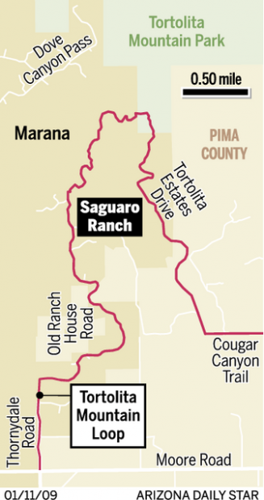
A trustee notice, the first step in the foreclosure process, has been filed for Saguaro Ranch's office, which sits just outside the development near West Moore Road and North Thornydale about 20 miles northwest of Downtown Tucson. The development's Web site, www.saguaroranch.net, is down.
And the developer has been working to refinance a $50 million development loan that was to mature in December, court documents show.
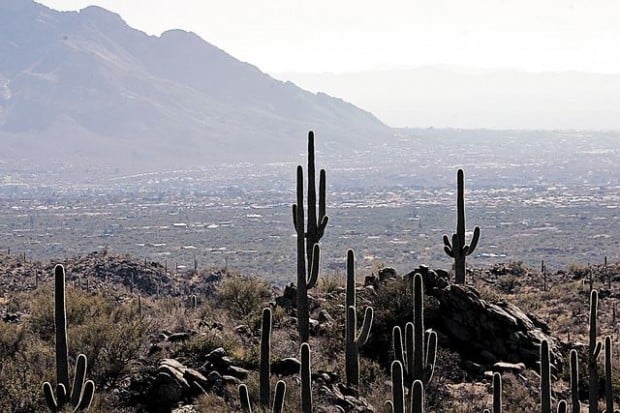
Set in the pristine Tortolita Mountains in the town of Marana, Saguaro Ranch was supposed to be the next big thing: a development so exclusive its residents would come and go through a 676-foot-long tunnel that developer Stephen Phinny had blasted through a mountain. Lots alone started at $1.25 million, and plans called for 180 home sites on 1,035 acres. Homes would average around $3.5 million.
People are also reading…
But the development has been slow to take off. There are only a few homes there, and a handful of properties face foreclosure, including one owned by former pro hockey star Paul Ranheim.
Although Saguaro Ranch garnered plenty of excitement a few years ago when it was first taking shape, most of the attention it has received lately is for its dispute over whether the public can use an easement that cuts through the exclusive development and connects nearby residents to Pima County's Tortolita Mountain Park.
Neither Phinny nor attorneys representing Saguaro Ranch responded to interview requests made by phone, e-mail and in a visit to the development's office.
"It was such an audacious project when you think about it. Just the fact that they put in a tunnel to make the grand entrance," Marana Town Attorney Frank Cassidy said. "I was surprised that there were financial issues. It seemed like it was a very well-capitalized project up front. Any project which has a tunnel as its main feature gives you the impression of a project that is very well-capitalized."
Financial difficulties
Back in January 2006, Saguaro Ranch received a $50 million loan from New Jersey-based Kennedy Funding, a private lender, to develop its second and third phases, as well as a guest ranch and resort amenities.
Phinny, the grandson of Daniel F. Gerber, founder of the Gerber Products Co., had already poured $50 million into Saguaro Ranch, having acquired the land in 2000.
"This is the best residential subdivision we have seen, not just in Arizona or in the Southwest, but the entire country," a Kennedy Funding press release announcing the loan said.
A number of high-end builders were looking to get in on the ground floor.
Custom-home builder Paul Hubble, of Living Spaces, said he considered buying a lot in Saguaro Ranch a few years ago but couldn't work out a deal with Phinny. Lots were either being sold for $1 million each, or in packs of six at a lower rate.
It was too much risk for a small custom builder, but Hubble said he was tempted to buy a lot at the time because of Saguaro Ranch's reputation.
"It would put you on the map for a custom builder in Tucson," Hubble said.
Since that time a few houses, including Phinny's, and the upscale McClintock's Restaurant have been built, but Saguaro Ranch has yet to develop its second or third phases, much less the resort amenities originally promised.
Meanwhile, Phinny's divorce documents show the $50 million loan was set to mature last month, and he was working to have it refinanced with another lender.
"Every lender thus far has required Stephen to personally guarantee its loans, and the contemplated new lender is no exception," reads an e-mail, included in the court file, that was sent in August by Joe Tarver, in-house counsel for Saguaro Ranch. "Up to now, none of the lenders has required Stephen to pledge his ownership interest in Saguaro Ranch, but it's conceivable that some lender in the future might require him to do so."
Court documents also show that the slowdown, coupled with the emergence of other upscale Marana developments, particularly the Ritz-Carlton, Dove Mountain, took a toll on the development.
"Stephen has recently had to borrow and advance substantial sums to Saguaro Ranch, and especially in 2008, given the slowdown in sales in light of the slump in the real estate market," Tarver wrote in an e-mail in the court file.
Messages left with Tarver for comment were not returned.
And in an affidavit from October 2007, Saguaro Ranch's controller, William Romancho, said Phinny was concerned about competition from the nearby Stone Canyon development and the Ritz-Carlton possibly undercutting the luxury market in a tough recession.
While the conventional wisdom is that a certain level of wealth is recession-proof, statistics from the Tucson Association of Realtors suggest the recession affected the luxury- home market. In November, there were 358 homes listed for at least a million dollars and four sold.
But in November 2006, when the market was strong, there were 293 homes listed for at least a million dollars and 10 sold.
Environmental lure
One of the big draws for Saguaro Ranch was its homes would have nominal environmental impact, and the few houses that have been built there blend seamlessly into the desert landscape.
"I just thought it was really awesome," said Marana Mayor Ed Honea. "It's so respectful. It's not a golf community, so they are not going in and clearing a bunch of land."
Indeed, in a 2004 Arizona Daily Star article, Phinny talked about requiring workers to take a 40-minute class on responsible development and how any construction workers who relocated a Gila monster would receive framed photos of themselves with the lizard.
"You get one of these big, burly guys driving a truck. He sees a desert tortoise and gets out and moves him," Phinny said at the time. "That won't happen in too many places, but it will happen here."
To show the workers he appreciated their efforts, Phinny said he made lunch for them each week. "So we fix some lunch and talk to them about what's going on and where the project is heading," Phinny said in 2004. "If they know I'll go the extra mile for them, they'll do that for me."
But all of the alleged unpaid bills with contractors have left a much different impression on Paul Amanti, owner of Amanti Electric Co., who filed a mechanic's lien in October for $28,133 for work he says he did on McClintock's Restaurant.
"It's all lip service. It's all PR because they want to sell lots. They want to sell real estate. On the other hand they are screwing all the guys up there who are making this thing happen," Amanti said. "These guys don't care about the Tucson subcontractors."
An exclusive community
While Saguaro Ranch is set in pristine desert, the values of the homes and the financing behind the project are tied to its exclusivity, which is why Saguaro Ranch's dispute over a public easement that cuts through it is so crucial to the development's future.
It's hard to market your community as exclusive if the public can just walk right through it.
The easement — a rocky dirt road that officials say was used for utilities — essentially curves around the development like a horseshoe, at times cutting through parts of Saguaro Ranch while connecting nearby homes to Pima County's Tortolita Mountain Park.
Phinny wants the road to be private, saying it now leads to a private development and no longer serves a public purpose. But nearby residents, who have long used the road as a walking and horseback-riding path, say it should remain open to the public.
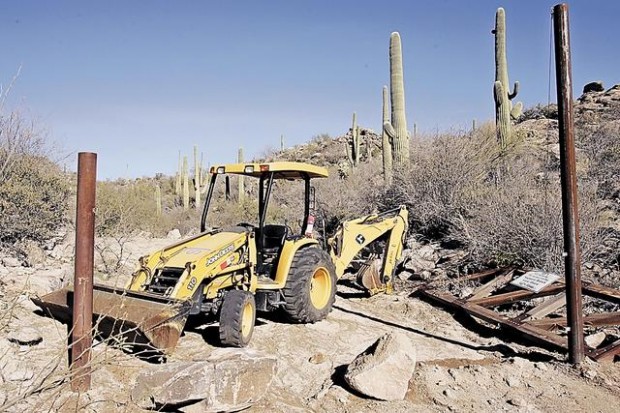
The dispute, which is being worked out in court, has gotten ugly as Saguaro Ranch workers have placed boulders at entryways to the road and recently parked a backhoe at one end of the easement to keep out the public. "No trespassing" signs have been placed along the road, including at the entrance to the Tortolita Mountain Park, which is county property.
McClintock's Restaurant and the development's septic have been built over the easement, too.
Theresa Chamberlain, a nearby resident who walks the dirt road regularly and owns 20 adjacent acres, sued Saguaro Ranch over the easement, and her attorney Brian Laird said documents show Saguaro Ranch knew the easement was public but went ahead with development anyway.
"I believe the law is very clear on that matter. Those buildings (McClintock's and the septic) have to be torn down. There is no other remedy." Laird said.
While the dispute over the easement plays out in court, Marana's Town Council will decide whether to abandon the public's right to it — a point that Laird said could also end up in appeals court for some time.
Marana town officials are optimistic Saguaro Ranch will come together in the end.
"I still have hope that it will work," said Cassidy, the town attorney. "That once Saguaro Ranch gets past some of these issues, that it will actually take off because it is such a remarkable development."