

As the price of copper continues to reach record levels, mining operations in Southern Arizona find themselves with a bit more more money for sprucing up mining facilities, launching new operations and environmental projects, and doling out cash to shareholders.
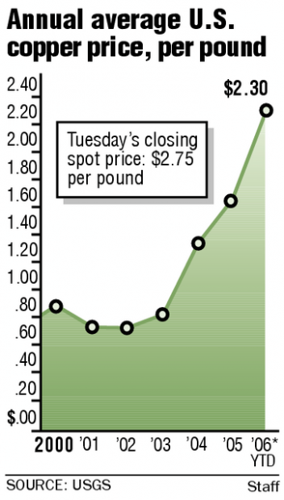
On Tuesday, the spot price for copper hit $2.7515 a pound on the Comex division of the New York Mercantile Exchange, a level never seen before. You would have to go back 40 years to see higher prices when adjusted for inflation.
So far this year, the price has averaged $2.30 a pound. Industry officials often cite $1 per pound as the break-even price. In 2002, producers struggled with copper selling for an average 72 cents a pound.
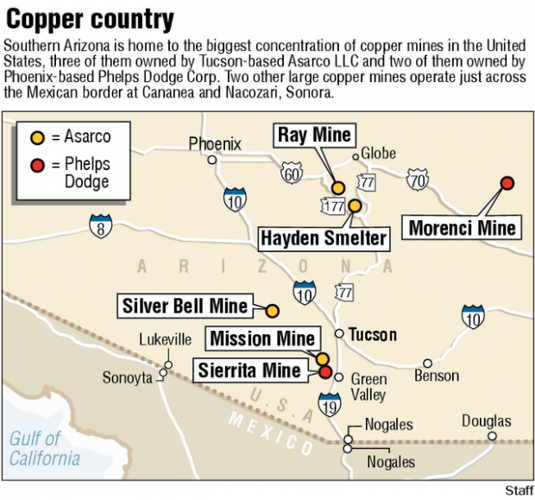
"It's certainly a strong time in the copper business," said Ken Vaughn, manager of mining communications for Phoenix-based Phelps Dodge Corp., which owns the Sierrita Mine, near Green Valley, and the Morenci Mine, near Clifton.
People are also reading…
Arizona is part of the largest concentration of copper mines in the United States, with six mining operations in the southern region, including Tucson-based Asarco LLC, which operates the Mission Mine, near Green Valley; the Silver Bell Mine, near Marana; and the Ray Mine, near Kearny. Calls to Asarco officials were not returned.
"We understand the history pattern (of the market)," Vaughn said. "Prices go up, then come down. We're trying to manage resources in a way to remain successful, not only through the good times, but also when lower prices come."
Still, the high prices are bringing more revenue for Phelps Dodge, fueling a new mining operation near Safford and another in the Congo, both of which will start construction later this year, Vaughn said. The corporation also is investing $210 million in a new operation in Morenci and is expanding a facility in Peru.
Another $400 million is going toward environmental reclamation at Arizona sites near Clarkdale, Bisbee and the Cyprus Tohono Mine, on the Tohono O'odham Reservation near Casa Grande. Work on reseeding and returning the land to a more "natural look" is under way, Vauhgn said.
Bonuses connected to production and overtime also are coming into play.
"We've ramped up production, and demand for copper is strong," he said. "We have had much stronger cash flow and more flexibility to declare special dividends to shareholders."
Last week, Phelps Dodge announced it would return $2 billion to shareholders, declaring its third special dividend in five months.
Besides strengthening balance sheets and repaying debts, Vaughn said the company is making contributions to medical plans and pensions.
In December, the PD mines employed 5,200 people, compared with 4,500 three years ago, Vaughn said.
"We are at all full production and we have increased staff, with some openings at mines," Vaughn said.
Some mining-industry suppliers also are seeing more business from the price surge.
"The (price) increase has allowed companies to upgrade their plant areas and refurbish their facilities," said Randy Walker, general manager of Sonoran Process Equipment Co., 1687 W. Grant Road. The firm repairs components for regional mines.
"We've seen 25 percent more orders and order values over the past six months," said Walker, citing more orders for pipes, valves, pumps and other items.
"It's a mushroom in growth," Walker said. "We haven't seen this uptick in growth in years, and we're trying to feel our way through it."
Across the industry, more companies are trying to produce more copper to take advantage of the high metal prices, said Manny Armenta, a regional spokesman for the United Steelworkers of America.
Armenta, who represents about 1,500 Asarco workers in the Southwest, said members are reporting more overtime as a result of the boom.
"It varies from location to location and in different departments," he said. "There have been a few changes in overtime, mostly for workers manufacturing it (copper)."
High copper prices could mean better job security for workers at the mines, said George Leaming, a mining consultant and owner of the Marana-based Western Economic Analysis Center.
But higher prices don't necessarily translate into higher wages and salaries, he said.
Instead, more employees could receive bonuses instead of raises, Leaming said.
"The bonus system seems to be a lot more prevalent in the industry these days, rather than giving a raise," Leaming said.
With the contract between Asarco and union members set to expire on Dec. 31, Armenta said he's not sure how the record high prices will affect contracts or pay raises.
Before the 1950s, many copper union contracts linked wages to the price of the metal, Leaming said.
"They did away with that when the Steelworkers came in and took over the unions," he said. "They didn't think it should make any difference what the price was if the work was the same."