

Drivers are paying 23 percent more for gas at Pima County pumps than they were a year ago, but most people who drive for work shouldn't expect their companies to help.
Just 18 percent of employers are increasing the reimbursement rate for miles driven by their workers, according to a new survey from Robert Half International of 539 workers nationwide.
Sixty percent of people said their company isn't doing anything to offset the rising cost of commuting. But some Tucson-area employers are finding ways to cover mileage costs.
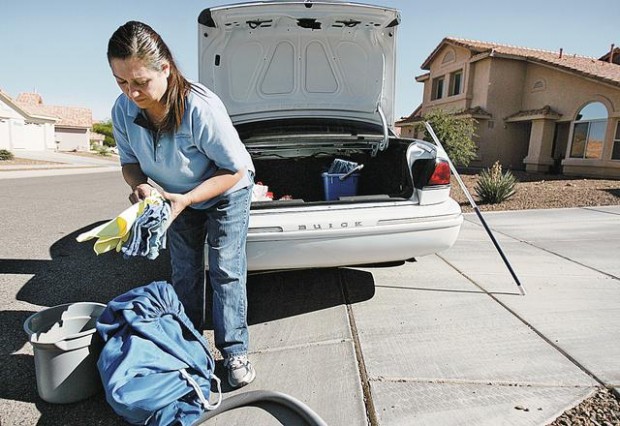
At Brighten Your Life House Cleaning, owner John Anderson raises the mileage reimbursement rate by 1 cent each time the price at the pump rises 20 cents.
He's boosting the rate to 42 cents per mile this week. His 12 workers appreciate it, but it's a lot of money for a small business to pay, he said.
People are also reading…
"It's becoming too expensive for us, so we're going to go to company cars" this summer, Anderson said.
If gas reaches $4.50 a gallon, and he thinks it will, four company cars will be less expensive than asking workers to use their own cars, Anderson said. Plus, company-owned vehicles bring the added bonuses of allowing the company to hire workers who don't own cars and to advertise on the cars.
Rochelle Garcia, a house cleaner, said she can log 200 to 400 miles per paycheck on her Buick sedan. That doesn't count her 26-mile commute to the office.
Gas prices are "ridiculously high," Garcia said, but "I just deal with it. You've got to make a living."
Some companies are getting creative with their mileage benefits.
AristoCare Home Health Services, which has about 300 employees who are paid by the day in Tucson, is trying a variety of perks for employees. The company has:
● Raised its mileage reimbursement rate to 50 cents per mile.
● Given workers a gas card during an appreciation week.
● Added a $10 travel stipend for any trip outside the city core.
● Used computer software to make assignments that are close to caregivers' homes and send route maps to workers.
"They all really like the stipend because it does pay for their gas. It's just a little added benefit for them to help them offset the rising price," said Cyndy Michaud, branch relations manager.
"The more we can do to make their life easier and keep a little money in their pocket" the happier they are to work for AristoCare, she said.
Companies that can't afford to pay higher mileage reimbursements are starting to offer other perks, said Tami Ballis, a Tucson branch manager for Robert Half International.
"Maybe they can't raise the reimbursement, but they're looking at less expensive ways to help employees, like facilitating carpooling or offering flexible work scheduling," she said.
Increasing the mileage reimbursement rate helps to improve morale and to reduce turnover, she said.
A spike in gas prices won't compel most people to look for a new job, but "for those people who feel undervalued, a spike in gas prices could prompt them to look elsewhere," she said.
And for job seekers, work that is close to home is increasingly a top criteria for a new job, Ballis said.
The University of Arizona last increased its mileage reimbursement rate to 44.5 cents per mile in 2006. But at the UA, the third-largest employer in Southern Arizona, according to the Star 200 survey, several programs are helping workers who want to cut back on driving. The university is:
● Paying half the cost of a bus pass.
● Arranging carpools and offering free parking to vanpools.
● Helping workers get started with "telework" and job sharing.
"It's helping people feel much better about the economic situation right now," said Bill Davidson, marketing manager for the parking and transportation department at the University of Arizona.
"People are having to reach deeper into their pockets to pay for fuel, and by offering programs we're able to help where it hits hardest. People are glad we're doing it."
Has your employer raised your mileage reimbursement rate? Take our online poll. go.azstarnet.com/mileagepoll