

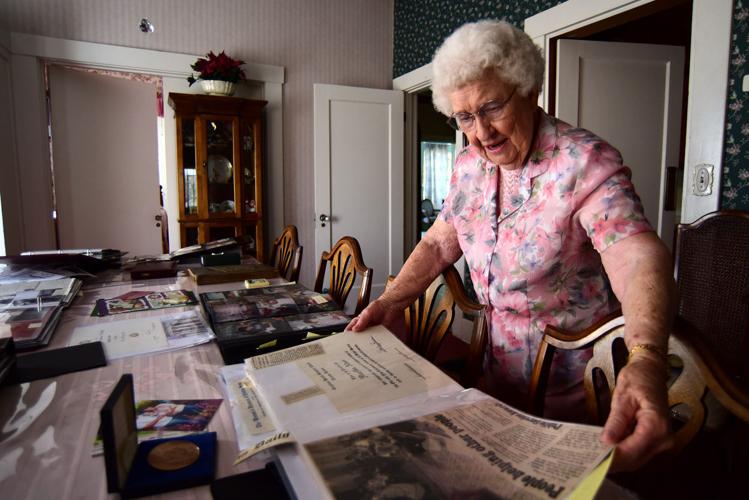
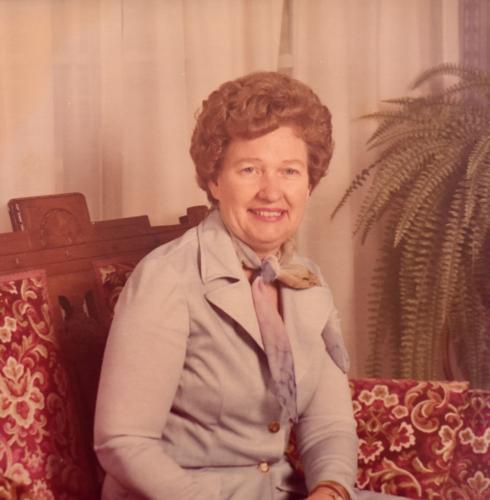
Death has given Martha J. Adair quite the life.
The matriarch of the Adair family’s funeral homes, Martha, 89, still swings by the Dodge Chapel location several times a day. And why shouldn’t she? She and her husband, the late Arthur J. Adair, built this business next to their home.
“If I’m in a hurry, it takes three seconds,” she says of her “commute” from the old house, which shares property with the original funeral home at 1050 N. Dodge Blvd.
When the couple started their business in 1956, they were east of city limits, which ended at Country Club Road. Other local mortuaries were more centrally located, Martha says.
“People said if we went any further east of Country Club, we would not succeed,” she adds, noting that most roads were unpaved at the time.
People are also reading…
They ignored the naysayers and moved their home and business to a residential area with schools and churches — where people lived and died.
Business boomed, and their family grew.
Over the years, they have expanded the Dodge location and added crematories for humans and pets. Now, the Adair family has five facilities around Tucson, Catalina and Nogales and about 35 employees.
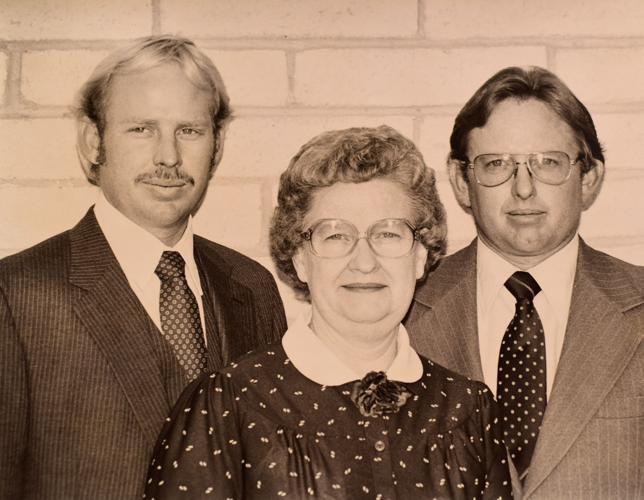
Martha’s sons Arthur “Ron” Adair and Harold “Hank” Adair, as president and vice president, oversee daily operations, and now two of their grandchildren work in the business.
Martha’s granddaughter Hillary Adair used to write in school papers that when she grew up she wanted to be like her grandmother.
In June, as the board vice president of the Arizona Funeral, Cemetery and Cremation Association, Hillary presented Martha with a Lifetime Achievement Award.
Martha was the first female president of that association and the Better Business Bureau of Southern Arizona in the 1980s.
“When I go to conventions, women are still scarce there,” says Hillary, a funeral director at the family’s Desert Sunset Funeral Home, 3081 W. Orange Grove Road. “It’s still something I have to deal with, but (Martha) is one of the people who has paved the path and made it easier for the rest of us.”
A Farm Girl At Heart
Growing up on a farm in Missouri, Martha knew she wanted to go to college, even though it wasn’t the norm. As a woman, her professional options would still be slim — a teacher, nurse, secretary or telephone operator.
Those farm days made Martha a realist, though a compassionate one.
“You took care of things as they needed to be taken care of,” she says.
When Martha’s family moved to Tucson in 1943 because of her brother’s tuberculosis, the teen found the city to be a good fit.
Once she became a mother, however, she saw to it that her four children get a dose of country living. The family once owned more than six acres of land where the Dodge Chapel mortuary is. There, at different points, they had chickens, rabbits, ducks, two Shetland ponies and “even a hog or two,” Martha says.
“I think it goes back to the fact that I was not a city girl, and I was raised on a farm, and Tucson was a laid-back place,” she says.
Tall, Dark
and Handsome
Early in life, Martha set a rule for herself: She would not marry until she had graduated college, and she would not marry someone who had not yet selected a career path.
“Of course, we all wanted to marry somebody who was tall, dark and handsome,” she says. “We would joke about it.”
Martha met Arthur J. Adair at University Methodist Church, which started and then merged with Catalina United Methodist Church, 2700 E. Speedway Blvd.
No sparks flew at their first meeting, but Martha wrote Arthur while he served in the military during World War II, because it was normal to write to service members, Martha says.
When Arthur returned, he had a career selected — his uncle had introduced him to the mortuary industry before his deployment — and he was also tall and handsome. Martha didn’t hold his platinum blond hair against him.
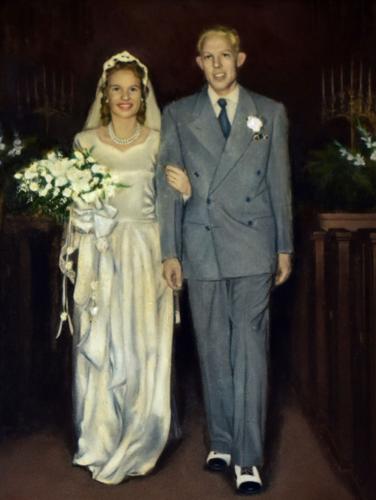
They married in 1947 — the year before Martha graduated from the University of Arizona with a degree in the area of home economics. Laughing, she admits she broke her own diploma-before-vows rule.
Family Matters
The Adairs never told their children to take up undertaking, but it couldn’t be helped.
Ron Adair remembers standing on a bucket to watch a coroner do an autopsy. At the age of 12, he recalls donning a suit to welcome people into the visitation room.
“I was raised in it, pretty much,” Ron, 65, says. His brother and two sisters also worked in the industry later in life.
The business phone still rings in Martha’s home, where they operated the office in the early days.
“You lived, you ate and you slept your work, but we felt we balanced it,” she says.
Martha learned the details of the business but was never licensed. Instead, she counseled grieving families and kept an eye on everything else.
Personal Tragedy
Grief rocked the Adair family when Arthur died of colon cancer in 1973, leaving his widow with an ever-growing business to run.
Ron, a newly licensed funeral director and the oldest son, stepped up to help.
Working around death professionally did not ease the personal pain.
“No matter how you prepare yourself, it’s still a shock,” Martha says.
Tragedy struck a second time in 2004, when Martha’s daughter Susan died at the age of 43.
“I think for her it was really hard, because she had lost her husband and her daughter, and she kept going and was still being surrounded by death everyday,” Hillary, 36, says.
But as Martha so often tells employees, experience begets understanding. After her husband’s death, she started a program to help grieving widows and widowers.
“Martha is just the friend that everyone would love to have because she is a good listener,” says Mary Davis, a friend for about 50 years. The women met at Catalina United Methodist Church, which Martha has attended for 72 years. “She is very smart, and if I ever need someone to go to, that’s who I go to.”
Helping Tucson
Beyond the funeral home, Martha’s membership in organizations such as the Daughters of the American Revolution, Catalina United Methodist Church and Altrusa International Inc. of Tucson has made her part of community life.
A Jefferson Award for public service, among other honors, speaks to Martha’s sharp blend of grace, kindness and business savvy.
“I’ve kind of had a life that I never dreamed of,” Martha says.
The industry has changed since she and Arthur began all those years ago. Urns, instead of caskets, are the big showpieces, and conglomerates have swallowed many other family-owned competitors.
But nothing has changed Martha’s compassion.
She says, at the end of the day, “I just go out the back door and say, ‘Thank you, dear Lord, and hopefully I have helped some families today.’”
Contact reporter Johanna Willett at jwillett@tucson.com or 573-4357. On Twitter: @JohannaWillett

Johanna Willett | This Is Tucson
Reporter