

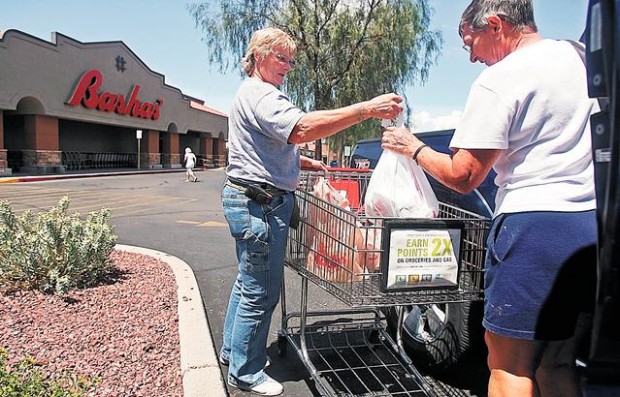
PHOENIX — A federal judge cleared the way Wednesday for Bashas' to use the cash it has on hand to keep the store shelves stocked, at least for now.
Bankruptcy Court Judge James Marlar agreed to free up the legal strings on about $27.3 million sitting in various accounts. That cash was frozen and placed off-limits the moment the family-owned chain sought protection from creditors late Sunday.
Attorney Michael McGrath told Marlar that failure to unfreeze the accounts would result in store supplies being depleted and not restocked. That would affect Bashas' ability to retain customers and stay in business.
The ruling also means the money is there to keep paying employees, not only the approximately $5 million they were due for the week just before the bankruptcy filing, but also going forward.
But that cash won't last long: Company President Mike Proulx said the chain probably spends $25 million a week on groceries and other supplies and another $5 million on salaries and fringe benefits.
People are also reading…
McGrath said, though, Bashas' has authority to use the cash that has been coming in since the bankruptcy filing — and which continues to come in — to pay future bills.
If that isn't enough, however, the company already has obtained what essentially amounts to a line of credit from Grace Financing Group. That limited-liability company was established just last week by its parent, Grace Development Co., specifically to deal with Bashas'.
"We have a $45 million facility that is there should we need to tap that for operations," McGrath said.
"For a vendor, an employee or one of our customers, there's plenty of capital to continue uninterrupted," McGrath said.
So far, though, Marlar has not agreed to allow Bashas' to tap that money. Attorney Robert Miller, representing several banks that are owed money by the grocery chain, filed an objection.
His concern is not so much that Bashas' will have access to more cash but that the agreement gives Grace "ill-defined rights" to buy all of the chain's property at certain predetermined prices any time the company taps that line of credit for at least $16 million. Miller said Grace should not get that automatic option.
McGrath acknowledged that the deal his client originally made with Grace Financing does allow that lender to obtain the property "in exchange for forgiveness of the money they're lending us." But to get around the objections, he said that agreement will be modified: Other creditors would get notice of any plan to sell off company land, and the deal would be subject to court approval.
Marlar will review the proposed language at a hearing set for Friday.
The 77-year-old company filed for protection from creditors late Sunday, blaming the state's economic woes and the tight national credit market. Proulx said the filing will give the company time to review its operations in light of those conditions without fear of running out of money, and to make necessary changes for how it intends to operate in the black and pay off its debts.
That could include closing more stores than the 10 announced earlier this week that will be shut no later than July 23.
"All of our remaining stores are being evaluated," he said. "In the coming month or so, we will be coming to some conclusions as to whether there will be any additional closures."