


Casino profits have given the Pascua Yaqui tribe a reason to hope — and an excuse to fight.
Gaming revenue has funded services for the elderly, scholarships for the young, health care for the needy and classes for people who want to learn the tribe's fading language.
But behind the closed doors of the legislative chambers, bitter infighting, entrenched nepotism and a lack of accountability have hindered the progress gaming was supposed to fuel, a Star investigation found.
"'More money, more problems' is very true," said former Councilwoman Alma Lopez. "When we didn't have any money, we didn't have anything to fight over."
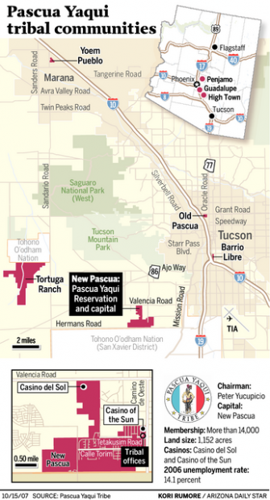
At the center of that fight is unprecedented wealth for the tribe of 15,000 members, half of whom live on two square miles of Yaqui land on Tucson's Southwest Side.
People are also reading…
Casino del Sol and Casino of the Sun brought in around $104 million in gross gaming revenue last year, according to a Star analysis based on the tribes' mandatory contributions to local agencies and governments as well as other financial information. Sol Casinos CEO Wendell Long confirmed the enterprises make "more than $100 million."
But despite the windfall, the Yaquis have made limited progress toward fulfilling state and federal requirements that tribes use casino money to promote self-sufficiency, develop their economies and strengthen their governments. The tribe's per-person spending of federal taxpayer money has more than doubled since 1997 and the portion of members using a state indigent health-care plan is up 27 percent since 2001.
That's largely because of frequent political upheaval, which recently spurred the ouster of Chairwoman Herminia "Minnie" Frias and before that saw the turnover of four casino CEOs, all non-Yaqui, in five years. Members who ask questions about spending say they can't get answers or they find themselves targets of retribution.
"A lot of people have gotten into that mentality that 'if it wasn't for us (the casino), you government people wouldn't have anything,'" Frias said.
"The casino is there because we're a tribe; we're not a tribe because there's a casino."
Infighting means instability
Political infighting is commonplace and old conflicts "continue to prevent the tribe from achieving economic goals," said a report by a consultant the council hired last year to draft an economic development plan.
"Everybody has allegations on everybody," said tribal member Amelia Cordova, 53.
Five of the nine current members have served as chairman, a position chosen from among the 11 elected legislators. Many members have faced or brought accusations against one another:
● Treasurer Francisco "Chico" Valencia and Tribal Chairman Peter Yucupicio twice called for a vote of "no confidence" against former Chairwoman Frias, who had criticized their management skills. They succeeded in removing her from office in September, but she's running again in a special election to fill one of two open seats.
● Robert Valencia helped remove Francisco Muñoz as vice chairman when Muñoz criticized the lack of competitive bidding at Casino del Sol in 2001.
The fights mean policies often don't last past one council's term and economic-development plans stall without majority support.
"Things slow down a lot," Frias said. "It's hard for people to buy into a project when six months from now the leadership might change. A good idea, if it wasn't their idea, is out the window."
That also frustrated former Councilman Muñoz, a Frias supporter.
"Political infighting creates an unstable environment where people are tiptoeing around and everyone's trying to cover their behind," Muñoz said. And people don't want to do business with an unstable government, he said.
Chairman Yucupicio, Frias' successor, disagrees that tribal politics are volatile, saying outsiders have misinterpreted what has happened.
"It's you grading us, not us grading us," he said.
Favors from friends
In a tribe of 15,000 members, it's a sure bet that relatives are working in the casinos and in the government.
Former Councilwoman Lopez said nepotism complicates both workplaces. It's easy for people to overlook small problems or make excuses for others when it comes to relatives, she said.
Sometimes the internal politics make young people leave jobs at the tribe. "They don't want to worry about who this person is, why they're there, why you shouldn't say anything," she said.
Frias said tribal politicians have used the government to grant favors to relatives and friends — asking a worker to overlook a missed application deadline, waiving a qualification requirement or bending other rules.
Muñoz said that leads people to question whether employees look out for the tribe's best interest or simply do what they're told to keep their jobs.
Just the rumor of nepotism can hurt.
Aurora Valencia, who has worked her way up the ranks at the casinos to become a marketing manager, said people still suspect her of receiving favors from relatives in high places. She is related to three tribal council members and is a niece of the late Anselmo Valencia, the tribal leader who pushed for federal recognition to allow the tribe to apply for federal grants and later open casinos.
"It's just a family name, but if you're associated . . ." she said. "There's always bad feelings. Just being a Valencia you get the good and the bad."
She said she supports the council because of its actions, not because of family ties.
Frias fired after call for audit
Concerns about where the casino money goes often disrupt the political agenda.
Frias said she ran for chairman in 2004 to bring accountability to the council, and it's been a struggle ever since.
"The people who are used to the old-school government — 'I elected you, therefore you pay me back' — don't like me. And I know this," Frias said. "But that doesn't stop me from doing my job. I've got a responsibility."
Yucupicio said he won't comment on the political turmoil with Frias but did say she didn't want to work with the council.
Frias said her questions about spending in the casino and in the government led to a 22-count ethics complaint this summer brought by seven council members who claimed she overstepped her authority.
In one incident that upset the council, Frias said she requested an audit of casino books in July because she was concerned that frivolous spending would take a bite out of the profits used to pay for health care, education and senior services.
Sol Casinos CEO Long said there is no financial impropriety at the casinos, and the last audit found no problems with the enterprise.
In another incident earlier this year, Frias canceled Councilwoman Priscilla Flores' government credit card because of $14,000 in what she deemed suspicious charges. Flores has been allowed to repay the money and hasn't faced ethics charges. That also led Frias to try to dismiss Councilman Valencia as treasurer because she said he should have been watching the council's spending.
Yucupicio said Frias had no authority to boot Valencia, who serves the council, not the chairman. Within a month of Frias' requesting the audit, the council voted to remove her from office.
Muñoz, who himself was removed as vice chairman in 2001 for publicly questioning spending on the construction of Casino del Sol, resigned days later. Frias' chief of staff, attorney general and directors of finance, education and health followed.
Frias isn't going quietly. She is running in the special election to fill one of the seats vacated by her and Muñoz. A regular election is next year.
"Wagging the dog"
Muñoz said he ran for office seven years ago because he wanted to know where casino money was going. The answer, he learned, is that "we rely on the casino to give us a certain amount of money to survive as a tribe," he said. "It should be the other way around. The tail is wagging the dog here."
The council, in turn, has sometimes limited the efficiency of the casino by involving itself in management, the consultant's report said.
Chairman Yucupicio and Councilman David Ramirez said they visit the casinos daily and attend management meetings but don't interfere. The CEO makes business decisions but reports to the council.
Former CEO Edmund Miranda told state Gaming Department investigators some employees were outside his control and politics made it impossible to manage an efficient business. He himself lost his state Indian gaming license for lax oversight after an employee was caught embezzling $269,000 over nearly four years.
"This tribe, because of its history, has on the lower level of the employment scale people who think they have more power than you do as a manager, simply because of whom they are related to," he told state gaming authorities. "It takes away from the authority of the manager."
CEO Long said attitudes have changed since then.
"Every employee has the opportunity to excel here," he said. "None of them feel they're entitled to a job here."
Other tribes have established boards of businesspeople to oversee casinos to remove politics from the operation. In 2004, the Pascua Yaqui council set up a gaming board, but the next council dismantled it because it didn't want to share the power, said Frias, who supported the separation of business and state.
Hope for the future
Casino revenue has brought the tribe economic opportunity, Yucupicio said.
"Nothing would have been possible without it," he said.
The tribe has reduced its average monthly reservation unemployment rate to 13 percent this year — a far cry from the pre-casino rate of 65 percent 30 years ago, but still more than three times Tucson's average this year.
By combining casino money with federal grants, the tribe has begun to offer new services to members.
"Gaming has greatly improved the quality of life for us as tribal members," said former Councilwoman Lopez, citing housing programs, a health center, addiction-rehabilitation programs and money for needy schoolchildren to buy clothing. The tribe also pays for about $4 million a year in college scholarships for members.
Participation in the tribe's language and culture program has jumped from 100 to more than 500, Yucupicio said.
The tribe broke ground this year on a $4 million senior center and a $4 million recreation center for programs to fight the growing diabetes epidemic.
On the economic-development front, the tribe has spent money to revive Tortuga Ranch, a tract of land northwest of West Ajo Highway and South Sandario Road that has wells, fencing and grazing. Officials view it as a long-term investment.
The tribe also bought land along West Valencia Road surrounding Casino del Sol and wants to partner with a developer to bring in retailers. A credit union for tribal members will open next year, and the next council will consider a hotel plan for Casino del Sol.
Now that the latest political spat has simmered down, Yucupicio said the council is re-evaluating its priorities.
"I hope that in the last few months of this term that we finish strong, and that we take care of a lot of programs that have been put on the back shelf," he said. "There's a lot of things that we're behind on."
Star Investigation: Gaming's slow payoff
Star reporters Becky Pallack and Cathy Burch take a look at where tribal casino money goes in this three-part investigation.
Go to http://www.azstarnet.com/ special/casinomoney to read the entire series.