

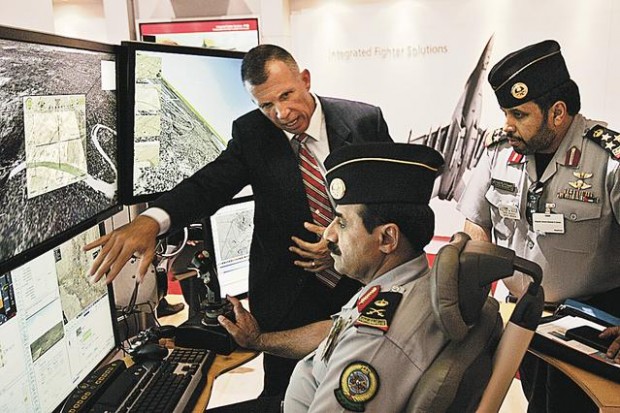
It looks like the ultimate new video game: The operator in the comfortable leather chair uses dexterous thumbs on a hand-held console to maneuver an aircraft, with its trajectory displayed on three large flat screens.
But the chair is for a qualified pilot, and the landscape on the screen is downtown Baghdad, as defense contractor Raytheon Co. provides a first look at its new control system for unmanned aerial vehicles, or UAVs.
The company says its Universal Control System, which uses some hardware from the gaming world, will shorten training time and help prevent crashes of expensive unmanned drone aircraft by providing a more interactive experience for the pilot.
"We wanted the human to get into a cockpit and feel they are stepping into the system," said Mark Bigham, director of business development, at the Farnborough International Air Show outside London.
People are also reading…
While older systems used only a keyboard, single screen and joystick, a key factor for Raytheon was making the system more intuitive — replacing keystrokes with a game console — after consulting with experts and discovering that thumbs are the most energy efficient and accurate way to control an aircraft.
In a move away from what Bigham calls the "soda straw" view of most UAV pilots, the screens are augmented with digital images that provide a near 180-degree view.
Other information, such as the status of the craft and troop locations, is provided on a fourth screen, in much the same way that video games provide extra on-screen information on characters and ammunition levels.
Raytheon, headquartered in Waltham, Mass., wants to capitalize on the rapidly growing use of unmanned aerial vehicles in both military operations and civilian projects around the world. Its Missile Systems division in Tucson is Southern Arizona's largest employer, with 12,500 full-time-equivalent employees, according to the Star 200 list of major employers last year.
The overall global market is expected to rise from $3.5 billion to some $55 billion in 10 years, according to the Teal Group.
The war on terror has spurred the use of drones in combat areas, with unmanned aircraft currently flown by the U.S. Air Force and the Royal Air Force in both Iraq and Afghanistan.
BAE Systems PLC announced plans at Farnborough to work with Britain's Ministry of Defense to develop an unmanned aircraft, known as Mantis, that can drop laser-guided bombs and fire missiles.
But the increased use of the drones has highlighted problems with control systems. A Predator drone crash in Iraq in 2006 was attributed to error by its pilot back in Nevada. Two more recent crashes involving RAF and U.S. Air Force Predators earlier this year were initially blamed on mechanical problems, but full reports on the incidents have not yet been published.
Raytheon believes its system could reduce costs for the U.S. Air Force by $500 million over a decade.
That estimate is based on a combination of reducing the number of crashes and the time spent training pilots to use the system and cutting the number of pilots required to fly the aircraft.
Raytheon hopes at some point to develop the system further so the console, and potentially the chair, vibrate to reflect the sensation of actual conditions — including turbulence and landing.
Raytheon, which has been building its system for the past three years at a cost of "several million" dollars, has been in discussions with the U.S. Air Force and the Royal Air Force and has hosted several delegations that have shown an interest at Farnborough, including the Saudi International Guard.
For now, Raytheon is focused on military applications. But the system can also be used for marine and civilian applications.
U.S. Customs and Border Protection operates Predator drones over the Mexican border.
"People say I'm crazy, but one day we'll see unmanned automobiles," said Bigham. "That's the next big area."