

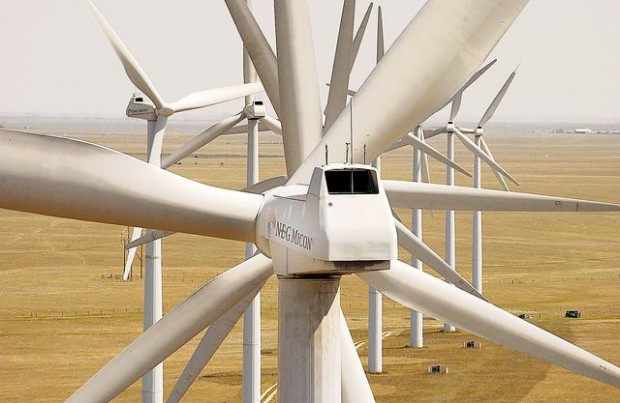
Wind power may have as much potential as those ads on television promise, but don't expect to see giant turbines dwarfing saguaros on the skyline of the Sonoran Desert.
Experts call the wind in Southern Arizona "marginal", and say Arizona overall has few hot spots for wind power.
The U.S. Department of Energy released a report in May that says the United States can generate 20 percent of its power from wind by the year 2030.
Oilman T. Boone Pickens says we can do it more quickly than that and has launched a public-relations campaign to blow us in that direction, but Pickens has his eyes on Texas. National wind maps show the greatest potential in the middle of the United States.
The wind, contrary to how we may feel in the breezy spring or during a monsoon storm, doesn't blow reliably in Arizona.
People are also reading…
Still, industry leaders say, Arizona has the potential for utility-scale wind generation in selected areas, and residential or "small wind" promoters say there may even be enough wind in the Tucson metro area to make it a feasible alternative to the local electric companies.
Big wind
According to Northern Arizona University professor Tom Acker, the best sites for utility-scale wind power are along ridges and on high plateaus in the north of the state.
There, energy providers are already negotiating deals for wind farms.
Salt River Project, which serves nearly 1 million electrical customers in the Phoenix area, has a deal with the Spanish energy firm Iberdola to buy power from its Dry Lake Wind Project, planned for a windy stretch of the Colorado Plateau northwest of Snowflake.
Iberdola expects to generate 63 megawatts (63 million watts) of energy from 30 giant wind turbines by the end of next year, according to an SRP press release. That's enough to power about 15,000 homes, according to the utility.
Western Wind Energy, which already produces and sells power from 500 wind turbines at sites near Tehachapi and Palm Springs, Calif., is working on a wind farm it wants to build near Kingman, according to Tucsonan Mike Boyd, vice president for development with the firm.
The Navajo Nation is also looking at its potential for wind generation, and companies are studying sites near Flagstaff, said Amanda Ormond, an energy consultant who is co-chair of Arizona Wind Working Group.
There is even some potential for "big wind" down south. The working group, headquartered at Northern Arizona University, determined that "developable windy land" across Cochise County could produce up to 275 megawatts of power.
One company is studying a ridge in the Mule Mountains near Bisbee and Fort Huachuca has announced its second wind-generation demonstration project west of the fort.
"There is a lot more wind in Arizona than people think there is," Ormond said.
That doesn't mean it all can, or will, be developed, said Boyd. "Most of the low-hanging fruit has already been picked."
Boyd said his company's 1,100 acres is "about as ideal a site as can be," with sufficient wind, electrical transmission lines that run through it, appropriate zoning and few neighbors to complain about the 225- to 250-foot towers that will hold the turbine blades, themselves 150 feet long.
Small wind
Small turbines can be economically feasible at lower consistent speeds, said Andy Kruse, co-founder of Southwest Wind Power, which manufactures residential wind turbines in Flagstaff.
"Large wind needs class 3 or 4 wind resources — 14 to 16 mph average at minimum."
Small wind generators can work efficiently at 11-12 mph, he said. "There are a lot of areas in and around Tucson with that resource."
Kruse, a former cattle rancher, said his business has been growing rapidly for 20 years. Southwest Wind now employs 100 people in Flagstaff and four in Germany and recently added an employee in China, Kruse said.
Katherine Kent, owner of the Solar Store in Tucson, said she hasn't installed any wind systems in the immediate Tucson metro area but has done "a ton" of business in off-grid wind systems in rural parts of Southern Arizona.
Payback depends on a lot of factors, said Kruse — the wind, the prevailing electric rates and the subsidies available.
"Without incentives, the payback is about 15 to 18 years. With state incentives (available from utility companies in Arizona), it's 10 to 12 years."
The industry is lobbying for a federal tax credit of up to $4,000 per residential system, he said, which would make wind power more attractive and cut the payback period to about eight years.
Wind economics
Like small wind, utility-scale projects depend on subsidies.
None of the utility-scale projects envisioned for Arizona will be built unless Congress reauthorizes production tax credits, said Ormond, co-chair of the wind working group.
Utilities historically fought wind, Ormond said, because of cost and the difficulties of incorporating its intermittent availability into electric grids.
Wind power rose in favor when subsidies and requirements came along — and will be even more attractive as the costs of fossil fuel rise, she said. "It provides stable-priced energy. The cost-stability factor is huge," Ormond said.
The Department of Energy study, performed by the industry groups and the DOE's national labs at Sandia, N.M., Berkeley, Calif., and Golden, Colo., concluded that adding 20 percent wind power to the national electrical grid is feasible but would require expansion and reconfiguration of that grid. Integrating the power into a utility's mix of sources would add a half-cent to the cost of each kilowatt-hour produced.
Mike Boyd said cost may argue against wind right now, but it won't in the future.
His company is trying to negotiate a price of 12 cents a kilowatt-hour for its proposed facility, on 1,100 acres it owns near Kingman. That's double what TEP pays to generate electricity from coal but could be a bargain at the end of the 20-year period, he said, especially if the U.S. government decides to enact some form of carbon tax.
Subsidies for renewable energy and sanctions against polluting energy are economically the same thing, said Nate Lewis, professor of chemistry at CalTech, who recently co-authored a report on Arizona's energy future for the Communications Institute.
"Someone is paying for it anyhow," Lewis said.
Without them, though, Lewis said, the U.S. won't shift its energy sources toward renewables.