

Got compressed natural gas?
Probably not, unless you're hooked up with some government agency or fleet using vehicles fueled by compressed natural gas.
But if you have a CNG-powered vehicle, you'll soon be able to fill up at a CNG fueling station on a city-owned lot on the southeast corner of South Kino Boulevard and East Winsett Street — that's across the street from the Father Kino statue near the Tucson Unified School District's bus yard.
The station may be doing most of its business at first with local government vehicles — several local government agencies, including some TUSD buses, and local business fleets run on CNG.
At the end of last year, 5,665 natural-gas vehicles were registered in Arizona, according to the Department of Transportation's Motor Vehicle Division.
People are also reading…
But dual-fuel (CNG and gasoline) vehicles are available from dealers, and after-market kits are available to make conventional gasoline engines run on clean-burning, and often relatively cheap, CNG.
The station is being built on leased city property and will be owned and operated by Clean Energy Fuels Corp., a Seal Beach, Calif.-based company owned by T. Boone Pickens, said Rick Lemmon, the company construction manager.
He said CNG is just natural gas, the same product many use for heating and cooking, that is filtered and compressed to either 3,600 pounds per square inch or, for newer CNG vehicles, 3,000 pounds per square inch. Lemmon said the fuel comes from a Southwest Gas line that runs past the station.
James Harger, a Clean Energy senior vice president, said CNG produces roughly 30 percent less greenhouse gas per gasoline-gallon equivalent when used to power a vehicle.
The Tucson Clean Energy station, one of about 50 that Lemmon said the company plans to open nationwide this year, joins a network of about 200 stations the company already operates across the country.
While Lemmon said the emphasis is on the cleaner-burning nature of natural gas, he said it's also cheaper than gasoline.
It typically sells for 50 cents to $1 less per gallon (equivalent) than gasoline, Harger said. And during last year's gasoline-price spike, he said, it was sometimes $1.50 cheaper than 87-octane gasoline.
According to Clean Energy's Web site, the current CNG price in Southern California is $1.49 a gallon.
The Tucson station is expected to open in early February, Lemmon said.
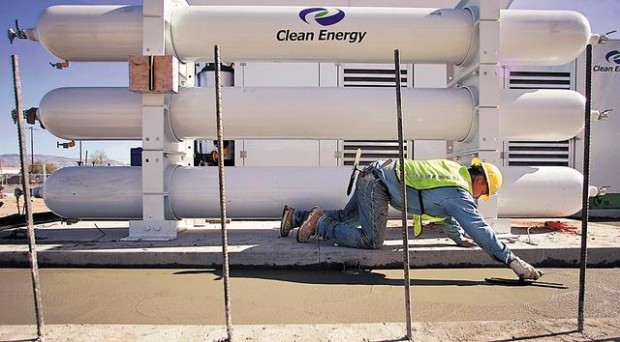
Except for a semitrailer-size compressor and filter, which are being hidden behind a masonry wall, and three white horizontal above-ground storage tanks, the Clean Energy station looks like a conventional filling station. There's a large white canopy with an island that soon will have two stations, each of which will be able to fuel two vehicles at once.
There's a $4,000 federal tax credit for buyers of CNG-powered vehicles, and a state deal that caps annual registration fees at just $28 for the life of a CNG-only vehicle, said Colleen Crowninshield, Clean Cities program manager for the Pima Association of Governments.
About 100 Tucson-area residents already are using overnight CNG fueling units called FuelMakers, which take low-pressure gas from existing service lines and slowly pressurize it for vehicle use for the equivalent of $1.40 a gallon at current prices, said Crowninshield.
The FuelMakers cost about $4,000, though that cost is offset by a federal tax credit of $1,000, said Dave Clement, owner of CNG Services of Arizona, a FuelMaker dealer based in Mesa.
Besides the lower pollution levels and relatively low cost per gallon equivalent, advocates of CNG say it is better than gasoline because it lowers engine wear and reduces maintenance needs while cutting U.S. dependence on foreign oil.
The drawbacks of CNG-powered vehicles have been their higher price — roughly $3,000 more for a 2009 CNG-powered Honda Civic than the same car with a standard gasoline engine — and, most significantly, a lack of places to fuel the cars. The vast majority of CNG-powered vehicles have been in local fleets — such as buses, utility company trucks and, in a few places, police cars — rather than private hands.
Southwest Gas spokeswoman Libby Howell said the local gas utility has used CNG to power its service trucks and some of its staff cars.
Find the latest news on alternative fuel at www.azstarbiz.com
On the Web
• Clean Energy Fuels: www.cleanenergyfuels.com
• CNG Services of Arizona, a Phoenix-area company that is a dealer and service provider for CNG-vehicle fueling equipment: www.cngaz.com