

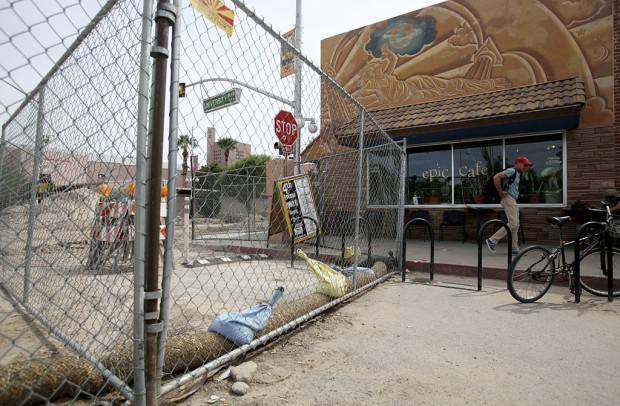
"This is not a stimulus."
That's what business owners at North Fourth Avenue and East University Boulevard say about the city's interminable streetcar construction in front of their shops.
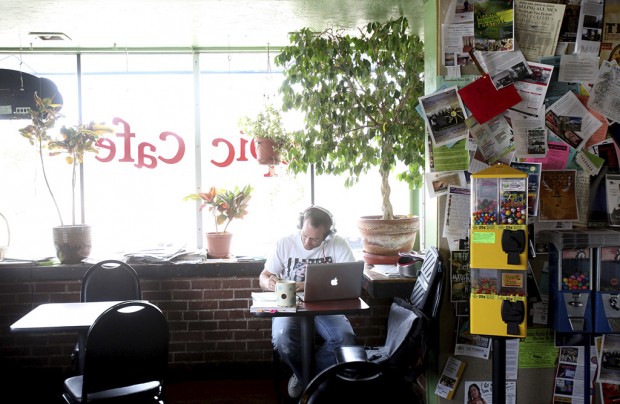
Epic Cafe owner Brian Wolff said the city's change of plans this summer has nearly cost him his business.
Wolff is one of a handful of business owners along the streetcar route who are suffering unintended consequences as the city extended its construction schedule this summer from the original three or four months to seven months or longer.
"I am down 110 customers a day since this construction started," Wolff said.
Wolff estimates he lost more than $100,000 and had to come up with an extra $37,000 to cover costs and keep the place afloat.
People are also reading…
"This place used to be packed," Wolff said, looking over a room of sparsely populated tables during a Wednesday lunch hour. "We're all little shop owners and we don't have a whole lot of money. I support 13 families working here. If I wouldn't have stepped up and taken my own money out of my pocket, these people would have been unemployed. Is that what the city's looking for?"
Construction started in mid-April, which shut Fourth Avenue down between University and Sixth Street. Businesses immediately felt the pinch of customers avoiding choked off streets and fenced in sidewalks.
Businesses saw an average 30 percent decrease in revenue during the closure, according to John Sedwick, executive director of the Fourth Avenue Merchants Association.
But that's what businesses expect whenever there are disruptions such as street construction, Sedwick said.
Tattoo artist Bruce Gulick was particularly hard-hit by the over-all decline of business, and especially pedestrian traffic, on Fourth Avenue.
"The frustration I have is there are days when the bills are due, I have no money to pay them and I come to work and there's just nothing happening here," said Gulick, who owns the Magic Fun Store, just south of University on Fourth Avenue.
Gulick also fears the construction is jeopardizing Fourth Avenue's identity.
"It's independently interesting and unique in the town, and that's why there's a separate Wikipedia page for Fourth Avenue," he said. "These mom and pop businesses can't call the corporate office in Iowa for help. … We are extremely vulnerable to changes in the environment."
Not all of the businesses have suffered equally under streetcar construction, though.
Lissa Marinaro, owner of Zoe's Boutique, said while she was worried in the beginning when sales took a slight drop, things eventually evened out.
"Overall we are doing just fine," Marinaro said. "I think once construction is done it's going to be awesome."
Marinaro said while every business is different, she credits an aggressive marketing campaign, especially on social media, with keeping her business in the black.
Fourth Avenue reopened in mid-July. But it was a short reprieve for Wolff and Gulick and others at the north end of the Fourth Avenue entertainment district, as the city quickly reclosed the street in front of their businesses for streetcar construction on nearby East University Boulevard. It could remain closed until as long as late November.
Wolff said merchants were told they would have a six-week window between the two project phases, but then the schedule changed.
"They moved the project up so they could tear the road up and it's been sitting here doing nothing for the past 2 1/2 months now."
Sedwick said things may have been easier on the businesses if the city followed through on its original plan to complete the track section by section instead of huge chunks at one time.
"When they sold this project to us, they told us it was going to be one block, one month, which would have been fine," Sedwick said. "We could've handled that. But then it became two blocks and then it became three blocks."
"I'm just tired of this happening," Wolff said. "I'm going to speak up. And even if nothing happens, at least I spoke up and didn't sit here with my tail between my legs getting crushed. … My situation can't be unique."
Congress Street
Wolff's situation is not unique.
Things aren't any better downtown, where Congress Street has been closed since spring.
While destinations like the Fox and Rialto theaters still draw audiences for their events, smaller businesses have found Tucsonans aren't willing to brave the construction zone and traffic maze to bar hop or grab a bite to eat.
"People say they can't find parking. It's difficult to get around. Some people tell me they don't feel safe walking on the sidewalks with the fence up," said Rene Knechtle, former Enoteca co-owner and current chef. "It's definitely been on the slow side."
As a result, Enoteca cut its weekday hours. It's now only open from 11 to 2 and serves dinner only on Friday and Saturday nights.
Up and down Congress Street businesses report losses ranging from 30 to 50 percent for going on six months. Even though most say they expect to survive, they say it hasn't been easy. At least one, Sharks nightclub, has closed.
"Before, we were doing fantastic," said Caffé Milano owner Carlo Borella, who opened the restaurant over a decade ago when he moved to Tucson from Italy. "The city tells everyone to come downtown and then they start this."
Borella said since he has a small staff, layoffs haven't been an issue, but he has adjusted hours and closes on Thursday nights.
"Thursday is like a ghost town," he said.
Borella said it would be nice if the city factored in how the construction would affect businesses and found some way to ease the pain of lost revenue.
"Maybe a tax break during construction. A little help and try to understand it is difficult on the businesses," he said.
Like others, Borella is frustrated by the slow pace of construction.
"It would be nice to see an effort to get this done as soon as possible," he said.
Noise ordinance
Wolff said he doesn't know why the contractor can't work double shifts, nights and weekends in order to finish the project so businesses can get back to normal.
Streetcar construction manager Jesse Gutierrez insists the city and contractor are doing everything they can to minimize any disruptions on businesses.
He said crews are working nights and weekends, but there are limits on when and where they can do that.
One problem, he said, is that night and weekend work is prohibited in residential areas, such as University Boulevard.
"We try to accelerate things, but there's a noise ordinance that we have to abide by," Gutierrez said. "I tried to pull in a double shift in one of these areas (recently) and we got beat up for it."
If downtown construction sites look deserted at night, it may be crews are working on underground utilities, he said.
Gutierrez said the schedule changed for the University and Fourth Avenue intersection because crews finished the first phase about a month early, and the intersection had to be torn out so crews could perform the necessary underground work before any tracks could be installed.
He said he expects to have Fourth Avenue fully open by Thanksgiving.
Downtown is more of a mixed bag.
Congress should be open between Fifth Street and Sixth Street this week.
But there are so many issues with the utilities and water lines under Congress between Stone Avenue and Church Avenue, it may be December before that opens.
"When the fences come down, it's going to improve those businesses," Gutierrez said.
Contact reporter Darren DaRonco at 573-4243 or ddaronco@azstarnet.com.