

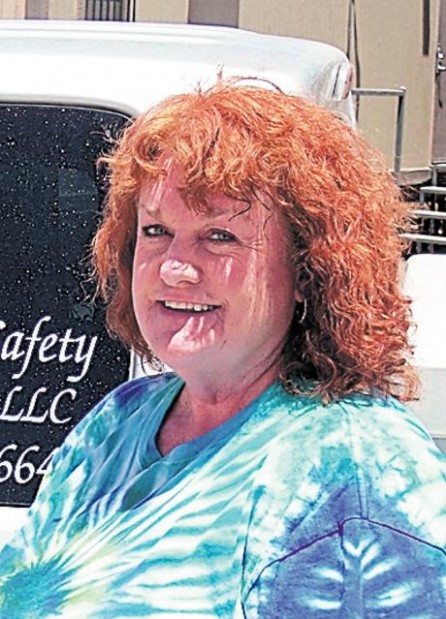
Sharon Powers recently invested more than 20 years of workplace-safety inspection experience in her own consulting business.
The straight-speaking woman with red hair, green eyes and purple-polished fingernails says she's always in safety-inspector mode, even while shopping. She regularly works 10-hour days and says her 45-plus clients are old friends.
After two years on her own as principal of Powers Safety Services LLC, she was selected by her peers to receive a Cornerstone Award. The award honoring skill and integrity is given by the non-profit Cornerstone Building Foundation, an association of six local trade groups.
We asked Powers about her career of working in non-traditional jobs for women and about starting her business. Here are excerpts:
Q How did you get started in your career?
People are also reading…
A I've been doing non-traditional work for over 20 years.
When I was in college I had no idea what I wanted to do. (I earned a degree in) physical education and biology. I started work in the medical field. I decided to go to work for the copper mines and make real money like the guys did.
Now some of the guys didn't like that because they felt we were taking checks away from guys who had families. But I learned lots of lessons along the way. I learned how to deal with guys the way they deal with each other.
Because they knew I had a medical background and a degree, they pulled me into the safety department. (I have) worked for the state mine inspector and then for ADOSH (the Arizona Division of Occupational Safety and Health). I was the first woman hired by ADOSH for the Tucson office.
Q What do you do for your clients?
A I'm like their part-time safety person. We keep track of the accidents, we monitor if they're having too many, we take care of all of their training and their safety programs. "We" is me, myself and I.
I average three to four construction sites a day at least three to four days a week. I enjoy it — even when it's 110 (degrees) out.
I taught at Pima Community College and I also do private classes through the trade associations.
Q What's it like running your own show now? And how did you make that transition?
A A lot of people had said to me all along: "You should have your own business. Why are you working for (a company)?" I couldn't imagine not working for someone else. What I tell the guys now is: I work for a lot of someone elses.
(When I quit my last job) I didn't know what I was going to do. The next morning, I turned around and I called every one of my clients. My schedule's busy. I said, "Look, I'm no longer with so-and-so, if you still want me to do your work I'll be glad to. It'll take me the next month to get my contracts and my paperwork in order, but we can continue on." They keep calling. I have never had to advertise because it's all word-of-mouth.
Q What do you do besides work?
A Little else (laughing).
I try to take the weekends off when I can and not touch the computer at all. Sometimes I have a Saturday class.
Usually I'm up at 5 and 5 to 7 is a work time when the phone doesn't ring, so I'm on the computer just sort of getting up for the day. Then after that I head to job sites or a training class.
In the summer I'm home earlier. Usually I'm home between 2 and 4 and then I'm still on the computer till 6, so there's a 12-hour day. But I have free time in between.
I work with horses. I had a mule for almost 29 years, and she died in February and I miss her badly. I do a lot of photography, but I also do photography at work. And I like going to craft fairs and that type of thing. And I like working in my yard with my citrus trees and flowers. I like to travel when I can. Those are my diversions.