

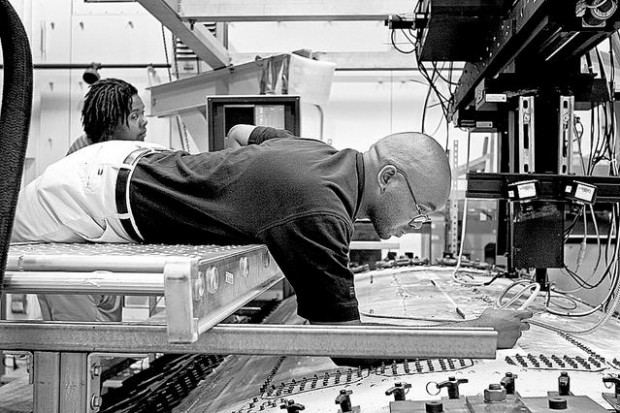
PHILADELPHIA — Every 30 seconds, the curved aircraft panel bulges slightly, its aluminum skin rising and falling like the sigh of some giant metal beast.
The movement is almost imperceptible. But after many thousands of repetitions, these subtle stresses cause tiny cracks — eventually ripping open this piece of an old Boeing 727 like a giant zipper.
The goal of the destruction — a test on the ground by Drexel University and the Federal Aviation Administration — is to make sure this never happens when you're in the air.
Never again, that is. In 1988, an 18-foot section of an Aloha Airlines aircraft tore apart in midair, sucking a flight attendant out of the plane and injuring dozens of terrified passengers. The culprit: a phenomenon known as fatigue.
The accident has spawned years of research, including the Drexel-FAA program, and a new proposal that is causing some turbulence in the industry. In April, for the first time, the FAA proposed limiting how long commercial airplanes could fly.
People are also reading…
Most old planes are being phased out anyway; their inefficient engines aren't viable with today's high fuel prices, industry analyst Robert W. Mann Jr. said. And airlines can get extensions as long as tests show a model is safe to fly.
But the rule, which the FAA can enact after reviewing comments due in September, would be a significant change for an industry that has long insisted its planes are safe to fly "indefinitely," so long as they are well-maintained.
Stressed metal doesn't heal
Ali Bahrami, manager of the FAA's transport airplane directorate, called the rule the "last piece" of many steps the agency has taken since the Aloha accident.
"Once it's implemented, it will take us toward a proactive approach of dealing with aging issues," he said.
But if the regulators have taken their final steps, scientists say they have much to learn.
Metal fatigue means what it sounds like. Repeated low levels of stress weaken a piece of metal. But unlike people, metal does not recover with rest.
Fatigued metal is deformed microscopically, in ways not fully understood. Tiny cracks develop, and eventually the material can no longer carry its weight.
You can demonstrate this with the humble paper clip. Flex it back and forth a few times, and eventually it snaps.
Similarly, an airplane flexes in various ways during flight, though the impact takes much longer to see.
One type of stress — believed to have led to the Aloha accident — is due to air pressure.
On the ground, pressure inside and outside the cabin is the same. But high in the sky, the pressure inside an airliner is typically about 8 pounds per square inch greater than the outside pressure.
The aluminum skin of the plane stretches slightly as a result, said Drexel's Tein-Min Tan, an associate professor of mechanical engineering.
The circular cross-section of a typical midsize airliner expands an inch or so in flight, he said. The circumference returns to its original size upon landing.
Catastrophic 'unzipping effect'
Engineers have known about fatigue since the mid-1800s, after studying broken train axles and other early casualties of the Industrial Revolution.
They learned more in the 1950s when crashes due to metal fatigue temporarily grounded Britain's Comet airliners, whose sharp-cornered windows led to cracking.
Yet the Aloha accident, in a Boeing 737 flying from Hilo, Hawaii, to Honolulu, was a surprise.
Investigators blamed the airline for poor maintenance, but engineers also discovered that they didn't know as much about fatigue as they had thought.
No one knew that a series of small fatigue cracks, each insignificant by itself, could be a problem, said John Bakuckas, an FAA research manager.
"When you have so many of them lined up, you have that unzipping effect," he said.
"Once they link up, they go very fast," Drexel's Tan said.
The FAA proposal would place different limits on each model of airplane, depending on data from the manufacturer.
It would affect commercial planes that weigh 75,000 pounds or more when loaded. About 1,600 smaller regional jets would be excluded.
If planes were retired at the end of their current "service goals," the rule would phase out 602 airplanes over 20 years — 15 percent of cargo planes and 10 percent of passenger craft.
But the rule would allow operators to apply for extensions, so long as tests demonstrated the crafts were safe.
Alloys, treatments in works
Most airlines have not yet commented on the proposal, and have asked for more time to review it. The National Transportation Safety Board supports the measure, but urged the FAA to extend it to smaller planes.
Meanwhile, planes have been improved since Aloha.
Designers now use titanium or advanced alloys of aluminum in parts of a plane where corrosion can be a problem, said Rao Varanasi, manager of Boeing's aging-aircraft program.
Anti-corrosive compounds are sprayed on. And planes are built for "damage tolerance": Assume cracks can develop, but make sure inspections are frequent enough so repairs can be made in time.