

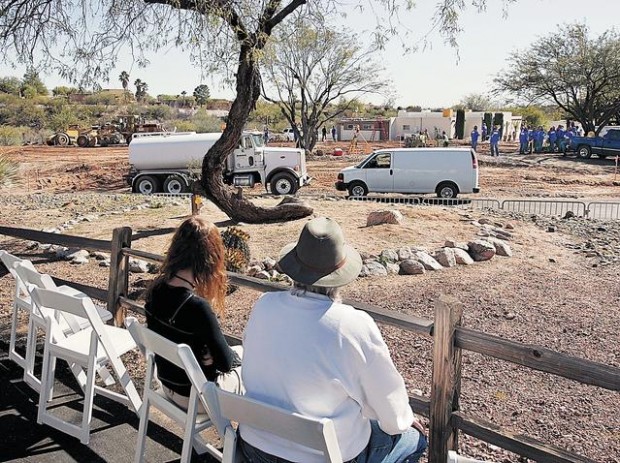
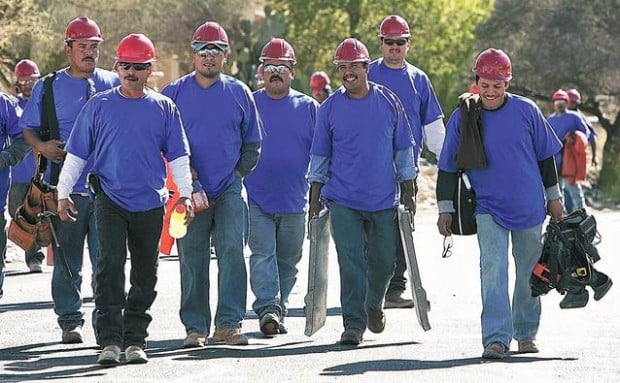
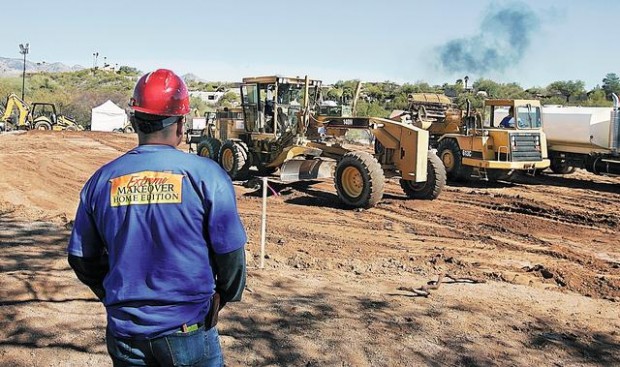
The hit TV show "Extreme Makeover: Home Edition" blitzed into town last week, capturing our attention with a feel-good story just as the economy shed 72,000 more jobs.
In the span of 106 hours, host Ty Pennington, with the help of hundreds of local volunteers, will have torn down Kathleen and Michael Bell's run-down Catalina Foothills home and replaced it with a 3,100-square-foot masterpiece.
This is something of a fairy-tale moment for the Bells, whose old home was hardly livable and whose 14-year-old daughter, Lizzie, has a rare blood disorder that necessitates transfusions every few weeks. It's a touching story, and one the community has rallied around with volunteers and materials.
And yet at a time when foreclosures are spiking and thousands of jobs are being lost, something about "Extreme Makeover: Home Edition's" hit-and-run nature seems out of place, a throwback to our housing bubble.
People are also reading…
The show first went on the air in 2003, gaining popularity at a time when a something-for-nothing attitude was seeping through the real estate industry: Flip this home, flip that home, put no money down and finance on interest only. So it's not surprising that a show that essentially gives away upscale, new homes would gain traction during our housing bubble.
But the bubble has burst.
Although Pima County is in the red and looking at deep cuts, "Extreme Makeover: Home Edition" isn't paying for either the $4,500 in outstanding permit fees or the sheriff's deputies who are stationed at the Bells' neighborhood around the clock for this event.
Instead, county officials said they are hoping someone will donate the cost of the fees.
"At this point, we don't have any solid indication as to how those fees will be paid," said Carmine DeBonis Jr., the county's development services director.
Maybe someone will pay the bill, but the show — which will profit from this event — is off the hook. When "Extreme Makeover: Home Edition" recently swung through El Paso, it had $93,000 in permit fees waived, the El Paso Times reported. Problematic makeovers
But even if the show were paying its permit fees, what happens after "Extreme Makeover: Home Edition" leaves town and the recipient's property taxes spike or energy costs soar?
There have been a number of stories of "Extreme Makeover: Home Edition" families running into financial trouble. Families in Detroit and Atlanta have faced foreclosure, news reports say. Similarly, a man in Oregon had to sell his home because he couldn't afford the increased property taxes and maintenance costs.
And then there is the Georgia Yazzie family, which lives on the Navajo Reservation in Pinon, Ariz. The construction of the Yazzies' new home was so faulty that it's left them freezing, at times struggling to get their thermostat above 40 degrees, the Navajo Times recently reported.
Numerous interview requests with ABC, which airs the program, and "Extreme Makeover: Home Edition" about these issues were unsuccessful. Instead, a spokesman for the show e-mailed a statement.
" 'Extreme Makeover: Home Edition' families aren't immune to the current state of the U.S. economy," wrote Chris Dilorio, a spokesman for the show. "EMHE (the program) has always strived along with our volunteer builders to create not only 'extreme' homes but homes that work for the owners for years to come. . . . We're proud that we've been able to help over 140 families get a new start." Makeovers for foreclosures
County officials said they were willing to waive permit fees because they thought the show would give Tucsonans a spirit of hope during these very tough times. And similarly, green builder John Wesley Miller, who is overseeing much of the work, said he was drawn to the project because of its spirit of benevolence.
"It's about love thy neighbor as yourself," he said. "That means you help people."
I couldn't agree more, and that's why I am proposing a new version of the show: "Extreme Makeover: Foreclosure Edition."
With each city stop, my version of the show would partner with a local non-profit agency such as the Primavera Foundation, which has a goal to assist 125 first-time home buyers in Tucson this year. Most of these families live on modest incomes, and most of them are considering buying foreclosures.
Instead of swooping in and out of town to build one sprawling upscale home, my version of the show would remodel 20 of those foreclosed properties, making sure they have good roofs, quality plumbing and wiring, and working heating and cooling. Volunteers would rush to help. Materials would be donated. Foreclosures would be taken off the market.
It wouldn't be as sexy as building a sprawling upscale home, and the ratings probably wouldn't be great, but it's the kind of work that could go a long way toward improving people's lives and changing the housing crisis we all are facing.