

At a time when Dave Dunlap needed most to remain calm, it was a solitary ladybug that came to his rescue.
On the morning of Sept. 11, 2001, Dunlap was co-pilot on Delta Flight 1989, the third flight scheduled to take off from Boston for Los Angeles — after American Airlines Flight 11 and United Airlines Flight 175.
Dunlap's plane, though forced to make an emergency landing in Cleveland, was safe. The other two flights' fate as the planes that hit the World Trade Center has been etched in history.
Long after the events of that day, it was the memory of that small ladybug calmly landing on his cockpit window in Cleveland that remained with Dunlap.
Six months after trying to give his job as a pilot another chance, he walked away from it all. He would start a business, one he'd been thinking about since 1999 but had been too afraid to try.
People are also reading…
Having a brush with death tends to give one a different view of risk, Dunlap said.
As homage to the little creature that helped him focus amid the confusion, he named his company Coccinella — Italian for ladybug.
No longer able to fly, Dunlap turned to another passion — language. Specifically, the development of language-learning software such as Coccinella's flagship product, 3DLanguage: Spain.
For three months, he lived with his wife, Lori, in Seville, using the city as inspiration while they worked on a business plan. When they returned to the States in 2005, they moved their family to Tucson from their Santa Barbara, Calif., home.
A video-game fan, Dunlap was inspired by the immersive environment found in first-person games such as the popular Grand Theft Auto series.
"We're inspired by a lot of those worlds," Dunlap said in an interview from his East Side home. "I thought, wouldn't it be great if instead of shooting at people, you could order a cup of coffee from them."
Wander the streets of Seville
Utilizing a team of developers and artists in the United States and across the globe — "We're a virtual company," Dunlap said — Coccinella released 3DLanguage: Spain in January 2006.
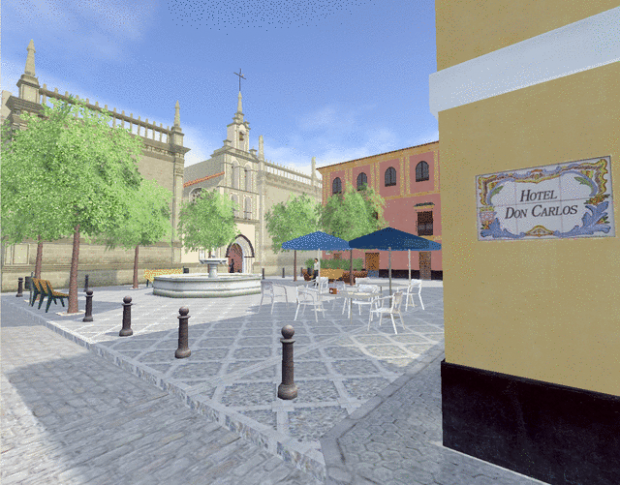
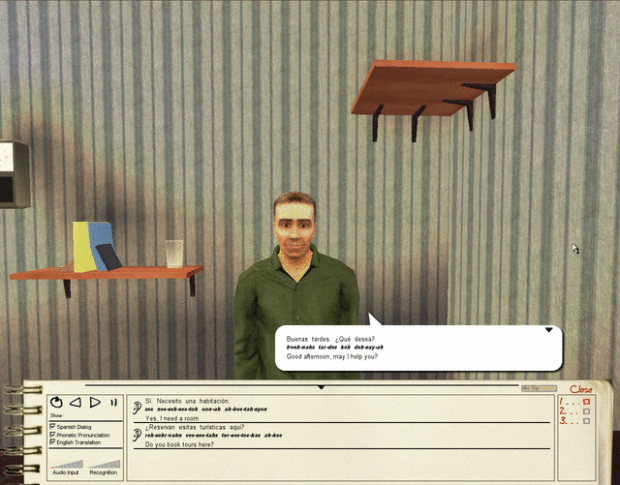
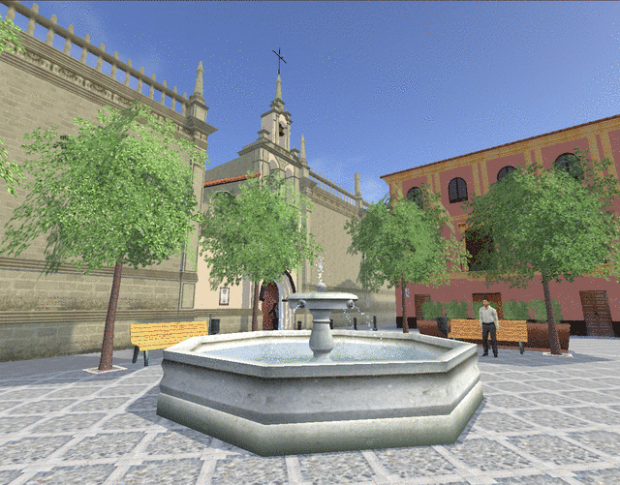
Set in Seville, users are free to wander the streets as they engage in conversations with the city's virtual residents with the use of a microphone and voice-recognition software. Clicking on objects such as a fountain in the central plaza brings up a box with cultural information — in this case, the Moorish influence on regional architecture.
From the texture of the street to the handwriting on a bar's menu, every detail was created from hundreds of photos taken by the couple during a three-month stay in Seville. The program, along with a demo version, is available via download from the company's Web site, www.3dlanguage.net.
"We created (the program) based on what people wanted and needed, versus what we thought they should need," Dunlap said. For example, "Most people are terrified of practicing speaking with another person."
The 3-D characters in 3DLanguage: Spain won't mock your accent or laugh as you fumble with grammar. If nothing else, they'll simply ask you to speak more slowly.
After receiving a demo of the first version, Maureen Cullen was hooked.
Cullen, a Spanish teacher at the American School of Dubai in the United Arab Emirates from 2004 to 2007, persuaded the school to purchase a license to use 3DLanguage: Spain on all of its library computers for use by about 200 students.
"It was especially effective with the students who were in the earlier language classes," she wrote in an e-mail. "And the key ... they asked me almost every day if they could return to the library to work again with the software ... and I am not exaggerating."
Now teaching Spanish at the American Embassy School in New Delhi, Cullen said she is working to get a site license there and writes, "We are anxiously awaiting the French version."
Virtual worlds
When not working on language software, Coccinella's development team is working on expanding the first-person platform for broader use.
Jayshiro "Jay" Tashiro is the co-owner of Tucson-based Wolfsong Informatics, and has been working with Dunlap on two simulations for use as supplements in medical-training programs.
An earlier beta version of one for paramedics-in-training had them walk through an emergency scene involving a shooting.
"With the shift in student interest in virtual worlds, we thought we should move our educational simulations toward immersion in these virtual worlds," Tashiro said. "I want to keep working with Coccinella as long as I can."
Relationships like that will keep Dunlap and his team busy. The company is planning to release a Latin American Spanish version of 3DLanguage, as well as an Arabic version, which Dunlap describes as having "a Damascus feel to it."
As it has been for several years, Dunlap's current passion happens to be the acquisition of languages. Already studying Italian, he's recently taken up learning Mandarin Chinese and Arabic.
"It's great to be a new student while I'm doing this," he said. "It helps so I can remember how ridiculously hard it is to learn a language."
Profile
• Name: Dave Dunlap
• Age: 43
• Job: Founder and owner, Coccinella Development Inc.
On the Job focuses on the people who make Tucson businesses run — those who are in charge, keep a business running, are just starting out or hire workers.