National Grid knows how to deal with windstorms. The utility company is also accustomed to dealing with Buffalo snowstorms, like the November event that delivered up to 7 feet of white powder, but very little power loss.
But with both at the same time, this weekend's blizzard was something totally new and different.
"We’ve never had this. Even though we get snow in Buffalo, from November to March, we’ve never had it blow to the degree it did," said Kenneth Kujawa, regional director for Western New York for the area's biggest electrical power company.
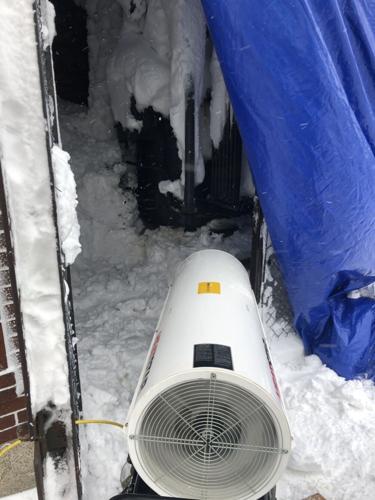
It required unique solutions to restore electricity to some of the thousands of Western New Yorkers who lost power during the height of the multi-day storm – such as bringing in high-powered torpedo heaters to melt snow and ice that accumulated on equipment, or front-loaders to clear a 12-foot snowbank piled up in front of one substation.
People are also reading…
Even before that, the city and county had to plow a path through the deep snow so the utility's trucks and crews could get to five paralyzed substations in the city. Only then could they start to re-energize the circuits, one feeder and one transformer at a time.
"This is the first time in our careers – and I’ve been with National Grid for over 30 years – that we’ve dealt with something of this magnitude," added Kujawa, 57. ."
Now, after facing more than 108,000 customers without power, and restoring all by Wednesday evening, the company is evaluating what it could do differently to "make sure our networks are more resilient every day," said Rudy Wynter, National Grid's New York state president.

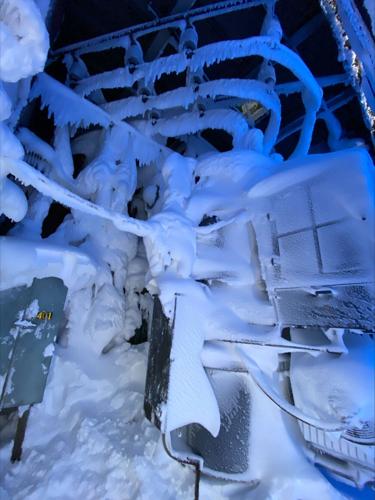
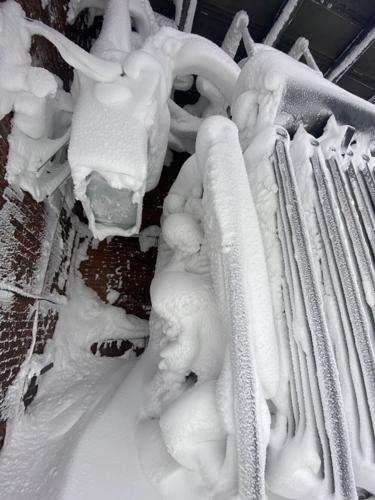
Snow and ice accumulated on National Grid electrical equipment in this substation on Elk Street during the December 2022 blizzard in Buffalo.
National Grid officials said they knew well in advance that it would be bad. They mobilized workers, brought in contractor crews and additional machinery, put out the call for extra help, and pre-positioned whatever they would need, "so that when the storm hit, we were ready to go," Kujawa said.
"We put them in hotels, waiting for the storm to hit, so that when it does, they’re already here on the ground," Kujawa said. "The challenge here, because the storm raged for two days, we were in effect grounded here."
Additional help came since then, after the storm released its grip elsewhere. The company employs about 800 in Western New York, but has amassed a total response team of 3,200 linespeople, service people, tree crews and damage assessment teams.
That includes more than 2,000 staff from other parts of National Grid's network – such as Syracuse, Utica, Albany and the North Country, as well as Massachusetts – and from 13 other states, even from as far as Iowa, Oklahoma and Texas. A team from New York City came, and National Grid also appealed for help through the North Atlantic Mutual Assistance Group, a consortium of utilities in the Northeastern U.S. and Canada. Ontario and Quebec responded.
"This is probably the largest deployment of a storm field force that we’ve ever done," Wynter said.
But "when the snow came, in combination with 80 mile-per-hour winds, now, all of a sudden, our drivers couldn't drive," Kujawa explained.
Only after the storm let up could the utility finally start repairs Saturday night. Five substations in the city were flat, after the heavy wet snow effectively short-circuited the equipment, triggering shutdowns. Those affected large swaths of neighborhoods in five areas – from North Buffalo and the Elmwood Village to the Old First Ward and East Buffalo.
One substation was on Spillman Street, near the Canisius College athletic center. Another was on East Delavan Avenue at Fillmore Avenue. Two stations on Elmwood Avenue were impacted – one in the Elmwood Village near West Utica Street, and one across from the Pierce-Arrow Administration Building, north of McKinley High School. A station on Elk Street had the biggest challenge – snow drifts 12 to 15 feet high.
The company worked with city, county and state officials to prioritize plowing streets in front of stations where the outages affected the most people – the two in East Buffalo. In each case, workers had to blow hot air into the facilities to warm them up and melt the snow and ice, using powerful cylinder heaters often found on football game sidelines.
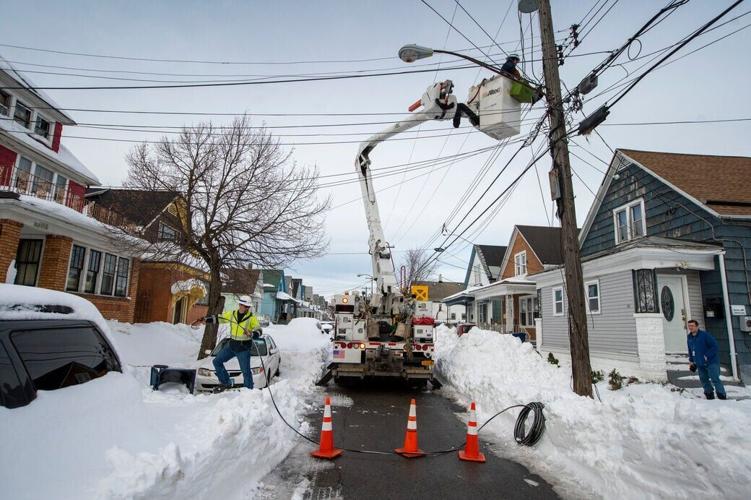
In all, National Grid suffered 148 broken poles, 137 damaged transformers and 1,260 sub-transmission circuits that needed to be replaced.
"You can’t just flip a switch and start bringing everybody back," Kujawa said. "It had to be very coordinated. It took time."