

Richard Ferranti stood center stage in a hotel ballroom, ignoring the podium to his right and opting for a clip-on microphone that left him free to move. He paced and gestured, gestured and paced, as if he were a coach in front of his team.
The new president of Buffalo-based frozen-food giant Rich Products Corp. was speaking to a group of 100 or so economic-development officials from across the country and said something that was hard to dispute: “You probably eat our products everyday.”
He shared a slide that depicted logos of some of Rich’s best-known clients, including Walmart and Starbucks. He dropped in details on the history, scope and growth of Rich Products: It’s a family business, founded in 1945; sells more than 3,000 food products; and has a presence in more than 100 countries, with nearly 11,000 employees around the world and $3.8 billion in revenues.
People are also reading…
Those are good numbers, numbers that veer Ferranti’s excitement into pep-talk territory. But he maintains that gusto when talking about something not so good, something more challenging than exciting. Something like this: “Kids don’t want to be 16 years old and work at McDonald’s,” Ferranti, 58, said.
If you think it’s good that teens are aspiring to do something different than flip-and-fry jobs, consider the ripple effect: When young workers start deciding that greasy, sweat-beading kitchen jobs aren’t their style, it creates a labor shortage that makes it more difficult for restaurants, grocery stores and food service operations to staff their kitchens.
“It just isn’t as attractive as it used to be,” Ferranti continued. “Labor is a big, big problem all companies are facing.”
With fewer workers in the kitchen, many of Rich’s customers want their products to arrive finished and ready to eat — or, at least, closer to finished, with less preparation required. Instead of selling cake and icing separately, for example, Rich’s may now be asked to deliver fully finished desserts, ready for slicing.
Simple as that is – sell the whole cake, rather than its parts – imagine trying to do it on the Rich’s scale. When you’re selling products across most of the globe, managing supply-chain logistics and food safety and a multitude of other factors, scaling up while maintaining quality and profit is complicated. Which means Rich Products needs to be more creative than ever. “Fundamentally,” Ferranti said, “if you’re not growing and thinking of innovating, you’re dying.”
It reads like a soundbite. But for Rich Products, it's reality.
From Lovejoy to South Africa
A few months earlier, Ferranti was the subject of a memo from CEO Bill Gisel to all of Rich’s “associates,” the company’s preferred word for employees. Gisel, 65, announced that Ferranti, who was in his 32nd year with Rich Products, was being promoted to president of the company. That made him only the fourth president in the 73-year history of the company. The first three were founder Robert E. Rich Sr., followed by his son and now company Chairman Bob Rich Jr., and Gisel, who is still the CEO and Ferranti’s boss.
Gisel outlined their responsibilities: As president, Ferranti would be responsible for the day-to-day performance of the business, while Gisel would focus on “long-term direction and organizational excellence.” The move was part of a larger redesign of Rich’s executive leadership team, which is a sort of cabinet that drives the operations of the company, and was aimed at ensuring Rich Products can simultaneously make quick and forward-thinking decisions.
“Richard has reported to me for 28 years,” Gisel wrote in the memo, referencing the late 1980s, when Ferranti joined a then-small team Gisel assembled to build an international business for Rich Products. “It’s safe to say that we know each other better than we know some of our family members.”
In their years together, Gisel and Ferranti have traveled the globe, talking business and family and building a brotherly bond. On a long walk in Munich from a hotel to a restaurant, they talked through the details of the “Rich Experience,” the company’s “be global, act local” plan. During an unexpected layover in Paris, they had a lengthy discussion on Ferranti’s career trajectory and his desire to do more.
On a walk in South Africa, they faced the prospect of death when they stepped on a black mamba, the world’s most poisonous snake. (The black mamba is so feared that even 45 minutes later – when, if they had been bitten, they would have been dead – the local Rich Products executives were still visibly shaken.)
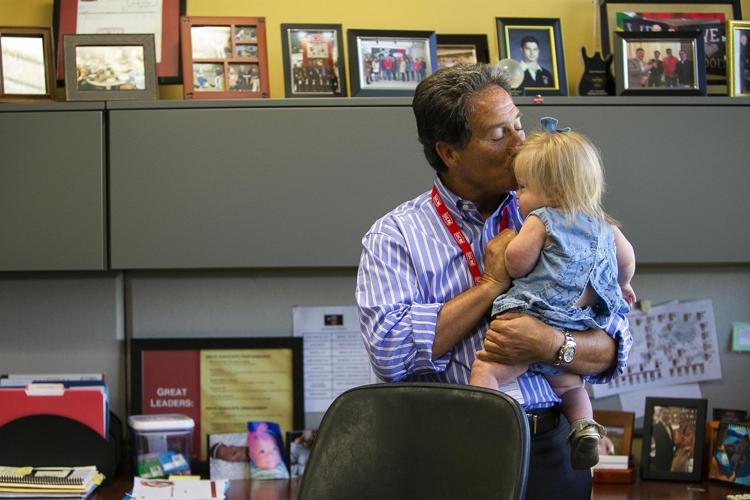
The two men have shared family moments, from Ferranti talking about his now-grown son Michael’s hockey and lacrosse games, to the funerals of Gisel’s parents. Gisel, whose office at Rich’s Niagara Street headquarters is steps from Ferranti’s, sees his colleague light up when Ferranti’s 1-year-old granddaughter Grace, who is in the company’s on-site day care, comes to visit.
Their relationship, Gisel said in an interview with The News, “has been a constant for us for a long time.”
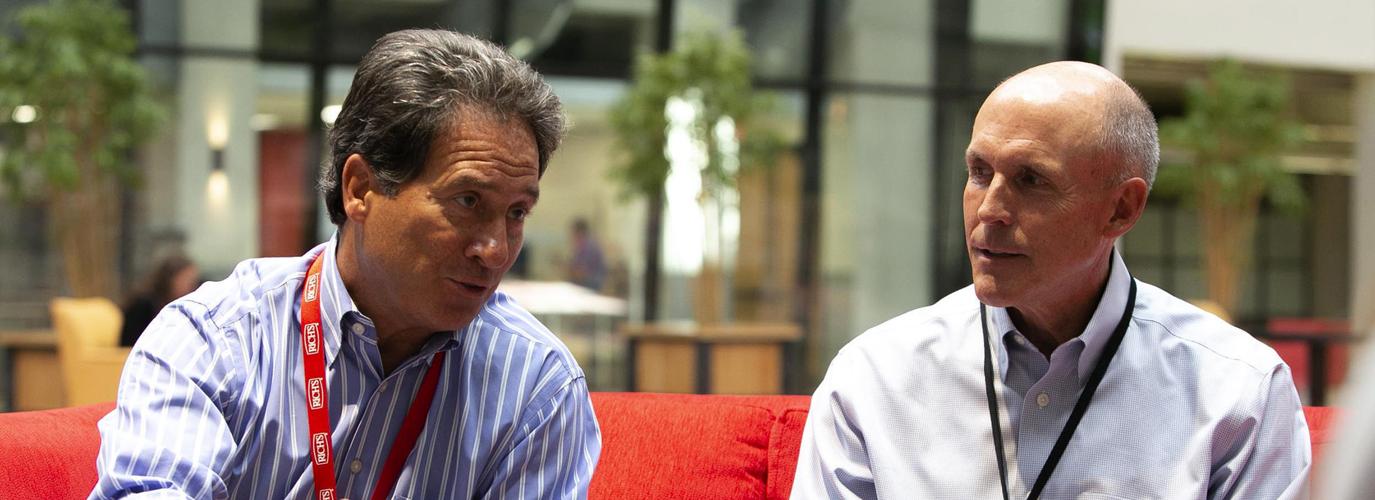
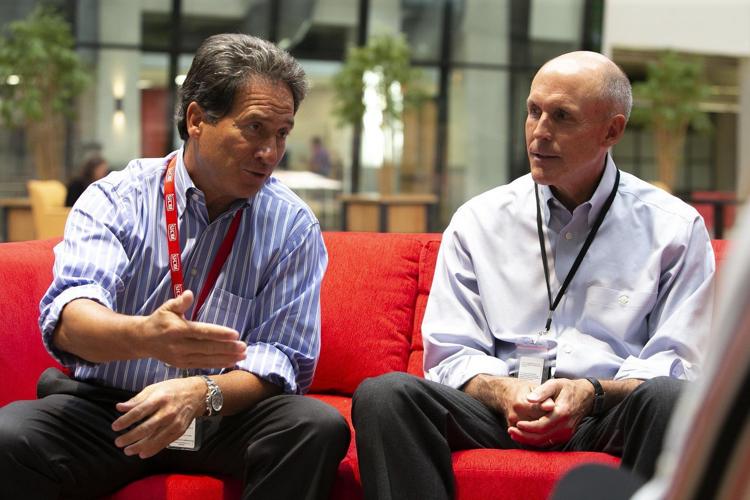
“It’s pretty seamless,” Ferranti added, sitting on a couch next to his boss in Rich Products’ atrium.
It dates to 1986, when Ferranti joined Rich Products as part of a management training program. He established himself as a standout salesman, though there was little reason to suggest he was destined to become president of the company. Ferranti grew up in Lovejoy, playing hockey and football and attending Bishop Timon High School, which is also when he met his future wife, Nancy. He attended Canisius College and worked at Goldome bank before joining Rich’s. Early on in his time with the company, he earned an MBA from the University at Buffalo.
Rich Products’ general counsel at the time was Gisel. His credentials included a trio of exclusive private colleges: a bachelor’s degree from Williams College, a law degree from Emory University, and an MBA earned from the University of Rochester during his first few years with Rich Products.
It was little surprise, then, that when Bob Rich Jr. formed an international division in the late 1980s, he put Gisel in charge. Until then, Rich’s had focused on the United States and Canada and built a half-billion-dollar business. But for the opening of an international division, Gisel put together a small crew of people who were willing to try to sell “anything, everywhere,” he recalled. “At that point we were all hands across all decks.”
One of Gisel’s early additions to the international team was Ferranti, who trekked to places as diverse as Scandinavia and the Caribbean, where he tried to drum up business selling candied cake toppings. “He set his own drumbeat,” Bob Rich Jr. recalled in a recent telephone interview. “He wasn’t afraid of new markets or dealing with people he’d never met before. He was ready to go in, take a risk and try to build something.”
“I look at Richard as a maverick from those days,” added Mindy Rich, the company’s vice chairwoman and Bob’s wife. “He was unafraid. He was ready to jump in and do whatever it would take.”
In the two decades that ensued, Rich’s business exploded. So, too, did the career of Gisel and, in turn, Ferranti. Bob Rich elevated Gisel to chief operating officer in 1996 and a decade later to CEO. Rich, in turn, became chairman of the company after his father’s death and stepped away from day-to-day operations. Ferranti followed his boss’ ascension, becoming president of Rich’s international division, then North American division, and finally the company’s chief operating officer.
Along the way, he developed a reputation as a smart, hard-working, information-hungry executive who liked to push himself and others. Ask Ferranti’s colleagues to break down his characteristics as a leader, and the messages are similar.
He’s smart, with an impressive ability to remember facts and figures. “He’s got a pretty deep appreciation for all the complexities of issues before he moves forward,” Gisel said. “He moves quickly, but his mind moves quickly too.”
He’s an intense worker. “He thinks nothing of working all week and then getting on a plane and going to Asia on a Friday night,” said Ray Burke, president of Rich's U.S. and Canadian operations, “and coming home two weeks later.”
He's the curious type. “Which is great,” said Georgia Dachille, Rich’s executive vice president for global growth and technology, “but it can also throw you.” Earlier this year, Dachille visited Brazil with Ferranti. There were supposed to visit “three or four customers,” Dachille said, but Ferranti got into such a deep and involved conversation with one of them that they ended up doing a tour of the plant and missing others that day. “We were done for the day; it was like 10 o’clock at night,” Dachille said, laughing. “We were supposed to spend an hour with this customer.”
He’s devoted to making his organization stand out. When Ferranti served as chairman of the International Foodservice Manufacturers Associations, he pushed for the organization to focus more on consumers and to explore new and innovative ways for member companies to get products on the market. “ ‘How is this different, and how is this unique?’ was constant mantra of his,” said Larry Oberkfell, the trade organization’s president and CEO. “It forced people to look at things a little differently.”
On change: 'You don't have any real choice'
Both Ferranti and Gisel are direct about the company’s challenge: Innovate or else. “You don’t have any real choice,” Ferranti told economic developers earlier this summer.
Innovation is a core expectation at Rich's. The company was founded on innovation in the 1940s. Its earliest product was a then-revolutionary non-dairy, soybean-based whipped topping that could be frozen and shipped — and therefore widely sold.
In the seven decades since, the company’s size, scope and profits have grown impressively — and in a way that, if the leadership isn’t careful, can introduce a level of comfort that thwarts innovation.
“We have this conversation all the time,” Gisel said. “We know how critical it is for us to make changes now, when we’re in a position of strength. I’m very transparent with the organization either in monthly updates or when I go out and speak to people."
Today, Rich Products’ biggest customer is Walmart. The Arkansas-based retail giant is such a significant source of income for Rich’s that the food company actually opened an office there, and it has a plant in Texas that is largely dedicated to making baked goods, desserts and other products for Walmart.
Gisel has often told this story to Rich’s associates: About a year ago, he and Ferranti and a few others met with some top Walmart executives. By Gisel’s recollection, one of those executives said to him, “You guys have been a great partner.”
That, alone, is good to hear: Rich’s and Walmart have worked closely on custom products, including a line of fully finished, ready-to-eat cobblers and bread puddings.
But that wasn’t all the Walmart executive had to say. The message continued: “But what you did in the past isn’t going to be good enough in the future.”
Gisel knew that already; neither an executive nor a company become successful by getting comfortable or complacent. But to actually hear it is a stark reminder.
“When somebody who is that influential in your future looks at you in the eye and tells you that, you know it’s true,” Gisel said, "and you know that that’s a challenge for anybody.”
