

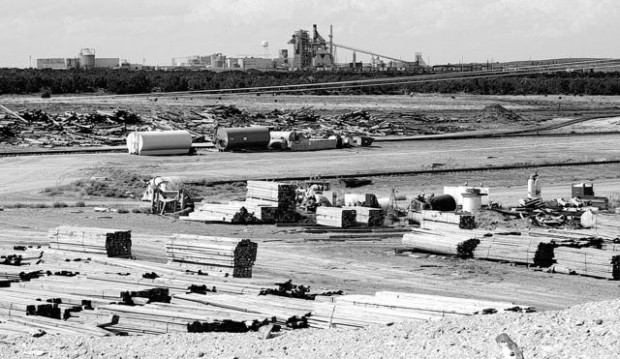
SNOWFLAKE — Teeny leftover paper fibers, a forest full of charred trees, and a pile of wood chips so high it looks more like a mountain all sit waiting in Eastern Arizona for the biomass plant they soon will help fuel.
The 24-megawatt, $53 million plant now under construction will be the second and by far the largest biomass plant in Arizona.
Builders and backers of the plant in Snowflake, about 130 miles northeast of Phoenix, say it will provide a stable source of electricity for the eastern mountain communities of Arizona, allow the state's utility companies to use more renewable energy, and help clean Arizona's forests of small-diameter trees, which have helped fuel some of the state's most devastating wildfires.
"This project is about environmental protection and creating electricity in an environmentally safe and renewable fashion," said Scott Higginson, executive vice president of NZ Legacy, a land- and energy-development company building the Snowflake White Mountain Power plant, which is expected to be in full production by December.
People are also reading…
Environmentalists aren't completely sold, citing emissions and fears for forests.
Fuel sources for the plant will come from leftover recycled paper fibers at a neighboring paper mill and from "woody waste," Higginson said.
The woody waste will come from three sources. The first will be small-diameter trees that were burned in the Rodeo-Chediski fire, which in 2002 charred more than 460,000 acres and burned 491 buildings in eastern Arizona while becoming the largest wildfire in state history.
More woody waste will come from forest thinning projects on wildland-urban interface — land where buildings meet the forest.
The third source will be leftover wood at sawmills.
Arizona's new plant will join nearly 100 biomass plants in the country, said Bill Carlson, chairman of the Redding, Calif.-based USA Biomass Power Producers Alliance, a national group of owners and operators of biomass plants. The state's other biomass plant was in Eagar but recently shut down. Its owner plans to open it again in May.
Carlson defined biomass as any type of woody material, ranging from bits of leftover wood to eucalyptus trees, that can be converted to fuel.
"It's a renewable form of energy, and we're always looking for domestic renewable forms of energy that would get us out of the stranglehold of the Middle East on our energy policy and our energy future," Carlson said.
He said biomass provides the nation with 2 percent to 3 percent of its energy and less than 1 percent of its electricity.
He said biomass plants are most common in California and Northeastern states, including Maine and New Hampshire, because those areas have more readily available fuel and their electricity systems have a high cost structure that makes using alternate fuels more financially logical.
In order for more biomass plants to be built, Carlson said governments need to issue more renewable-energy requirements. For example, the Arizona Corporation Commission approved new rules in October that require state-regulated utilities to get 15 percent of their electricity from renewable sources by 2025, with annual increases of roughly 1 percent.
Although Salt River Project, one of Arizona's major utility companies, is exempt from the new rules, it also plans to get 15 percent of its electricity from renewable sources by 2025.
SRP is the reason the biomass plant is being built. In July 2004, the company requested that energy providers submit proposals for a 10-megawatt biomass plant, said Dan Brickley, manager of resource acquisition at SRP.
Higginson said his company went above the request for 10 megawatts of power to 24 because it would mean a greater cash flow.
He said SRP is buying 10 megawatts of power for 15 years and 20 megawatts for five years after that. Arizona Public Service, the state's largest utility company, is buying 10 mega-watts for 15 years. The other 4 megawatts will power the plant itself, Higginson said.
Arizona Public Service's portion of the power will go to the White Mountain communities. SRP's will help serve its 900,000 customers in the Phoenix metropolitan area, Brickley said.
Environmental concerns
Environmental groups have expressed concern about the biomass plant.
"We certainly wouldn't want to see Arizona put all its eggs in the biomass basket," said Sandy Bahr, conservation outreach director of the Sierra Club. "I don't think that biomass plants are really a good energy solution per se because clearly there are still issues with emissions."
Bahr said another concern is whether the biomass plant will have enough fuel in the long-run. "Do they start looking at, 'Well maybe we should take the last of some of these big trees?' " she said.
But communities in Arizona's White Mountains, which include Show Low, Heber and Pinetop-Lakeside, are grateful to be getting a nearby power source.
"It will stabilize the electric grid system of the White Mountains because suddenly we're putting a 20-megawatt production facility at the end of the line, and so all of those electrons we create, they're going to go straight to the toasters, electric blankets and blenders of the communities of the White Mountains," Higginson said.
Currently, the communities, which collectively have more than 20,000 people, rely on two 69-kilovolt power lines. But those lines are often compromised during Arizona's active wildfire season.
Last summer, lightning ignited a fire that grew parallel to one of the power lines, forcing power to be rerouted.
Snowflake Mayor Kerry Ballard said the biomass plant will help the town by providing jobs, cleaning up the forest and attracting industry.
"We're very happy that it's coming," he said.