

Deward "Dewey" Manzer's last high-tech startup was sold off by investors before he could take the company to the next level.
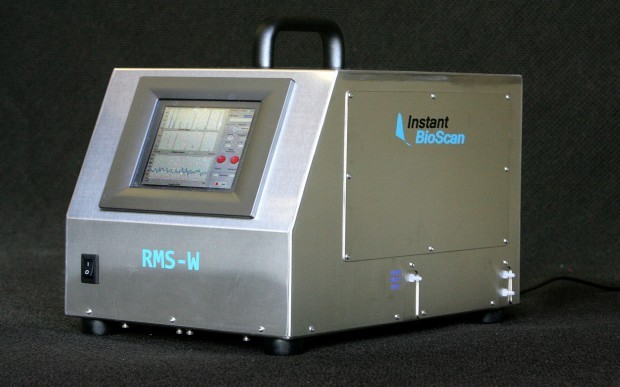
Now, he's looking for new investors to take his latest company to the next level and beyond, with a new optics-based technology to detect microbial contamination in water in real-time.
Manzer's new company, Instant BioScan LLC, is one of two Tucson-area companies to be selected to make pitches to potential investors at Invest Southwest, a regional angel-and-venture capital conference set for Nov. 28-30 in Scottsdale.
The other local presenter is REhnu Inc., which is working to commercialize an advanced concentrating photovoltaic technology developed by University of Arizona astronomer Roger Angel.
Instant BioScan is just the latest venture for Manzer, a high-tech entrepreneur who has developed several companies that have gone on to attract venture-capital investment or have been sold.
People are also reading…
In the early 2000s, Manzer co-founded BioVigilant to commercialize technology to detect airborne microbial contamination, first for military and homeland-security applications and later, for industrial uses like pharmaceutical manufacturing.
The technology - which essentially analyzes laser light reflected from samples to detect and characterize organic particles - is based on methods patented by BioVigilant co-founder Jianping "J.P" Jiang, a physicist and former University of Arizona postdoctoral student in optics.
The company's technology attracted attention and venture-capital money, but in 2009 the majority venture owners, including Battelle Ventures, sold a 70 percent stake in the company to a Japanese firm, Yamatake Corp. (now Azbil Corp.), which now operates the company as Azbil BioVigilant.
Manzer said that the sale prevented him and Jiang from exploring new applications for the microbe-detection technology - including microbial detection in water.
While marketing BioVigilant's airborne microbial detector to potential biomedical customers, the potential for detection in water was a recurring question, Manzer said.
"They kept asking, 'do you have this for water?' " he recalled.
That's a good question - representing a big market.
The market for testing drinking, recreational and industrial water is estimated to be worth some $5.9 billion, the company says.
Instant BioScan's instrument, developed by Jiang and another company co-founder, chief engineer Steve Blomquist, uses a form of laser spectroscopy, in which laser light passed through a thin, flat glass tube is filtered and analyzed to detect the fluorescent signatures given off by microbes.
The instrument can instantly detect when microbial contamination reaches critical levels - measured in colony-forming units per milliliter of water - in real time, as opposed to current hand-culturing methods that can take days.
And because the instrument can be hooked up to receive a constant trickle of water for testing, it can be used for real-time monitoring that can quickly be followed up with more traditional identification methods.
"It's like having a speedometer in a car," Manzer said. "At the water plant, they can look at it and see how each part of the process is performing."
Such inline, real-time monitoring already is used to monitor water for things like pH balance and absorbed oxygen.
Other rapid-response instruments are available for monitoring microbial contamination in food, including some designed to identify specific pathogens. But those typically involve manual labor and reagents (chemicals used to prompt observable reactions or changes).
In the future, the company plans to add microbial identification capabilities with a form of laser spectroscopy - using a device known as a Raman laser, Jiang said.
Manzer said the company is busy building 10 demonstration instruments at its offices and lab near Interstate 10 and West Grant Road, where the company is a client of the tech-development and engineering firm Aztera LLC.
Four of the instruments already have been leased by potential customers for evaluation, Manzer said. The instruments are initially priced for sale at $40,000 each, or about $60,000 for a more sophisticated model designed for the pharmaceutical industry, he said.
The company is looking to raise $500,000 from investors as part of a $2.5 million first round of angel and venture funding, Manzer said.
Manzer's an old hand at pitching investors - in fact, he was the first one to pitch 20 years ago at what is now called Invest Southwest (originally the Arizona Venture Capital Conference).
In 1992, Manzer raised $2 million after making a pitch for Vanguard Automation, which developed an automated soldering process for electronics. In 1997, the company was sold to a new York-based robotics company in a deal then valued at more than $50 million.
Meanwhile, REhnu is busy raising about $1 million in private equity capital to advance its technology, which uses a system of mirrors developed by Angel to focus sunlight on super-efficient photovoltaic cells to create powerful, utility-scale solar farms.
The company has installed a prototype of its second-generation system at The Solar Zone, a solar-energy demonstration site at the University of Arizona Science and Technology Park.
Contact Assistant Business Editor David Wichner at dwichner@azstarnet.com or 573-4181.