

NASA space research has helped drive some of the most important and just plain cool technological innovations of our time, from computers and satellite imaging to freeze-dried food and so-called memory foam.
Thanks to the efforts of a Tucson entrepreneur and former NASA engineer, you can add another one to the list: battery-free, solar-powered refrigeration.
David Bergeron spent several years as a NASA contractor in Houston as the head of the space agency's Advanced Technology Refrigeration Project, working on high-efficiency refrigeration units that could be used in future space missions.
NASA filed for a patent on the battery-free technology in 1999 with Bergeron as co-inventor, and he founded a company to commercialize that and related technologies.
NASA didn't send the technology into space, but Bergeron forged ahead, even after coming to Tucson to work for NASA contractor Paragon Space Development in 2004.
People are also reading…
Bergeron's company, SunDanzer Refrigeration Inc. (www.sundanzer.com), developed a line of high-efficiency, battery-powered and battery-free refrigerators.
Such refrigerators are a critical tool for agencies like the World Health Organization in underdeveloped nations, allowing vaccines and medicines to be stored in remote clinics in hot climates.
But batteries have their drawbacks.
"They'll put four or five hundred units out there in Kenya somewhere, and they come back a year later and they're not working because the battery died. It's not handled well and the temperatures are hot," Bergeron said.
"They wanted to know if it was possible to do something battery-free."
Bergeron, who holds a mechanical engineering degree as well as a master's degree in finance, had moved away from the battery-free technology because the battery units were much better sellers.
But he relicensed the battery-free patent from NASA and developed a model specifically to keep vaccines in the optimal temperature range of 36 to 45 degrees Fahrenheit.
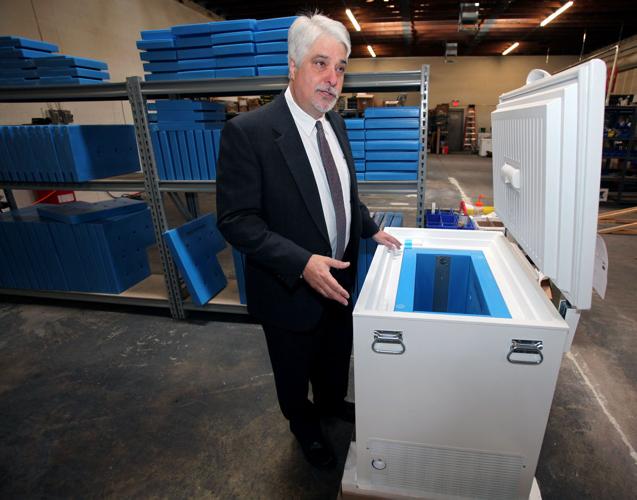
The system combines a high-efficiency DC compressor, special electronics and thermal storage to create a system that can keep its cool when the sun isn't shining.
On the factory floor of his south-side headquarters, Bergeron shows off the thick plastic thermal panels that hold a special liquid medium that has a higher freezing point than plain water. The panels fit flush against the refrigerator walls, and when frozen they can maintain the optimum temperature for about five days, he said.
The vaccine storage model, which was certified by WHO in 2011 for use by affiliated agencies like UNICEF, has sold more than 200 units, Bergeron said.
SunDanzer's success prompted NASA to recently name the battery-free solar refrigerator its 2011 Commercial Invention of the Year, which is awarded to technologies that have produced license revenue for NASA.
The battery-free solar fridge was honored mainly for its potential in keeping vaccines and medicines refrigerated, said Jesse Midgett, technologist for NASA's Inventions and Contributions Board.
"He's gotten around the problem of getting batteries out in the middle of nowhere to people that need it when (batteries) wear out," Midgett said.
Co-inventor Mike Ewert, life-support and thermal systems analyst at NASA's Johnson Space Center, said NASA is keenly interested in the direct solar connection for large-scale applications. Bergeron is working on that, too. Out back at his shop, he's testing solar-powered air conditioning systems on shipping containers under Army research grants.
Those systems could help the military save millions of dollars on fuel deliveries to remote places, which can cost from $10 to $100 a gallon, he said.
But there are still commercial markets to conquer, starting next with a new line of battery-free solar fridges for residential use.
Using a design similar to the vaccine fridge but with thinner thermal packs filled with water, the roughly $1,500 units are just the thing for that remote, off-the-grid cabin.
The company just unveiled an ad in a major magazine for off-grid living, Home Power, Bergeron said.
That should boost growth at the company, which has 12 employees in Tucson, at a residential products center in El Paso and a business-development and finance office in Carmel, Calif., and a small office in China.
Bergeron said he expects about $3 million in revenues this year, a figure that could grow to between $5 to $10 million in a few years if the residential products take off.
"Thousands and thousands of people live off the grid," he said.
Contact Assistant Business Editor David Wichner at dwichner@azstarnet.com or 573-4181.