

To Rocco Termini, putting a new Buffalo Bills stadium in the suburbs again would be a major missed opportunity.
Termini, one of Buffalo's most prominent developers, is pushing hard for a new stadium to be built in downtown Buffalo along the north side of South Park Avenue, rather than in Orchard Park.
Putting the stadium in Orchard Park, he believes, would be a huge mistake – on par with the decision to put University at Buffalo's main campus in Amherst, rather than downtown.
A suburban stadium, he said, would be something the entire community would come to regret .
Termini knows that such a plan would be much costlier than the Orchard Park proposal that is being discussed – to the tune of $1 billion extra.
And he knows that taxpayers from Erie County and across the state – including himself – would have to foot a good portion of that bill.
People are also reading…
But he and architect Benjamin Michael Siegel argue that it would be well worth it in the long run, because of the spinoff benefits of drawing tens of thousands more people to downtown Buffalo – to its hotels, restaurants, bars, entertainment and other activities.
A downtown stadium, he argues, would also be much easier to get people to and from Bills games, with public transportation a more viable option than at a stadium in Orchard Park.
"This is the time to do it. We always think small, instead of thinking big. Now we have an opportunity, and we’re cheaping out," Termini said. "This would be a game-changer for downtown."
He's already got an ally in the Common Council, which passed a resolution to that effect earlier this week, and now he's seeking to build support more broadly.
And contrary to the skepticism about potential parking and traffic, Termini insists that it could work, not only as well as the current site, but better because of the nearby parking lots and ramps, easy highway access and both Metro Rail and Amtrak trains within walking distance.
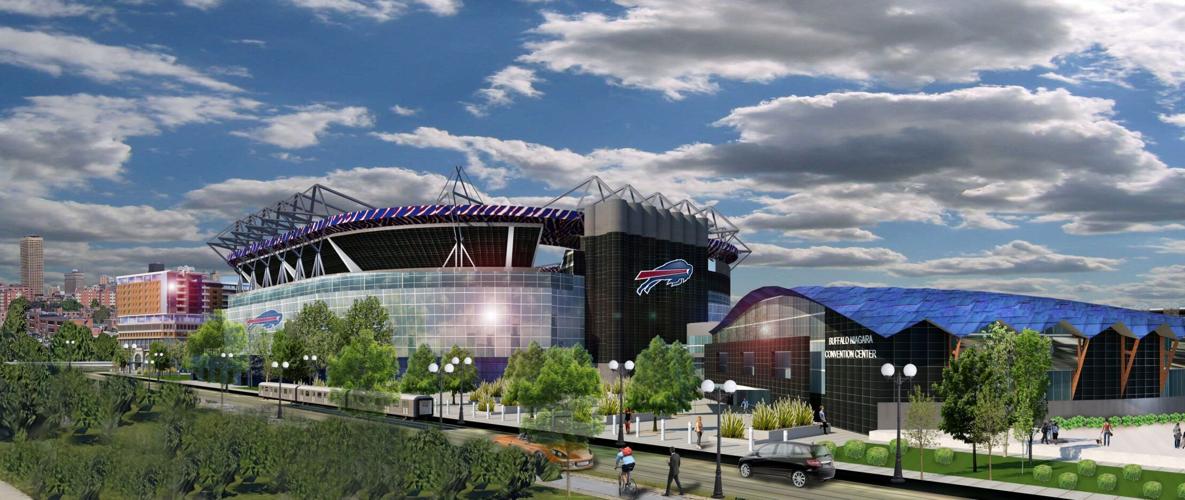
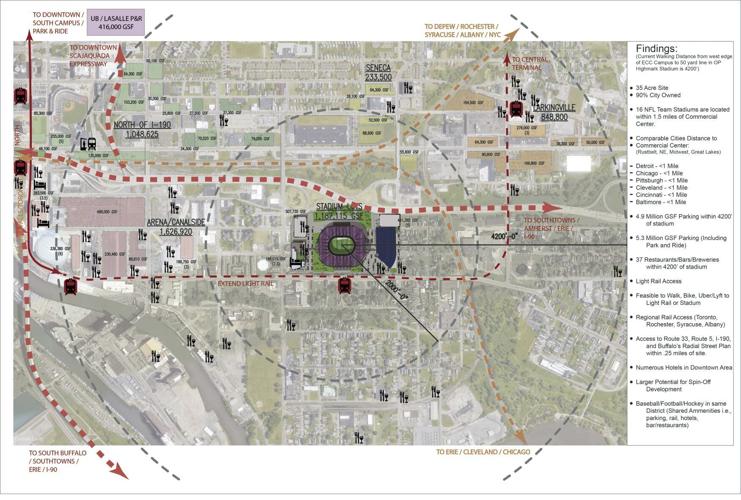
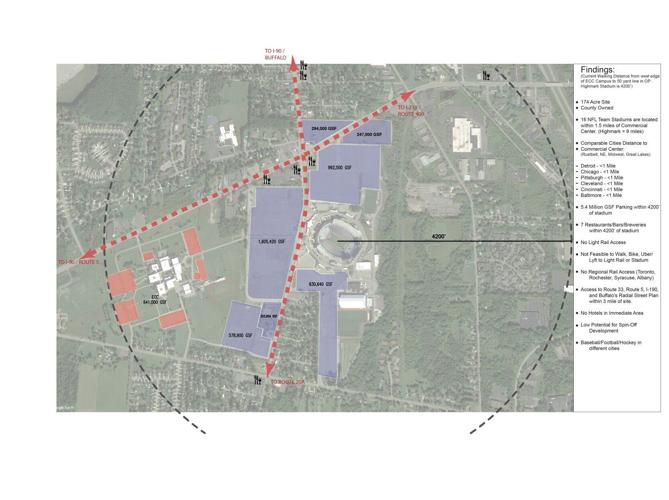
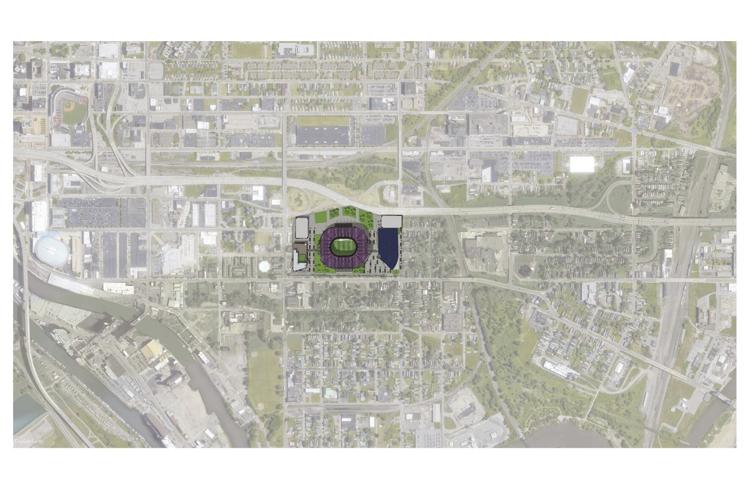
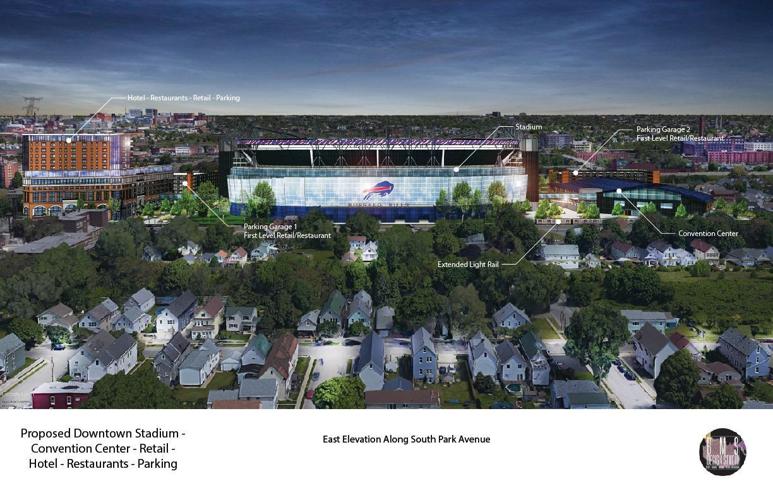
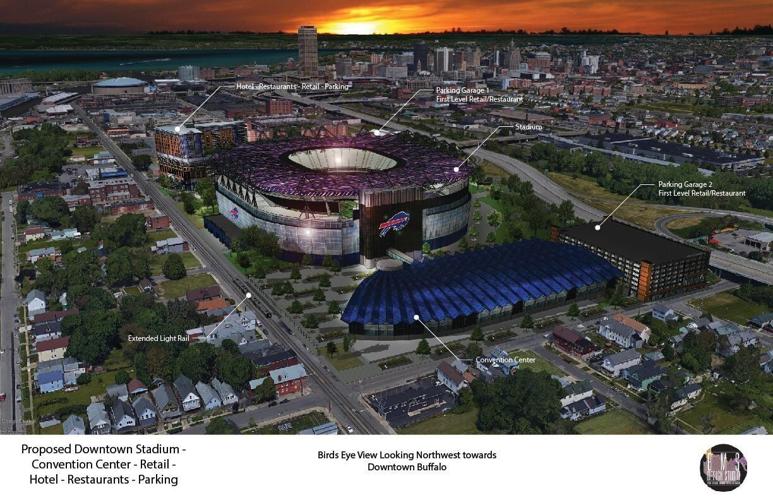
They've even taken to the drawing board to prove it, using visual diagrams, maps and renderings with placeholders to show what it could look like and how it would fit in.
The lobbying by Termini and Siegel is the latest effort to sway decision-makers toward a downtown stadium. Both also say they are doing it on their own initiative, as advocates for the city, and are not being paid or seeking any personal gain, although Siegel does work for Termini's Signature Development and shares office space with Termini's team.
Their effort comes as the region awaits the results of a state study of stadium options, which has been ongoing for several months. That study follows a separate report that was commissioned by Pegula Sports & Entertainment, the holding company that manages the Buffalo Bills for owners Terry and Kim Pegula. The PSE study has not been made public.
PSE spokesman Jim Wilkinson declined to comment.
Those reports are expected to tilt in favor of the Orchard Park site, largely because of the significant cost differential – estimated by PSE to be $1.4 billion versus $2.5 billion for a downtown stadium.
PSE executive Ron Raccuia previously said that the company narrowed 10 to 12 different locations down to the Orchard Park option as the “fiscally responsible” and “economically efficient” choice.
Termini and Siegel don't dispute those cost estimates. In fact, Siegel admits he prefers spending $500 million to renovate the current stadium, rather than what he sees as "a bad way to use public dollars." But if a new stadium is going to be built, he said, it should be downtown.
That's what many other NFL cities have done, including Cleveland, Pittsburgh, Detroit and Chicago. In all, 16 NFL stadiums are within two miles of the city center.
"I agree that it would be more expensive to build in the city, but the spinoff development part would be huge," Siegel said. "We have to be creative with ways of paying for it and realize it’s not a sunk cost. It’s going to take years and years, decades, to get the full return on investment from it. But in the long run, just like most cities have seen, it does help the economy, the neighborhood and the city."
The site targeted by Siegel is a short walk from the Cobblestone District, HarborCenter, KeyBank Center, and Canalside. It's bounded by South Park and Louisiana, Hamburg and Perry streets, south of the I-190 expressway and exit ramps. The site includes the deteriorating Commodore Perry public-housing community.
The land is already largely consolidated in city or Buffalo Municipal Housing Authority hands. Significant other portions are vacant sites, while a few properties are owned by Ellicott Development Co. Only a handful of parcels are privately owned and occupied, including the Mercy Comprehensive Care Center, the Schofield Adult Day Health Care Program, a retail plaza with a Family Dollar, and a bar. Termini does not own any of it.
Under Siegel's mock design, the site would include the stadium in the middle, with a replacement convention center and five-story parking ramp next to it on the east along Hamburg Street. Then, there's two more structures – on the west side along Louisiana – of five stories and 2.5 floors, respectively, with parking and potentially retail stores and a hotel. All told, there's 1 million square feet of parking.
Currently in Orchard Park, there's 5.3 million square feet of surface parking within a walking radius of three-quarters of a mile from the stadium, Siegel measured.
In examining the same radius of the proposed downtown site, Siegel found 4.9 million square feet of surface and ramp parking, including in the Cobblestone district, Canalside, Seneca Street and the area north of the I-190, and Larkinville, plus Riverworks and Ganson Street. Add in the park-and-ride lots at the UB South Campus and LaSalle Metro Rail stations, and the tally matches what's available in Orchard Park, Siegel said.
The Exchange Street Amtrak Station offers a way for travelers to come in from the suburbs, Rochester, Syracuse, Albany, Cleveland or Canada, with an onsite hotel and two others nearby at Canalside to accommodate them. Orchard Park has none of that, he said.
There are also 36 bars, restaurants and breweries within 4,200 feet of the downtown site, compared to seven in Orchard Park – and no large hotels.
Then there's the roads. In Orchard Park, the highways and interstates ultimately feed traffic into two main thoroughfares – Southwestern Boulevard and Abbott Road – both of which get heavily congested for games.
In downtown Buffalo, the I-190 is a block away, the Oak/Elm Street corridors feed into the Kensington and the 190, Route 5 heads south and the city's radial streets take traffic to the north and east.
"It's actually very efficient," Siegel said. "Everyone has been worried that traffic is going to be crazy, but how many people leave the city every day at 5 p.m.? So it's not that we can't handle it."


