

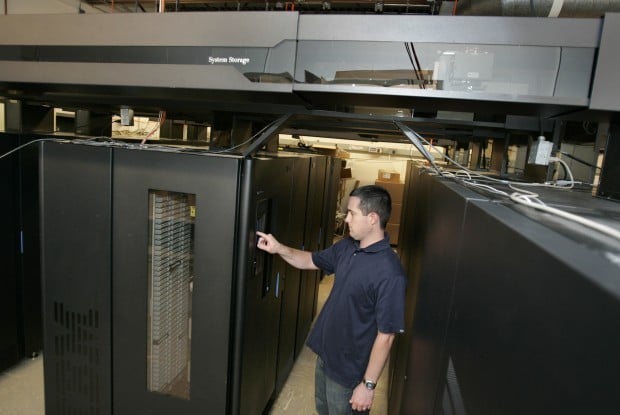
As IBM Corp. approaches the celebration of 100 years in business next month, the scientists and engineers at IBM's storage-technology development center in Tucson are still busy innovating.
IBM recently unveiled its latest round of new storage products and product improvements developed in Tucson, including a new robotic tape-retrieval system.
And though the Tucson facility at the UA Tech Park is less than half the size it was in its heyday in the mid-1980s, before manufacturing operations were moved out, it's no less important to Big Blue today, said Cindy Grossman, IBM vice president and site executive for the local operation.
"The hub of storage development is still in Tucson," said Grossman, who'll mark 32 years with IBM when the company celebrates its centennial on June 16.
"It's a core site for us, and we continue to innovate here, and we continue to be part of the community here," she said, adding that local IBM employment has remained stable at about 1,350 workers.
People are also reading…
Tape is still the medium of choice for large data-backup needs, Grossman said, noting that IBM is the leader in tape storage, with a market share of about 40 percent.
IBM is second to EMC Corp. in disk-based data-storage products, says the market-research firm IDC.
In what has become an annual rite of spring, IBM earlier this month announced a lineup of new data-storage products and product enhancements:
File robot
It's one thing to develop a new tape system with huge data-storage capacity, but getting to that information quickly is another matter.
To give clients quicker and more-efficient access to tape archives, IBM unveiled the IBM System Storage TS3500 Tape Library.
The system features new, IBM-developed "shuttle" technology that uses a robotic car that travels on an overhead rail system to pluck a tape cartridge from the top of one file library - a frame of tapes and drives - and insert it into another across the room.
Some modern tape libraries feature robotic tape movers, but moving tapes between libraries typically has a "Rube Goldberg" system of tape handoffs, said David Hill, a market analyst and principal in the Mesabi Group near Boston.
"It's a little like a connecting flight, where this (new IBM shuttle system) is a direct flight," Hill said, borrowing from IBM's description.
Such a system could be particularly useful when so-called fixed-content data, such as images, needs to be moved from one area to another, he said.
Adding zeroes
In its continuing quest to squeeze more data into its storage systems, IBM has created the industry's first tape library system to provide more than 2.7 exabytes of data - enough to store nearly three times all the mobile data generated in the U.S. in 2010. (An exabyte is 1 followed by 18 zeroes).
The TS 1140 Enterprise Tape Drive holds 2 million times the data stored by the world's first commercial tape drive, the IBM 726 Magnetic Tape Recorder - counted among the 100 top milestones in IBM's century-long history - which could store just 2 megabytes of data in 1952.
The new drive boasts 80 percent greater performance than comparable drives offered by competitor Oracle Corp. while using 65 percent less energy, Grossman said.
"Energy (usage) is something many clients are very, very concerned about," she said.
Among the other new offerings, IBM announced the Linear Tape File System Library Edition, which allows users to view file location and other information in a familiar directory format; enhancements to IBM's Scale-Out Network Attached Storage (SONAS) system that allow greater data-processing speeds and automatic migration of data to tape storage; and new options for data deduplication, a method of stripping out duplicate data.
Contact Assistant Business Editor David Wichner at dwichner@azstarnet.com or 573-4181.
