

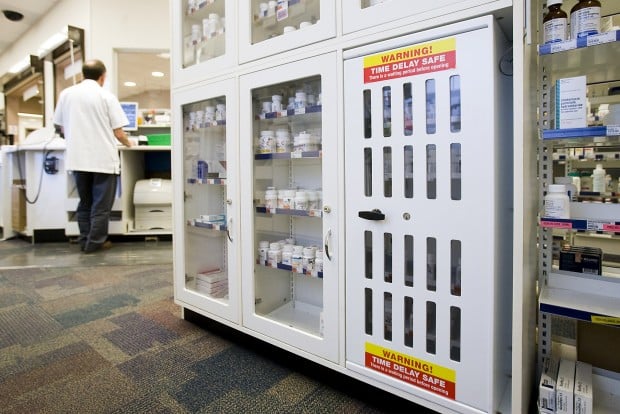
Tucson is not known as a hotbed for prescription-drug thefts, but that hasn't stopped Walgreens from installing new cabinets designed to deter drug thieves.
The drugstore chain has installed time-delay security cabinets in all of its Arizona stores, with company officials saying the cabinets will protect its inventory of Oxycontin, oxycodone and other prescription drugs commonly targeted by thieves.
"This time-delay approach will help minimize pharmacy robberies in Arizona stores by eliminating the immediate availability to robbers of the prescription drugs they seek the most," company spokesman Robert Elfinger said in an email.
If a potential thief or robber goes to the pharmacy and demands one of the drugs, the pharmacist will press a button to activate the cabinet, which will remain locked for several minutes before it can be reopened.
People are also reading…
This would give police enough time to respond if the criminal chooses to stick around.
It also will allow the store's security cameras to take more footage of the thief, which would aid law enforcement, said.
The light-colored cabinets are adorned with red and yellow stickers that have the words "Warning: Time Delay Safe" in large letters.
Walgreens borrowed the concept from banks and other retailers that use time-delay devices to protect money, he said.
"In our pharmacy application, we are simply limiting immediate availability of prescription medications as opposed to money, which again raises the risk of being caught and eliminates the reward to a would-be robber," Elfinger said.
The company installed the cabinets to combat what it describes as an "upward trend" in robberies.
There have nine robberies and attempted robberies in Tucson and 47 incidents in Phoenix within the last year, he said.
Walgreens began installing the cabinets in its Washington state stores in 2009.
The company also put the cabinets in its stores in Portland, Ore., Knoxville and Chattanooga, Tenn., and all Colorado stores between 2010 and 2012, he said.
According to company figures, all of those stores have experienced an 84 percent reduction in thefts since they received the cabinets.
The company has not had any reports of robbers becoming aggressive and threatening harm because the cabinets are locked, he said.
"There have been no safety issues in any other markets," he said later in a phone interview.
Pharmacy employees have specific instructions on how to deal with those incidents, but Elfinger would not elaborate.
The cabinets are a proactive method of deterring thieves while safeguarding employees and customers, said Sgt. Maria Hawke, a Tucson Police Department spokeswoman.
"We see it more as a deterrent, very much like a security guard standing in front of the store," Hawke said.
Police are not concerned about an increased safety hazard for pharmacy employees because prescription-drug thefts are not common in Tucson, Hawke said.
"We don't really have a lot of those types of crimes. It's probably less of a concern," she said.
"We see it more as a deterrent, very much like a security guard standing in front of the store."
Sgt. Maria Hawke, a Tucson Police Department spokeswoman
Contact reporter Jamar Younger at jyounger@azstarnet.com or 573-4115.