

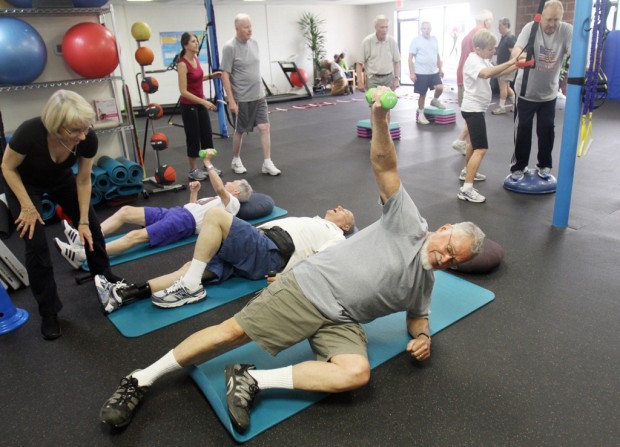
There's an exclusive new gym in town.
The Parkinson Wellness Recovery Gym, 134 W. Fort Lowell Road, opened in March and is aiming to change the way Parkinson's is treated.
Plenty of studies point to exercise being beneficial to Parkinson's disease. Some research indicates exercise slows the disease and improves brain health, including research Becky Farley, the gym's founder and CEO, has done herself.
For Farley, a neuroscientist and physical therapist, creating a space for Parkinson's patients to do research-based exercise seemed obvious, but others just weren't doing it. There are places that offer some classes, and in Indiana there's a no-contact boxing gym for people with the disease. But there isn't another gym specifically for people with Parkinson's that is applying this research, she said.
She started the Parkinson Wellness Recovery Gym (PWR) about three years ago in a small space inside Tucson's Mid-Valley Athletic Club. The PWR classes had to work around the gym's schedule and there wasn't enough room.
People are also reading…
The new space allows the gym to be used as a model center to show what happens when the research is applied, Farley said.
"This is the best thing that ever happened to Parkinson's," said Saul Rutin, 77, who was diagnosed about six years ago.
Since coming to the gym, he is able to button his left sleeve, which he said is "phenomenal."
His wife, Dian, said his neurologist told them Saul's Parkinson's is progressing much slower than what is expected.
"This is like medicine," Dian said. To Saul, a licensed pharmacist, "it's as important as medicine, maybe even more," she said.
IMPROVEMENT NOTED
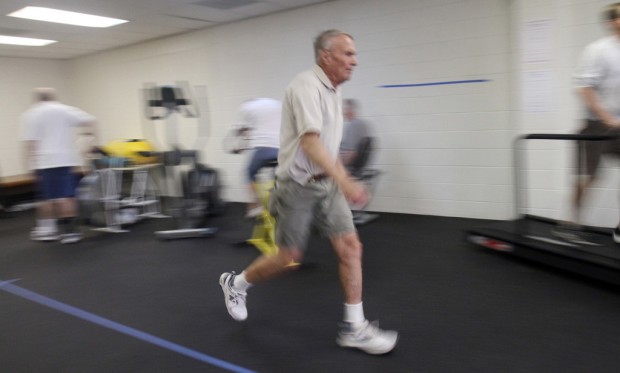
The gym is a great program that many of his patients benefit from, said Dr. Scott Sherman, director of the Movement Disorder Clinic at the University of Arizona. He said he has definitely noticed improvement in patients' symptoms particularly in how they walk.
"Becky knows a lot, has worked in the field of Parkinson's for a long time and she's really fought to find a scientific basis to what she's doing," Sherman said.
With Parkinson's, the internal motivator dopamine decreases. Without it, people have apathy and are not able to recognize when they move correctly, Farley said.
That makes encouragement and feedback a big part of the gym.
"You can't learn if you don't know when you do a good job, and you can't learn if you don't know what to change," Farley said. "So we give a whole lot of feedback."
Wes Ulmanek, 76 and diagnosed about a year ago, has been going to the gym for six weeks. He comes five days a week and said he has more flexibility, balance, stamina coordination and confidence. Six weeks ago, he couldn't jump. Now he can.
"You got to have someone pushing you," Ulmanek said, noting how important it is to stretch your muscles until they hurt.
One exercise done at the gym is bounding, where patients spring across the room using large strides while swinging their arms big. Ulmanek couldn't do this four weeks ago.
"Wow, what a difference," said Krystal Greene, PWR gym clinician, personal trainer and nutrition expert, when talking about Ulmanek's progress.
Greene is known for her "tough love" and doesn't hesitate to yell out "Lame!" when the circuit class winds down with a big breath that isn't big enough for her standards.
The group exhales again and this time is met with cheers.
High-fives are exchanged.
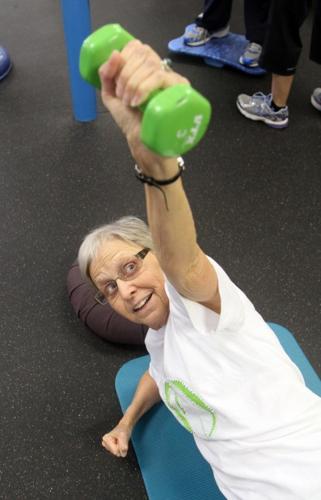
Farley's method, Exercise4BrainChange, challenges patients both physically and mentally through exercises that force them to not only move but also think about how they move.
Among the exercises: going through obstacle courses while answering questions and sidestepping to a beat.
At their new facility, the gym has more equipment. In the future, there will be bungee equipment hooked to the ceiling so that patients can move and jump around without fear, Farley said. Right now the building's beams have various resistance bands to hold on to and straps that allow patients to sway and move about in ways that they wouldn't feel safe doing otherwise.
There are classes every day except Sunday and there are options for all levels. Each person is assessed before beginning at the gym. Patients can do one-on-one therapy, small or big group classes.
People come from across the country for the gym's "surges," which are three days of intensive sessions at the gym, Farley said. The price is about $800.
"They come in with no confidence and no one's told them they could get better or what they can do," Farley said. In the surges, the gym's physical therapists teach them how to move again, give them ideas to take back home and help them regain their confidence, Farley said.
GYM BECAME A NONPROFIT
The gym became a nonprofit last year, Farley said. It has seven employees and eight regular volunteers.
For its first fundraiser as a nonprofit, Tim Bowden, 66, who was diagnosed five years ago, plans to do a 15-mile hike up Mt. Lemmon today.
He raised $10,000 last year for the gym, before it became a nonprofit, doing the hike. This year he hopes to raise the same amount.
Farley's method has allowed him to continue to do the things he loves, he said.
Not too long after he was diagnosed, Bowden felt uneasy about a 3-mile hike they had planned to do, said his wife, Diane.
"That would never happen today," she said.
Farley was in North Carolina recently training physical therapists and YMCAs in the state so they can use her method and start collecting data. She travels about a week or two each month training physical therapists about exercising in a way that changes the brain for the better. There is a lot of interest in the method, Farley said, and she would like the gym to become a training site.
She hopes to start collecting data at the PWR Gym in July. If the gym's research shows that people are likely to fall less often and will need fewer medications, she hopes insurance will be more likely to cover proactive approaches like the gym.
"I just can't not do it," Farley said. "There's so much data that it's shameful that our health-care system and our research paradigms are not keeping up with the data."
"This is the best thing that ever happened to Parkinson's."
Saul Rutin, 77, who was diagnosed about six years ago
Bethany Barnes is a University of Arizona journalism student who is an apprentice at the Star. Contact her at starapprentice@azstarnet.com or 573-4117.