

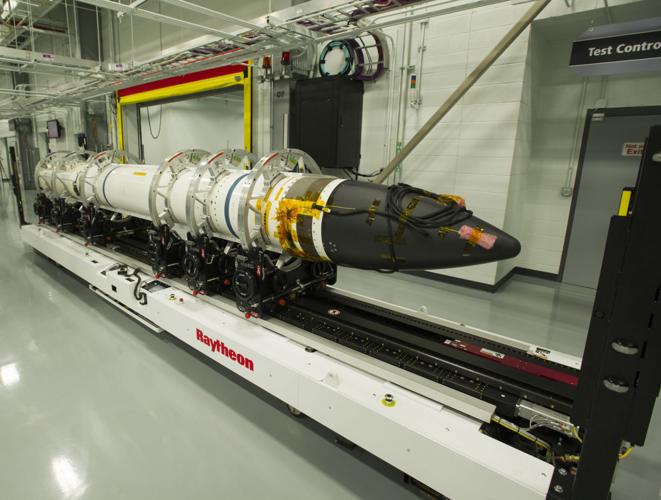
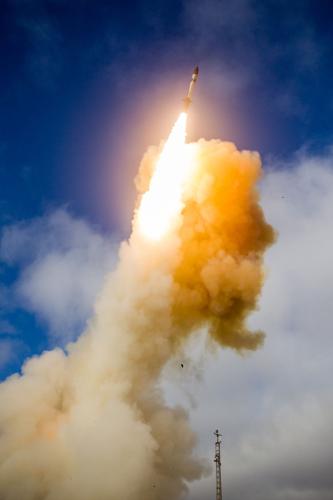
The Missile Defense Agency awarded Tucson-based Raytheon Missile Systems an $87 million contract to purchase long-lead materials needed to produce the newest version of the company’s Standard Missile-3 ballistic missile interceptor.
The contract announced Wednesday funds enough lead material purchases to make up to 17 Standard Missile-3 Block IIA missiles for testing and initial deployment, Raytheon said in a news release.
A follow-on contract for the additional materials, parts and components is expected by early 2016, the company said.
Co-developed with Japan, the SM-3 Block IIA is on track for deployment in 2018, Raytheon said.
Earlier versions of the SM-3 already are deployed with the sea-based Aegis Ballistic Missile Defense system as part of the U.S. missile shield for Europe.
People are also reading…
The longer-range SM-3 Block IIA has bigger rocket motors and a larger, improved kill vehicle that allows it to destroy threats earlier in flight and protect larger regions, Raytheon said.
The U.S. is building a land-based version of the system, dubbed Aegis Ashore, in Romania that is expected to be operational this year with the SM-3 Block IB version. The MDA plans to use the Block IIA version aboard ships, at the Aegis Ashore site in Romania and at another planned land-based station in Poland by 2018.
Raytheon Missile Systems President Taylor Lawrence lauded Japan for its support of the Block IIA program, adding in prepared remarks that the partner nations have “taken ballistic missile defense to the next level.”
The SM-3 Block IIA is the only ballistic missile defense interceptor that can be used at sea or on land with no modification to the missile, said Amy Cohen, Raytheon’s Standard Missile-3 program director.
Raytheon, the region's biggest private employer with more than 9,000 Tucson-area workers, says it has delivered more than 230 SM-3s to date.