

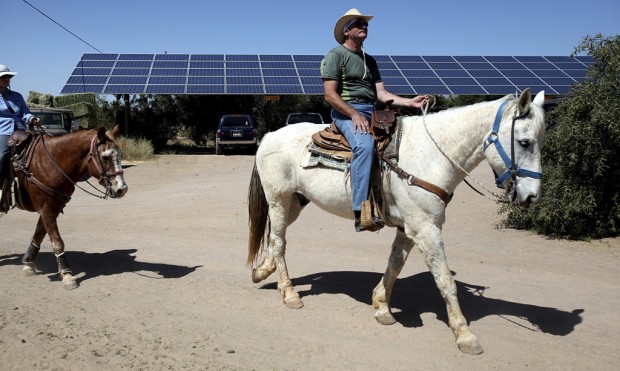
For nearly 50 years, the White Stallion Ranch has relied on Southern Arizona's unwavering sunshine to help bring in business.
Many of the 4,000 tourists who flock to the Old West-style guest ranch annually to ride, rope and play cowboy decide on the Stallion because of the good weather, especially during peak season, said co-owner Russell True.
These days, the sun is doing much more for the place than providing a selling point for potential visitors.
For a little more than a year, the White Stallion, nestled along the Tucson Mountains, at 9251 W. Twin Peaks Road, has depended on solar power to help with its day-to-day electrical needs.
Multiple solar structures, erected by the Oro Valley-based company Solar Path, line the north end of the 3,000-acre compound and come in different shapes and sizes.
People are also reading…
Some are large enough to be used as shaded parking by ranch staff.
Others appear as staggered "solar trees," large stand-alone structures clustered in groups along the graded dirt road that leads to the main facility.
A third set sits atop the bunkhouse where staff members live.
'Produced as promised'
Most of the solar structures are out of sight from visitors, built just beyond the horse corral and tack room, though guests have noticed.
"Our goal was to make a small part of the project visible," said True, who runs the ranch with his brother Michael and Michael's wife, Kristin True. "We knew it would resonate with our guests. They have been very enthusiastic."
Russell True estimates the panels - 480 in all - take care of 40 percent of the electrical needs in the winter and 30 percent in the summer, and have saved the ranch an estimated $20,000 over the last year.
The electricity created helps power the 45 guest rooms, the bunkhouse and the well pump, which supplies water to the ranch's visitors, staff, cattle and more than 130 horses.
The solar system also helps the environment.
A month-long study conducted by Solar Path in May revealed the ranch offset more than 43,000 pounds of carbon dioxide from being generated by coal power.
"In the short term, it has produced as promised," True said.
Incentives clinched deal
The ranch, which has been owned by the True family since 1965, had long been searching for alternate energy options.
When True came across Solar Path at a business luncheon a few years back, he was sold, except for the $595,000 pricetag.
The recession was already in full swing and that was a lot to invest during a down economy. "It took us a while to decide," True said. "We were twitchy about it. It was the fear that comes with uncertainty."
True said the incentives offered clinched the deal.
Tucson Electric Power paid half of the bill upfront.
Federal and state tax incentives will help make up the rest of the cost over the next three years.
The entire construction process took three months.
"The construction job came second to making sure the horses didn't get spooked," said Joseph Brown, solar design and project architect with Solar Path. "We had to keep a person on watch when we knew people were riding to warn us and reduce noise."
Otherwise, he said, it wasn't that different from most large commercial jobs.
"You just had to watch where you stepped every once in awhile," he joked.
Guests enthusiastic
Brown said while federal and state incentives have remained more or less the same, TEP has since reduced the amount of upfront incentives it offers for small commercial projects.
For True, the benefits of going solar have surpassed saving money and minimizing the ranch's carbon footprint. The general interest from guests, many from overseas, has been just as invaluable.
"Most of our guests are pretty informed, involved, caring-about-the-Earth type people," True said. "They feel better about their vacation because they like the renewable-energy aspect."
Did You Know?
White Stallion Ranch started as a cattle ranch in the early 1900s. It was converted into a guest ranch in 1940 by former Chicago liquor store owner Max Zimmerman and purchased by the True family in 1965. See wsranch.com for more info.
This article also was published Thursday in the Star's Northwest section. Contact reporter Gerald M. Gay at ggay@azstarnet.com or 807-8430.