

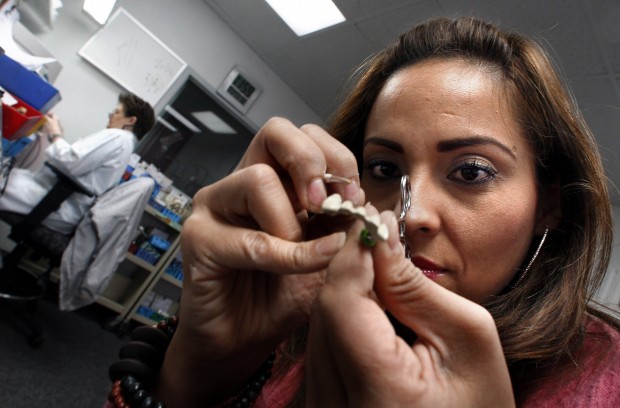
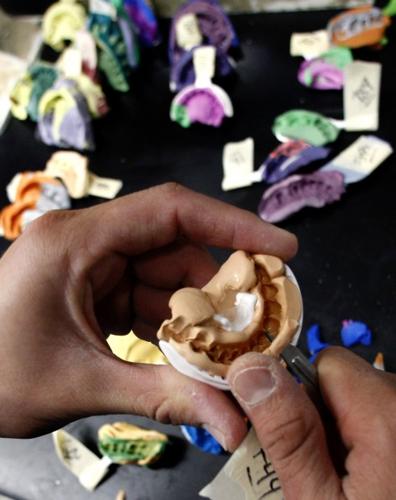
Dental Prosthetics Inc. is a local company making crowns, dentures and laminates for local dentists and their patients, but competing with everything from one-person local shops to factory-sized Chinese labs.
There is no single answer to beating them all. But hyper customer service, obsessive nitpicking about quality and a variety of production methods and pricing seems to be working, said general manager Andy Herr, son of founder and owner Wendell Herr.
He said the 40-year-old company grew from a two-person operation to today's large, modern facility with 35 full-time employees at 4545 E. Fort Lowell Road, strictly by word of mouth.
The lab's work is a combination of ancient labor-intensive technology - lost-wax-method casting - and combinations of the latest innovation - laser-scanned impressions fed to a computer-aided design/manufacturing program, to a robotic, computerized numerical-control milling machine that spits out a precise crown body.
People are also reading…
The labor-intensive part of the operation - particularly in making dentures and color matching porcelain to the patient's natural tooth shade - is still hard to beat with even the latest machines, said Herr and John Anderson, who is known as the company's director of client success.
Anderson started out as a technician and now does what he must in order to live up to that title. That includes monitoring the dentist customers' satisfaction by asking them to fill out a quality-of-product-and-fit card on every item they get from Dental Prosthetics.
Some dentists, Herr said, are priced out of the company's services by the set prices paid by insurers. But Herr said attention to detail, especially on the fit of crowns, can give the local company an edge, even when it is beaten on price by giant factory labs in California and China.
Saving a dentist time during a crown procedure is worth the money.
"Putting a crown in, it can mess up your schedule. Their crowns go in in about five minutes with very little adjustment," said Harry Reece, a Tucson dentist and 10-year Dental Prosthetics client.
Reece said fitting a poorly shaped crown could take a half-hour, or more. When that happens, he said, "there goes my day."
"Their premise is if my crown goes in in 10 minutes, it makes me more productive. Patients are more satisfied."
Reece said he's also a fan of the company's practice of sending over a technician to be there chairside on particularly tough cases.
Reece said he had a particularly tough case in which a man wanted major work done on his front teeth, an eight-month project. Reece said having the technician actually see the patient and the angle of the teeth being replaced, not just a casting, made the various pieces work together and improved the outcome.
Herr admits engaging in a bit of industrial espionage, occasionally sending off impressions to big U.S. and Chinese labs.
"We send a model off and get it back and ... generally ... ," Herr said with some hesitation, the product doesn't measure up with Dental Prosthetics Inc.'s. He said he knows it sounds self-serving, but the precision of the crowns that come back from the big labs is off enough that it would force a dentist to spend more time fine-tuning the fit while the patient sits, mouth agape, blinded by that light.
"Ninety-five percent of our business is right here in Tucson," Herr said.
"We want to go to Phoenix, but one thing we do really well is service" - and he questions whether they could offer the chairside support they offer in Southern Arizona to Phoenix without being there. "Sierra Vista is close enough if there is an urgent issue," he added.
In an area at Dental Prosthetics, automated machines toil under the supervision of Robert Bourland.
Their company's latest machine, the 3M Lava system, makes a "coping" - the core or body of the crown that the dentist will glue to the "cut down" remainder of the patient's real tooth after a porcelain, or gold, coating, is fused to the coping.
The Lava system uses zirconia, a tough ceramic oxide of the metal zirconium, to make the coping. The heart of the system is a large enclosed machine similar to a computerized numerical-control (CNC) milling machine. The mill's spinning tools carve a coping out of a small block of zirconia using the instructions from the CAD/CAM program.
Despite the latest machines' laser-accurate shaping, tinting the porcelain surface of crowns, partials (bridges) and dentures is still an art.
In another part of the building techs match the dental appliance's color to the patient's natural tooth color. It's not as easy as matching paint chips, Anderson said.
The color must be applied on the surface of the coping before the porcelain surface is bonded. Porcelain is translucent, so the color will show through, and the technician must know what the tinting will look like when it shines through porcelain.
Not only that, but our teeth are not the same color throughout. "They're whiter near the edge," Anderson said.
Things are further complicated when the porcelain is applied. "Porcelain shrinks when it's fired," Anderson said, "so we have to build (the coping and porcelain) so it shrinks down to the right size.
"We have a 95 to 96 percent success rate on fit," Anderson said. "Sometimes, it amazes me."
The potential for error, whether handmade or machine-made, continues throughout the two-week process. It starts with the impression - that mouthful of goo the patient must chomp down on in the dentist's chair - and continues through a dozen or more steps that produce the crown or other dental appliance that a dentist will install in a patient's mouth.
Herr and Anderson said the feedback cards from the dentists, and following up on them, is the key.
Further automation, when it does come, won't end craftsmanship, either, said Herr.
"We have not replaced any one employee yet with a machine. Volume has definitely gone up. It has increased quality."
In fact, he's looking into opening a dental-prosthetic technician-training program next door to the company's Fort Lowell headquarters.
The plan is to "train people from the ground up" in the company's procedures.
"We have a 95 to 96 percent success rate on fit. Sometimes, it amazes me."
John Anderson,
Dental Prosthetics Inc. executive
Contact reporter Dan Sorenson at 573-4185 or dsorenson@azstarnet.com