

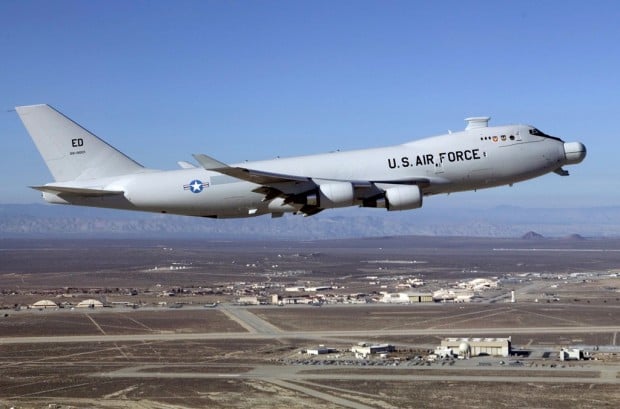
Work has ended on a futuristic airborne missile-defense system built mostly in Southern California after more than 15 years of development and $5 billion in federal funding.
In what was once considered the stuff of science fiction, the airborne laser program involved a Boeing 747 jumbo jet equipped with an advanced tracking system and a massive laser gun on its nose to identify and obliterate enemy missiles as they blast off.
It was conceived as part of a multibillion-dollar defense system that would shield the U.S. from missile attacks. But the program experienced a series of cost overruns and delays. It never went beyond testing.
The program began in 1996 and was a major economic boost for Southern California, where much of the high-tech system was developed and tested. At its peak, the program employed hundreds of physicists, chemists, computer scientists, aerodynamicists and engineers across the Southland.
People are also reading…
But after years of development and testing, funding dried up, and the 747 took off from a runway at Edwards Air Force Base in the Mojave Desert for the last time.
The jumbo jet was sent in February to the military aircraft "boneyard" at Davis-Monthan Air Force Base, where it will be kept in storage, the Air Force confirmed.
The conclusion of the program "represents the end of a historic era in airborne directed-energy research, not only for Edwards Air Force Base, but for the Department of Defense at large," said Lt. Col. Jeff Warmka, the director of the Airborne Laser Test Bed Combined Test Force at Edwards.
The Pentagon's Missile Defense Agency, which oversaw the airborne laser program, had asked Congress for more funding for this year but didn't receive enough to keep the program going.
"In the current environment, there's not a lot of money going around," said Debra Christman, an agency spokeswoman. "We didn't have the funding to continue flying the aircraft."
She said the program had achieved its goals and reached the end of the contract.
The ambitious airborne laser program involved a heavily modified Boeing 747 jet carrying a chemical laser. The plane shot a super-heated, basketball-size laser beam out of a rotating nose turret at a missile traveling 4,000 mph.
It was powerful enough to destroy targets in seconds. It was designed to wipe out the missile and send the warhead falling back onto the enemy launch site.
The airborne laser had its first major success in February 2010, when it shot down a Scud-like missile launched from an ocean platform over the Pacific near Point Mugu, Calif.
It took just a few seconds for the beam to create a stress fracture in the missile, causing it to split into pieces, the Missile Defense Agency said. But Pentagon officials declined to say how far the aircraft was from the missile, saying the information was a military secret.
After the success, the program was plagued by a series of technical problems that delayed a follow-up missile test for months. When the follow-up test finally occurred, a software glitch caused the laser to miss the desired mark on the target missile.
The error came at a crucial time because government spending had been under intense scrutiny from Congress.
DID YOU KNOW?
The 309th Aerospace Maintenance and Regeneration Group (AMARG) next to Davis-Monthan Air Force Base is known as the "boneyard." It is there that the government sends its aircraft destined for salvage or restoration. Tucson's dry climate helps prevent corrosion.
More photos
See photos of the laser aircraft arriving in Tucson at the 309th Aerospace Maintenance And Regeneration Group on the group's Facebook page at tinyurl.com/6qeua66