

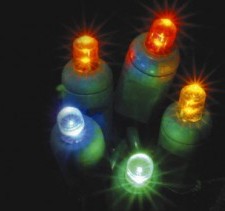
A white Christmas is a bit of a long shot in the Old Pueblo, but it may be just the place for a "green" one. Growing options for holiday lighting - including energy-stingy LEDs and even solar-powered Christmas lights - can help consumers save energy - and perhaps some money in the long run.
Solar lights
Solar-powered holiday lights made their debut a few years ago, and a limited selection has found its way onto the shelves of such big-box retailers as Target, Home Depot and Lowe's.
Solar lights typically use LED (light-emitting diode) lamps, which need less power than traditional incandescent lights. They feature a small solar panel for each string of lights, a battery (mainly lithium-ion) to store the sun's energy, and a sensor to automatically turn them on at dusk and off at dawn.
Why solar?
People are also reading…
Solar Christmas lights appeal to people who want to cut their power usage, help the environment and avoid running a lot of extension cords, said Jennifer Keller, editorial director of the product-review website www.solarchristmaslights.org
Keller said the desire to "go green" with free energy from the sun is a factor, but eliminating the need for power cords is huge.
"The extension cords are a very real issue to many people; they are unsightly and one more hassle when rigging up your decorations - especially for people who really go all-out with decorating," Keller said.
If you're going to go solar, sunny Arizona is the place to do it. Solarchristmaslights.org notes that solar-powered lights may not charge fully under gray skies, making them glow dimmer or poop out early.
Price of going green
Solar lights may keep your electric meter from spinning quite so fast, but their prices are so high that your lights may wear out before you recover their cost.
Solar lights sold locally at major retailers cost about $13 to $20 per 50-light string, or about $30 per 100-light string (depending on style and brand).
On average, 40 feet of solar LED Christmas lights costs $35, according to Solarchristmaslights.org
By comparison, a 100-light string of old-style incandescent lights costs as little as $3 to $6, while plug-in LED lights run about $15 to $25 for 100-lamp strings or their equivalent in 50-lamp strings.
For example, Target, which has one of the larger selections of solar lights, offers 50-light Philips solar strands and 3x4-foot netted lights for $19.99, and stake-mounted globe and snowflake lights for $12.99 and $14.99, respectively.
Home Depot and Lowe's carry General Electric solar lights, such as 100-lamp icicle-style strings ($29.97 at both stores).
Some websites, such as SolarSanta.com, offer a larger selection of solar holiday lights.
LED lights
Holiday lights using energy-efficient LEDs - light-emitting diodes - broke into the mass retail market about five years ago and now comprise about half of the market, analysts say.
Home Depot started selling LED Christmas lights in 2006 and says its sales have grown each year.
In the last few years, sales of LED holiday lights have grown from an estimated 25 percent of the market to right around 50 percent by value and, probably, by unit volume, said Jagdish Rebello, principal consumer electronics market analyst at IHS iSuppli Market Intelligence.
Solar Christmas lights are an extension of the trend toward solar landscape lighting, which has become cheap and widely available, Rebello said. The growth of LED holiday lighting is reflected in stores like Walmart and Target, where LEDs now comprise about half of the holiday-lighting aisle.
Prices dropping
The price of LED holiday lights has dropped in recent years, helping to drive sales.
"The cost differential (between LEDs and incandescents) is coming down," Rebello said, noting that LED light strings that cost $20 last year cost about $10 this year.
But there's still a big price gap. At Lowe's, for example, a 100-lamp string of GE incandescent holiday lights was $5.47 this week, while a 100-bulb strand of GE-branded LEDs cost $23.97.
Paying back
LEDs use about 90 percent less energy than incandescents - which emit most of the energy they consume in the form of heat.
As a result, cool-running LED holiday lights can save consumers some real money on power costs - especially for those with big, whole-house displays.
According to a calculator used by Tucson Electric Power Co., by switching to LEDs a consumer with a small display of 4 strands of mini-lights and 10 strings of large outdoor-style bulbs could save nearly 75 cents per day, or $22.20 over a month of holiday-lighting usage that would cost $23.40 with all incandescents.
A consumer converting a big display of 100 mini-light strings and 50 big-bulb strands to LEDs could save about $6 a day, or nearly $180 on a monthly cost of about $191 with all incandescents.
If and when you can recoup your upfront costs for LEDs through reduced power bills depends on how long you use them.
Besides using less energy, LED lamps last far longer than incandescent bulbs, because of their expected life span of up to 20,000 hours and durability compared with glass bulbs.
But Consumer Reports recommends discarding holiday lights after three seasons, for safety reasons, and that could limit your payback.
Switching over
Energy savings have prompted many consumers to switch to LEDs, including homeowners who participate in Winterhaven's annual Festival of Lights.
Longtime Winterhaven residents Jeff and Karen Miller have changed over about 75 to 80 percent of their roughly 3,000 lights to LEDs, and they say most residents have been in the process of changing over in the last few years.
"I've literally seen a change in my electric bill since going over to LEDs," Jeff Miller said, adding that color-changing LEDs add a new twist.
Saving the planet
The month or so of holiday-lighting usage each year represents a small fraction of overall power usage, even as part of typically low winter demand, TEP spokesman Joe Salkowski said.
But every little bit helps, Salkowski said.
In the Phoenix area, the Salt River Project is offering $2 discounts on LED holiday lights purchased at Costco.
TEP has no such program, though it has subsidized price breaks on compact fluorescent light bulbs in its service area. A few years ago, the local utility donated thousands of dollars to the Winterhaven Festival of Lights to switch out community lights to LEDs.
On a larger scale, the U.S. Department of Energy estimates that if every household and business switched to LED holiday lights, the savings would equal the output of one large (1,000-megawatt) power plant or the annual power consumption of half a million homes.
Recycle your lights
Changing over to LEDs can help the environment, but don't offset your good deed by throwing your old strings out with the garbage.
According to Tucson Clean & Beautiful, several places take old holiday lights, including Desert Metals Recycling, 3119 East Pennsylvania St.; Computer Renaissance, 7254 N. Oracle Road; RISE Equipment Recycling Center, 1134 S. Park Ave.; and World Care, 3538 E. Ellington Place.
'Green' holiday lights: Here are the trends
Contact Assistant Business Editor David Wichner at dwichner@azstarnet.com or 573-4181. See the latest in holiday lighting trends on Page A5