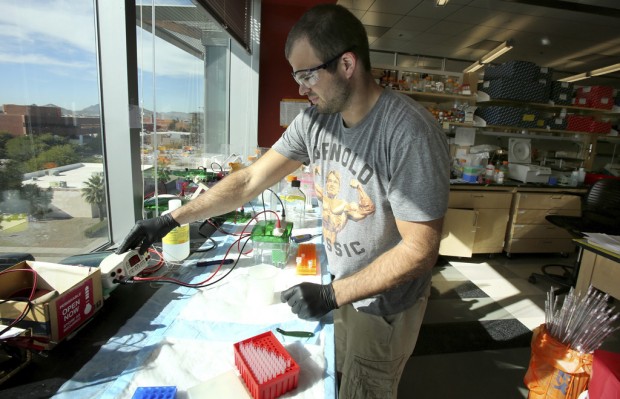
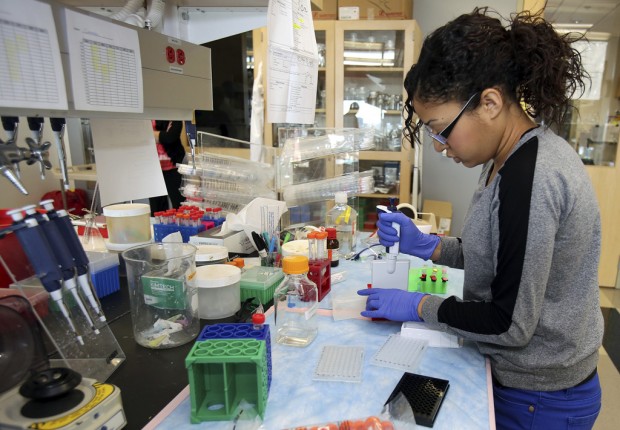
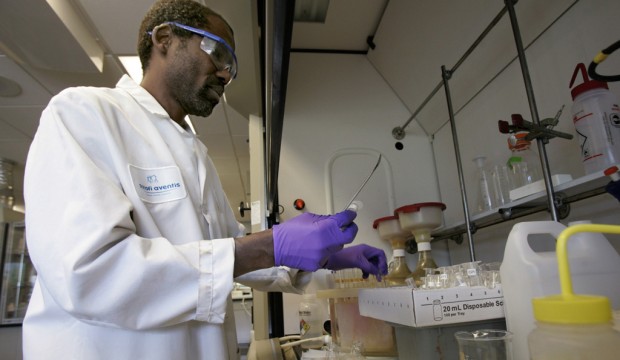
Ten years after Arizona launched a major initiative to become a leader in the biosciences, the state is still a small player compared with bio bastions like California and Massachusetts.
But the Arizona Biosciences Roadmap has been well worth it to its main backer, the Phoenix-based Flinn Foundation, which is celebrating the effort's 10th anniversary today at an event in Phoenix.
Launched in 2002, the roadmap has been credited with steering the state bio sector - including hospitals, medical-device firms and drug-research companies - on a path to growth.
Indeed, the state's bio industry has grown, particularly in the Tucson area.
Since Arizona's Bioscience Roadmap was launched in 2002, through 2010, private biosciences employment including hospitals has grown 41 percent, compared with 11 percent nationally, according to a roadmap update issued earlier this year by the Battelle Technology Partnership Practice.
People are also reading…
And in the Tucson region, non-hospital employment in research, testing and medical labs rose 33 percent over the same nine-year period, the Battelle study found.
Locally, University of Arizona tech spinoff Ventana Medical Systems and drugmaker Sanofi have expanded in Oro Valley, while the UA's Bio5 Institute opened an Oro Valley campus in 2010.
In all, the state has made substantial progress in 10 of 19 key areas, and some progress in eight others.
Arizona still has a long way to go - particularly in boosting local venture capital available to startups - but Flinn believes the progress is encouraging.
Flinn has committed more than $50 million to the biosciences, including $3 million to $4 million annually over the past decade, in the form of support for Bioscience Roadmap research and major grants to groups including the Translational Genomics Research Institute (TGen) and International Genomics Consortium in Phoenix; the Tucson-based Critical Path Institute; Science Foundation Arizona; and the Arizona Bioindustry Association.
During the same period, part of a sixth-tenth of a cent sales tax increase passed by voters in 2000 has raised hundreds of millions of dollars for education, including university research in biosciences, optics and environmental science.
Flinn Foundation President and CEO Jack Jewett said the nearly 50-year-old philanthropy is committed to ongoing support of the biosciences, which has comprised about half of Flinn's giving.
But Flinn's focus is shifting.
"We want to meet the ongoing needs of the biosciences in Arizona," said Jewett, a longtime Tucsonan, former legislator and Arizona Board of Regents member.
"Ten years ago, that meant major investments to help organizations like TGen, IGC and C-Path," he said.
Going forward, Jewett said, Flinn will target smaller investments in specific research.
"We will consider and help fashion grants that are very collaborative in nature, that are catalytic, but you won't see us throwing around $50 million numbers anymore," Jewett said.
Bio5 has seen little in the way of direct financial support from Flinn, though the philanthropy sponsored a Bio5 symposium a few years ago.
But the roadmap has had an important though perhaps intangible effect, said Nina Ossanna, co-director of Bio5's Oro Valley operation, who serves on the 75-member roadmap steering committee.
"The biggest thing the roadmap has done is to galvanize a commitment by the state," Ossanna said. "Without the roadmap, I think a lot of these things wouldn't have happened."
Jeff Jacob, chairman and CEO of Tucson-based Cancer Prevention Pharmaceuticals, has perhaps a unique perspective on the roadmap.
As a co-founder and former chief program officer for C-Path, Jacob welcomed a $1.25 million grant from Flinn that helped launch the institute, which is working with federal regulators and drug companies to develop test regimens to speed drug development. He's also been an adviser to TGen.
The presence of C-Path and TGen alone have helped his company, which is in clinical trials with drugs designed to prevent the reoccurrence of cancers.
"I credit both those organizations with helping support the development and creation, and survival, of little companies like mine," Jacob said.
"People who know the business and are willing to take the risk, those people are not going to do anything in an environment that doesn't have some support and know-how."
Bioscience timeline
Some of the key bioscience developments in Arizona
2000-02
• Prop. 301 passage secures $1 billion over 20 years for university research.
• Flinn Foundation commits to 10 years of major funding of Arizona biosciences.
• The Bio5 Institute (founded as the Institute for Biomedical Science and Biotechnology) debuts at UA.
• Bioindustry Organization of Southern Arizona forms in Tucson.
• The Translational Genomics Research Institute (TGen) is created after a $90 million fundraising effort; the International Genomics Consortium locates in Arizona.
• Arizona's Bioscience Roadmap launched.
2003-04
• ASU's Biodesign Institute established.
• Legislature approves $440 million to build university research facilities.
• State's bio cluster group reorganizes as Arizona BioIndustry Association.
• $100 million for bioscience and health care training approved for Maricopa Community Colleges.
2005-06
• Critical Path Institute founded in Tucson.
• Legislature passes angel investor tax credit.
• Science Foundation Arizona formed.
2007-08
• Classes begin at UA College of Medicine-Phoenix.
• TGen, ASU Biodesign Institute join Nobel laureate Lee Hartwell to launch Partnership for Personalized Medicine.
• Caris Diagnostics purchases the Molecular Profiling Institute, an IGC spinoff.
• Swiss drug giant Roche buys Oro Valley-based UA technology spinoff Ventana Medical Systems for $3.4 billion.
• Bio5 wins $50 million grant for iPlant Collaborative.
• Investors form the Translational Accelerator LLC (TRAC), a $20 million fund for Arizona bio companies.
• Legislature passes expanded research and development tax credit.
2009
• BioAccel launches in Peoria as bio startup incubator.
• UA breaks ground on Arizona Bioscience Park.
• Covance opens Chandler drug-development facility.
• Abraxis BioScience (since acquired by Celgene) opens $70 million Phoenix site.
2010
• Medical device maker W.L. Gore begins $130 million expansion in Phoenix.
• UA breaks ground on Health Sciences Education Building on Phoenix Biomedical Campus.
• Governor creates Arizona Commerce Authority.
• Roche announces major expansion of Oro Valley's Ventana Medical Systems.
• Sanofi US opens new, larger facility in Oro Valley.
2011
• Chan Soon-Shiong Institute for Advanced Health announces plan for Phoenix headquarters and $200 million investment in health-data infrastructure.
• UA, St. Joseph's Hospital and Medical Center form partnership to expand UA Cancer Center to Phoenix Biomedical Campus.
• $109 million Banner MD Anderson Cancer Center opens in Gilbert.
• Mayo Clinic and ASU announce partnership to establish medical-school campus in Scottsdale.
Source: Flinn Foundation
Contact Assistant Business Editor David Wichner at dwichner@azstarnet.com or 573-4181.