

An old Chevy bus and one man's vision some 40 years ago are now worth $2 million a year to better the lives of Arizona farmworkers.
Portable Practical Educational Preparation, a nonprofit employment and education program, began in 1967 with a grant of $19,000 from the Tucson Committee for Economic Opportunity. From that, founder John David Arnold bought "La Tortuga," a 1957 Chevrolet bus, which served as his mobile office for teaching farmworkers from Mexico.
Today, the U.S. Labor Department provides about $48 million annually to fund similar employment programs all over the country.
Portable Practical Educational Prep receives about $2 million of that for what PPEP Field Operations Manager Barbara Simcoe describes as "one of our larger grant programs." The program educates and trains agriculture workers and their families in Arizona.
People are also reading…
"We aim at improving the quality of rural economic life," Simcoe said. PPEP's mission benefits both employers and applicants - applicants who earn low income or are at or near the poverty line.
An enrollee is eligible even without prior farmworking experience and if unemployed. These applicants must have a caretaker who earned $800 or more from farm work or worked 25 days in agriculture in the last 24 months. Applicants must also provide proof of citizenship or residency.
"These aren't people who are going to walk into a metropolitan job office and apply for work," Simcoe said.
The income guidelines operate on a sliding scale. One person would be eligible if his or her annual income was at or below $9,000, while the eligibility of an applicant from a family of five would hinge on a household income of $30,000 or less.
"They could be facing a layoff, be employed or unemployed," Simcoe said. Applicants are assessed and placed in on-the-job-training if necessary, and many stay on after their training is finished.
Not all alumni of the program become farmworkers. Many go on to become truck drivers, work in the food service industry and apply as medical assistants, Simcoe said.
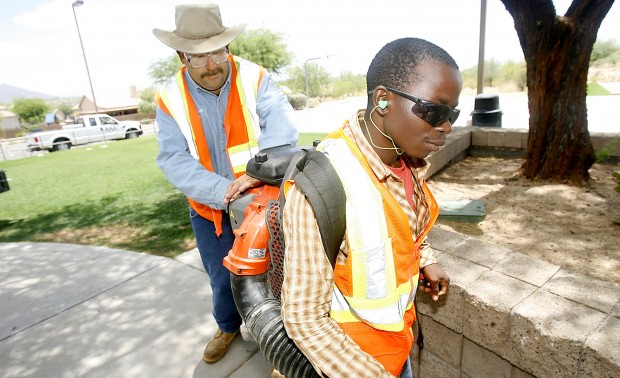
Nyandwi Jonas, 20, was enrolled in the program in March of last year after both his parents lost their jobs at Eurofresh Farms in Willcox about two years ago.
"They picked tomatoes," Jonas said. Originally from Tanzania, Jonas spoke very little English. But his parents' work at the company made him a candidate for PPEP educational and occupational training. Jonas also attended English immersion classes for his on-the-job training.
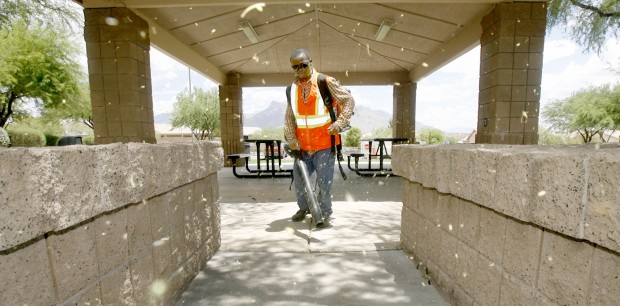
He is now employed with AAA Landscape in Tucson as a landscape maintenance worker, and with the help of a Dodge van PPEP donated to him and his family, Jonas can get to and from school and work.
"It helped when I first started," Jonas said.
Now, he has a 401K, medical and dental insurance and is afforded sick days.
"He had no landscaping background when he started," said Jonas's mentor, Mario Quiñones. Quiñones has mentored about 80 individuals. "They learn irrigation, how to use a Weed Eater and the proper way to prune trees and shrubs. They're schooled in everything to start."
The workers Quiñones trains are PPEP placements or come through AAA Landscape's own H2B program, which employs guest workers during busy seasons.
"These guys are hard workers and most of them just want to make a living and support a family," said Richard Underwood, president of AAA Landscape.
The guest-worker program welcomes documented workers for the dry vegetable season, farming lettuce and cantaloupe. After the crop rotations, the workers head home, Underwood said.
"Some of these guys have come on for eight years in a row. They're lead hands, operators - jobs with a lot of responsibility. They've got socials (Social Security numbers) and pay income tax."
Simcoe said she hopes the skills PPEP enrollees learn help them to move on to careers or to move up through the ranks of their respective workplaces.
"I think that's what we mean when we say 'portable education.' It started with the bus. We still do that; we like to take things to people rather than them coming to us," Simcoe said.
"But also it could take you from one career to another. (An education) can take you through life."
Jonas echoes Simcoe's sentiment. When asked what he'd be doing if not working with AAA, he replied, "I would probably still be going to school."
Charlie Golestani is a University of Arizona journalism student who is an apprentice at the Star. Contact him at starapprentice@azstarnet.com