
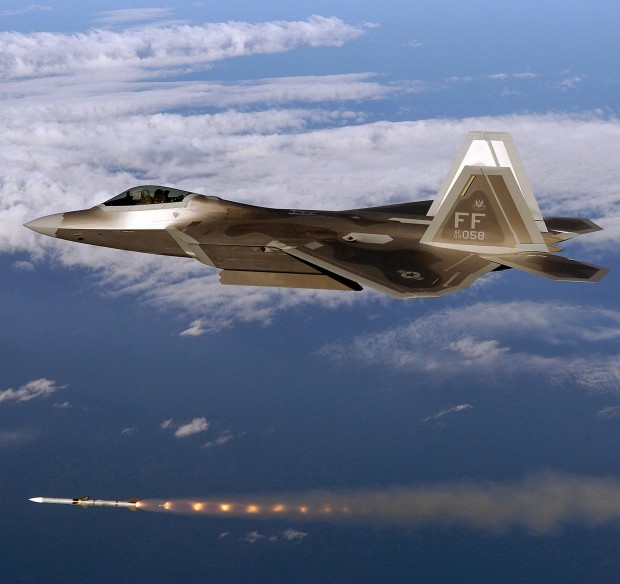
It is arguably one of the most important weapons in the arsenals of the U.S. and its allies, and it's made right here in Tucson
But the Advanced Medium-Range Air-to-Air Missile - a mainstay of Tucson-based Raytheon Missile Systems, the region's biggest private employer - has been in trouble, because of a key component made elsewhere.
Due to a nagging problem with AMRAAM rocket motors, Raytheon missile deliveries were delayed, and the Pentagon has suspended payments totaling more than a half a billion dollars until Raytheon can prove the problem is fixed.
Now, Air Force officials believe they've found the root of the problem with the motors, made by Virginia-based Alliant Techsystems (ATK), though the motors still face critical testing.
Together with the pending certification of motors from a second, Norwegian supplier, deliveries and payments could restart by the end of the year, perhaps sooner, said Col. Jason Denney, manager of the AMRAAM program at Eglin Air Force Base in Florida.
People are also reading…
Denney said the importance of the AMRAAM, first fielded in 1991, can hardly be overstated.
With its fire-and-forget, "beyond visual range" capability, the AMRAAM is the main air-superiority weapon for the U.S. Air Force and Navy and 35 allied nations.
"This is incredibly important. There's no other weapon that's this advanced in the world. It's a beyond-visual-range weapon, so you're going to shoot the other guy before he sees you," Denney said.
Major Raytheon program
AMRAAM is also a major program for Raytheon. The publicly traded company booked $696 million in AMRAAM contracts in 2011, down from $698 million in 2010.
As of 2009, more than 1,000 Raytheon employees worked on the AMRAAM program in Tucson; Andover, Mass.; Farmington, N.M. and McKinney, Texas.
In March, the Air Force notified Raytheon that it was withholding $419 million in fiscal 2010 payments for AMRAAM because of delivery delays. That's in addition to $202 million the service was already withholding for 2007 to 2009.
But the Pentagon gave the program a vote of confidence in April, when Raytheon was awarded a three-year, $497 million contract to make AMRAAMs for the Air Force and Navy.
Raytheon says it is working hard to overcome the motor issues and has resumed some AMRAAM deliveries.
"Restoring AMRAAM to full production is a top priority for Raytheon, and has the full involvement of company leadership and our rocket motor suppliers," the company said in a prepared statement. "Raytheon has continued to produce AMRAAM guidance and control sections on schedule, while we wait for our primary supplier to deliver compliant rocket motors."
The company statement noted that Raytheon has enlisted a second rocket motor supplier, Norway's Nammo AS, that has begun to deliver motors.
Raytheon said it recently delivered 132 complete AMRAAM rounds to the Air Force.
"We continue to work closely with our rocket motor suppliers and our customer (the Air Force); we expect to be on track making additional significant missile deliveries to our customers before the end of the year," the company said.
ATK would not comment on the motor failures, referring questions to Raytheon.
Motors fail tests
Some of ATK's solid-fuel rocket motors have been failing so-called "cold-soak" tests that subject the missiles to temperatures as low as minus-65 degrees Fahrenheit - approximating the cold of high-altitude flight, Denney said.
The failures have been somewhat of a mystery, since neither the testing regimen nor the rocket motors have changed since ATK began supplying them in the 1990s. ATK became the motor supplier after motors made by the previous supplier, Aerojet, had problems.
Denney said that an Air Force review board concluded in April that the low-temperature rocket problem was due to "not a single root cause, but a collection of process escapes."
"They've tightened up their processes, and that's what they're trying to move forward with now," he said.
Denney noted that ATK's propellant formula has not changed but any of a number of manufacturing variables could create a problem.
"I kind of classify mixing a propellant as a 'black art,' " Denny said, adding that the nation lost some key solid-fuel rocket expertise when the space-shuttle program was canceled.
"With this, it could be anything from the speed at which they mix the propellants, it could be the size of the (propellant) grains, the temperature they grind the grains at," he said.
First fixes failed
But the fixes didn't work the first time around.
Denney said the first lot of missiles produced under the tighter processes had a failure and in response, ATK and Raytheon "scrapped the entire lot."
Before accepting any new ATK motors, Denney said, the Air Force will require testing of the next lot of about 50 motors, and a second lot after that. The Air Force is testing 10 motors from each lot, instead of the normal two, he added.
If the motors that failed had been used in the field, they could have posed serious hazards, Denney said.
"They could have not fired properly, they could have overpressurized and exploded once it's gone off the aircraft - which is a very bad day for everybody - so it is a possible safety concern," he said. "But we believe the lot-acceptance testing that we've instituted envelopes everything that we'll see."
Denney said he expects the recertification of the ATK motors to take place by the end of the year.
But AMRAAM deliveries could resume as early as next month, with new motors from Nammo, he said.
Some ATK-made AMRAAM motor cases were recently shipped to Nammo, which has been filling them with its own propellant.
More testing
Next month, that limited-production hybrid motor configuration, along with Nammo's own complete motors, will go through so-called insensitive-munitions testing - to prove they won't blow up due to vibration or other outside effects.
When they pass those tests, the Air Force will be able to accept full AMRAAM rounds with Nammo motors.
Going forward, if testing succeeds, both ATK and Nammo will supply AMRAAM motors, Denney said.
Having a second source for the motors will boost reliability in the future, even though Nammo isn't a U.S. company, Denney said.
"Solid-propellant contractors (represent) a critical industry, first, I would love to protect in the United States, but in lieu of having someone that can deliver rocket motors, I'd rather go to an international customer," he said.
Norway is a NATO member and is among 35 allies that use the AMRAAM. The latest international version of the AMRAAM is the AIM-120C7.
The next version, the AMRAAM AIM-120D, adds new electronic jamming protection, GPS navigation and an active, onboard radar seeker that extends the weapon's range. It is expected to reach initial operating capability in late 2013.
Budget cuts
A military analyst said the AMRAAM remains the premier air-superiority weapon for the U.S. and its allies.
But the Pentagon - which canceled a next-generation replacement for the AMRAAM amid budget cuts two years ago - is "putting all its eggs in one basket" with continued AMRAAM development, said Carlo Kopp, an Australian military consultant and editor-in chief of Air Power Australia.
"The troubles with the AMRAAM should be a wake-up call" for the Pentagon, Kopp said in an email.
"The AMRAAM is a single point of failure weakness in US capability, and is approaching the end of its useful design life due to advancing Russian and Chinese capabilities," he said.
The Air Force's Denney declined to discuss emerging threats in detail but said the AMRAAM must become more capable to meet such challenges.
"It's no secret to how the U.S. fights wars - we gain air superiority first, then we support our troops on the ground. That's the way we've been fighting since Desert Storm," Denney said.
"If we don't have the AMRAAM - particularly the AMRAAM (AIM-120) D - it's going to be very hard for us to do that in the future because the electronic attack environment out there is getting much more challenging."
At a Glance
AMRAAM (Advanced Medium-Range Air-to-Air Missile) AIM-120
• Purpose: Air-to-air combat
• Prime contractor: Raytheon Missile Systems
• Users: U.S. Air Force, Navy; 35 allied nations
• Entered service: 1991
• Length: 12 feet
• Weight: 335 pounds
• Diameter: 7 inches
• Range: around 35 to more than 100 miles
• Warhead: High-explosive blast fragmentation
• Power: solid-fuel rocket motor
• Guidance: Inertial navigation, GPS, active radar (depending on version)
• Unit cost: $300,000 to $700,000 (est.)
Contact Assistant Business Editor David Wichner at dwichner@azstarnet.com or 573-4181.