

Defense contracting giants Raytheon Co. and Lockheed Martin Corp. have settled, in Raytheon’s favor, a years-long trademark dispute over the name of a key weapon system made by Tucson-based Raytheon Missile Systems.
A 2012 federal trademark-infringement lawsuit Raytheon filed against Lockheed over Paveway laser-guided bomb kits was recently settled with a stipulated judgment that awards exclusive ownership of the name “Paveway” to Raytheon. Raytheon has agreed to license the name to Lockheed for its laser-guided bomb kits.
Raytheon declined to comment on the matter. Lockheed Martin declined to answer questions, releasing a statement only confirming that “the matter is settled” and saying the company is pleased to continue providing the weapon systems.
The naming of a weapon system may seem relatively trivial, but branding is important even in the arms industry, and the Paveway has been widely used by the U.S. and its allies since its rollout by original developer Texas Instruments in the late 1960s.
People are also reading…
Raytheon acquired the product along with others from TI in 1997, later moving production here and developing versions with satellite as well as laser guidance. Raytheon, the main supplier of Paveway kits to the Air Force, says more than 500,000 of the kits have been delivered over the years.
The Paveway was the most widely used precision munition during the U.S. invasion of Iraq in 2003, during which more than 8,700 of the bombs were dropped, and more than 40 nations use some version of Paveway, according to Raytheon.
Lockheed began making laser-guided training rounds in the mid-1990s and live-bomb kits with the name Paveway in the early 2000s. Lockheed is the main supplier of such systems to the Navy and Marine Corps.
In its trademark-infringement suit against Lockheed in 2012, Raytheon said confusion over the name was harming its business. Lockheed officials argued that the term “Paveway” — which originated from an acronym for an avionics system — is generic and dropping it would hurt the sales of its version of the weapon, particularly in the international arms market.
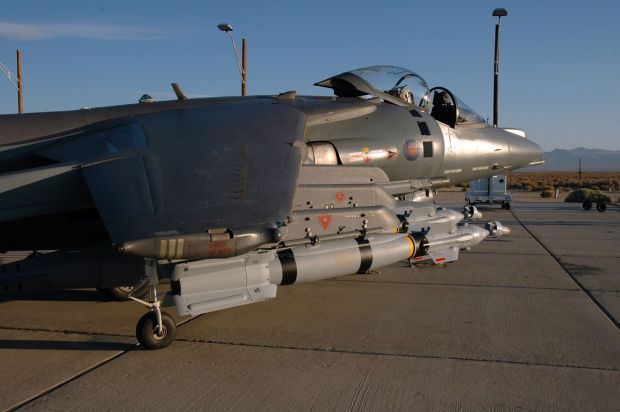
The Paveway weapon system, with a military designation of Guided Bomb Unit, or GBU, consists of nose- and tail-mounted guidance kits fitted on otherwise unguided 500- to 2,000-pound bombs.
Both Raytheon and Lockheed also make bomb-guidance kits with combined laser and satellite guidance. Raytheon’s Paveway series includes laser-guided Paveway II, the dual-mode laser-GPS Enhanced Paveway II and the Paveway IV, a dual-guidance kit specifically for 500-pound bombs that was developed for the United Kingdom.
Lockheed has made laser-guided bomb kits and training rounds primarily for the Navy and Marine Corps, as well as some foreign customers, and says it has delivered more than 65,000 LGB kits and 125,000 training rounds to the Navy, Marines, Air Force and international customers.
Raytheon filed to register the Paveway as a trade name in the U.S. in July 2005. Raytheon also sought to protect the name in several allied nations that are users of Paveway.
Lockheed pushed back in trademark proceedings in the U.S. and other countries. In 2011, the company won a key ruling by an appeals board at the U.S. Patent and Trademark Office that Paveway was a generic name that couldn’t be trademarked. In September 2012, Raytheon sued Lockheed in U.S. District Court in Tucson, seeking a judgment confirming its right to trademark the Paveway name and alleging trademark infringement, unfair competition and unjust enrichment.
Raytheon contended that Texas Instruments had been using the term Paveway at least since 1972, and that Lockheed didn’t start making bomb-guidance kits for live rounds until 2002.
The case never reached trial, and on Sept. 19, U.S. District Court Judge Frank R. Zapata signed a stipulated final judgment that recognizes Raytheon’s right to protect the Paveway name as a trademark, and noted that Raytheon had agreed to license the name to Lockheed for its “single-mode LGB kits.”
Lockheed has used the uncapitalized “paveway” in association with its bomb kits as recently as January, but an August news release about its latest version referred only to a Dual Mode Laser Guided Bomb.
Contact Assistant Business Editor David Wichner at dwichner@tucson.com or 573-4181.

David Wichner
Reporter