

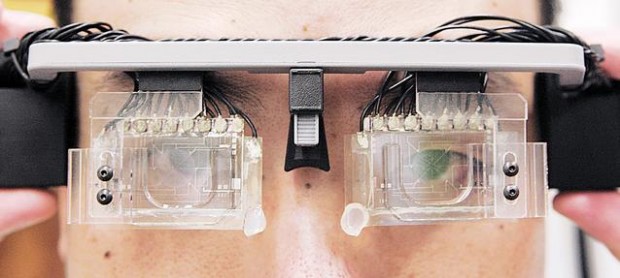
Electronically variable-focus eyeglasses developed by a University of Arizona optics team could soon help presbyopic Baby Boomers pitch their bifocals.
The "smart" glasses — which vary magnification using a microscopically thin layer of liquid crystal sandwiched between two layers of glass — adjust the glasses' focus to match the object being viewed, said the UA's Nasser Peyghambarian.
The glasses — aimed at wearers of bifocals, trifocals and progressive lenses — could come to market in two or three years, said Peyghambarian, UA professor of optical sciences and chair of photonics and lasers in the College of Optical Sciences.
UA's prototype looks bulky, "like goggles," says Peyghambarian.
Indeed, the prototypes have a look only a committed nerd could love.
Normal-looking glasses next
People are also reading…
But Peyghambarian said he is confident the technology — including a focusing system like that used in autofocus cameras and a battery to control the liquid crystal — can be miniaturized to fit into a normal-looking pair of glasses.
The technology is essentially complete and what is needed to turn it into a consumer product was "some work to make it look good, so they look cool," he said.
Peyghambarian said a team of UA optics scientists and technicians initially started working on the prototype glasses for a firm known as The Egg Factory and, more recently, medical products giant Johnson & Johnson.
The license for the technology has since been sold to another company, Pixel Optics, of Roanoke, Va., a firm related to The Egg Factory.
Ron Blum, Pixel Optics' chief executive officer and chairman, said he wouldn't comment on an introduction date or an introductory price because of concerns about competitors and the effect speculation might have on stockholders.
He said the price will be "competitive," within the expectations of wearers of "higher end" progressive lenses.
"A good-quality pair of progressive (lenses) and frames," Blum said, "you're in the $450 range, and it's not uncommon to be in excess of $500."
And, he said, the high-tech glasses would offer some advantages over traditional bifocal, trifocal and progressive lenses. He said wearers will be able to turn off the magnification feature and instantly have single-vision lenses.
"You'll be able to lie in bed and watch TV and read the newspaper at the same time," Blum said, because they switch between close and far focus more quickly than the human eye can detect.
Upgrading of Rx in glasses?
Eventually, he said, they might even be able to be upgraded, so a new "prescription" could be uploaded to the glasses, eliminating the need to replace them each time the wearer's vision changes.
Blum said his group, now known as Pixel Optics, already held most of the 12 patents to be used in the consumer product before Johnson & Johnson acquired the rights. When Johnson & Johnson sold its lens division, Blum said, Pixel Optics reacquired the rights.
During the development work, Blum said, UA scientists "did invent certain aspects" of the technology.
"We're very pleased with the job the Arizona Optical Sciences Lab did. Nasser (Peyghambarian) is the leading scientist in the world in electro optics," said Blum.
Peyghambarian said the three key patents crucial to the development of the prototype "were all stuff that was developed at the university. The invention, the three patents that make it work, was done here."
He said he's been getting calls from news organizations worldwide since an article was published in the April 5 edition of Proceedings of the National Academy of Sciences.
Jeffrey Weaver, director of the clinical-care group of the American Optometric Association in St. Louis, said the technology has a huge potential market.
Vision industry estimates put the number of U.S. residents who will have presbyopia by 2016 at 90 million. Onset of the condition, which requires a person to wear reading glasses or hold objects at arm's length to read clearly, is typically experienced in the 40s.
"Nothing would make our patients happier than being able to focus like they were when they were young. I'm just really excited to see eyewear progressing in technology," Weaver said.
He said his only concern was how the new glasses would be regulated for safety, although he "assumed" they would be governed by the U.S. Food and Drug Administration under standards developed by the American National Standards Institute.
Ultimately, says Peyghambarian, the technology could be used to correct vision for many types of distortions, including astigmatism.
TECH FILE
● A look at the technology behind electronically focusing eyeglass lenses under development at the University of Arizona:
l A microscopically thin (5 micron) layer of football-shaped liquid crystals (as used in LCD — liquid crystal display — screens) is sandwiched between two layers of glass.
l Invisible circuits are etched on one of the lenses.
l When energized by power from a small battery, the crystals align to vary the magnification of the image coming through the lens.