

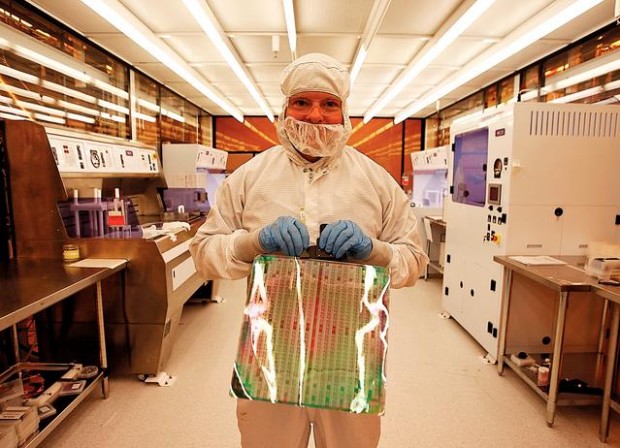
SAN JOSE, Calif. — Until now, creating the microchips that power all of our electronic gadgets has been a laborious, complex and time-consuming process costing billions of dollars.
But if a Milpitas, Calif.-based startup succeeds, making them could be as easy as printing a piece of paper.
And that could open up a huge market for so called "printed semiconductors," which would contain an enormous amount of data but would be cheap enough to slap on thousands of products.
Kovio envisions the tags containing information about whatever product they are attached to. That could include everything from the age and nutritional content of packaged food to tips on how to take a prescription medicine and whether an item has been exposed to contaminants.
Backed by investors who include former San Francisco 49ers Brent Jones and Tommy Vardell — and a board that boasts Sun Microsystems co-founder Vinod Khosla — privately held Kovio hopes to launch in a matter of weeks what is believed to be the world's first manufacturing plant for printed semiconductors.
People are also reading…
By using inkjet and other types of printers, the company plans to make radio frequency identification devices — so called RFID tags. Such tags traditionally contain microchips but are so expensive now that their use has been limited.
If Kovio succeeds in keeping the price of the devices low, according to its executives and other experts, it could herald a new era for consumers and the chip business.
"If Kovio can pull that off . . . it's going to revolutionize that whole industry," said Carl Taussig, director of Hewlett-Packard's Information Surfaces Lab, which is exploring a different but related technology.
What Kovio, HP and a growing list of other companies are working on falls under the broad category of printed electronics, which includes such things as solar panels, disposable blood-glucose sensors and gadgets for displaying various types of information.
Using an imprinting method it has developed, for example, HP is trying to make flexible electronic displays that can fold like a newspaper or bend around a building. Possible applications for the displays range from computer games to product promotions. HP also is working on what Taussig calls a "Dick Tracy watch" for the Army, which could tell where an enemy is located or how to clean a rifle.
By using silicon-based ink, Kovio says it can print RFID tags on soup cans, textiles and a wide range of other surfaces. While Kovio's printed semiconductors aren't nearly as complex and powerful as many other traditional chips, particularly the brainy microprocessors made by such companies as Intel, they take far less time to make, said Kovio's CEO, Amir Mashkoori.
But the biggest selling point is their cost. Mashkoori said Kovio should be able to produce them for about 5 cents per tag — perhaps even for as little as a penny — making them appealing to a broad assortment of businesses.
Kovio plans to target its tags especially at consumer goods. By approaching the product with a cell phone equipped with the right program, Mashkoori says, people will be able to access whatever information is stored on the product's RFID tag.
That way the person could tell how old merchandise is, for example, or if it contains something the person is allergic to, Mashkoori said.
He also envisions people using the phones to pick out the perfect wine for a meal.
"We see that application evolving to the point where you can actually put in, 'I'm having chicken for dinner tonight with a Greek salad,' and you can scan your phone over the wine bottles to see what's a better match with that food," he said.