

Don't pigeonhole Carl Heldt. You can call him an artist, but his palette is all over the place. Wood, canvas, machines, paintbrushes.
The lifelong artist, 83, never tires of creating; he loves what he does, and he does it every day.
Heldt retired from the University of Arizona, where he taught art, 20 years ago. But he never retired from making art that captures the imagination while it makes use of such recycled items as chunks of furniture wood, which he piles into 30 barrels and grabs when inspiration hits.
Heldt's art has been as eclectic as his tools. He's painted, sculpted, and even created bumper stickers for radio station KIIM-FM 99.5. His artwork is in 45 public institutions and in 150 private collections, and can command as much as $1,800 for a large painting.
His passion for making art is contagious — his son Aaron, 57, is a freelancer for Hallmark and creates movable Christmas toys.
People are also reading…
And Heldt is quite proud of Aaron's accomplishments.
On a recent visit to Heldt's northwest Tucson home, he takes out one of Aaron's designs from a closet, a snowman playing the piano. He carries it from the closet to the table delicately, beaming with pride. He sets the snowman on the table and puts the batteries in, treating the happy snowman poised to play the piano with tenderness and respect.
"Aaron was here for a week and he is just like Carl," said Heldt's wife, Dolly.
"They were into one project after another and fooling around the stable for days."
We spent a day with Heldt, talking to him about this work and his life. Here's some of what we discovered.
The beginning
Heldt was born in Stanford, Ill., where his love for art blossomed at a young age. He grew up in a rural area, surrounded by cows and chickens; back then, they were the center of his artwork.
After he graduated from high school, he went into the Army Air Corps for three years. His art was not neglected during that time — he would create paintings on the back of flight jackets.
"I would stretch the jacket over a garbage can and tie the arms really tight and paint pictures of girls, words, or whatever," recalled Heldt. "Seven flight jackets in a row with my paintings."
After leaving the Air Corps, Heldt attended the University of Illinois and graduated with a bachelor of fine arts in painting. During his time in school, Heldt worked as a lab technician and was a medical illustrator at a hospital.
"Looking through the microscope my eye would start twitching. . . . It would get boring, so I would paint and draw underneath and go back to work when I heard someone coming," said Heldt.
Life in education
Heldt began his 35-year teaching career at the University of Illinois. In the mid-'60s it continued at the UA, where he taught graphic design and illustration. He retired in 1989.
His love and excitement for teaching comes from his mother, who was also an educator, he said. But deciding between his art and teaching is something Heldt can't do.
"As a teacher you feel like you're helping someone," he said. "You can go through your life without hurting people."
He also loves that he was able to do his art while being a teacher, which gave him the best of both worlds.
"I am so blessed that I can teach and do my own work," said Heldt.
He reached for a drawer stuffed with e-mails from former students who praised his teaching and explained the impact that he had on their lives. He grabbed one of the papers and put it on the counter and in a beaming voice read:
"You have been my best teacher and I have had a long and enjoyable career," a student who had graduated in 1968 wrote.
Former UA student Jeff Ivanhoe credits Heldt for changing the course of his life.
"He truly changed my life. I was a business major and always liked art," said Ivanhoe. "I decided to take an art course with him. Once I found out I could have a career in graphics, I changed my major. He is the reason I changed."
The passion and dedication that Heldt had for his students can be seen even decades later.
"If I had time I would drive down there and hold his hand right now," said Ivanhoe, who makes his living as an artist.
" He absolutely changed my life. I love my mom and my dad, but he was responsible. Everything I've ever done has been from him."
Artist Andy Rush was teaching at the UA at the same time, and it was Heldt's role as an educator that stands out to him.
"I remember him as really dedicated to his students," said Rush.
"He made his students the centerpiece of his life."
His art
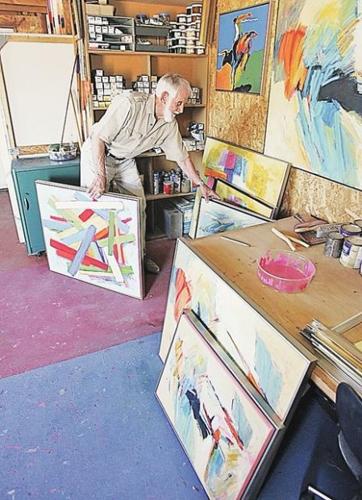
Stepping into the cozy red barn next to his house, you would expect horses, not barrels of wood piled up in each stall. The barn also has a small furnished apartment — students sometimes use it to do work and study. An upstairs studio is used as a place to work and a home for a majority of his abstract art. Canvases line the walls and paint covers the floor.
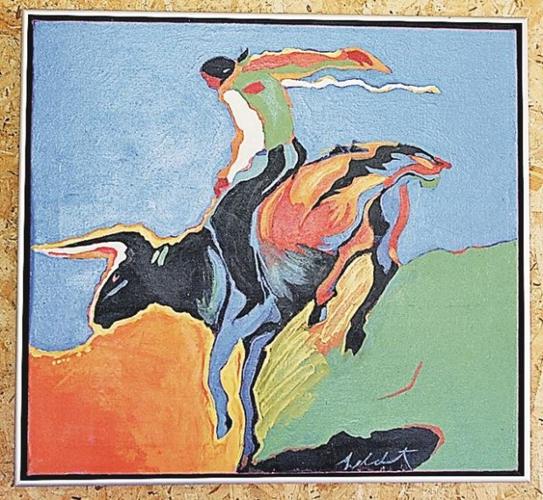
The squeaky steps up to his studio above the barn lead to a different world. It's a world with brightly colored abstracts that challenge the mind to create shapes and images. A world with purple skies and bright-colored cowboys and horses.
"Artists like abstracts for a very special reason," said Heldt.
"Nature tells you what color, where to put it — tells you everything. (In abstract), no one tells you what color to make it. That's why it's so exciting for a person, because you are in charge of everything."
Before he got into abstract art he did portraits, including about 30 for Harper's Bazaar. He also kept busy doing commissioned portraits. He did portraits of several World War II pilots who had died in the conflict, as well as of young women who had made their debuts.
His favorite commissioned portrait was of a janitor that a high school had asked him to do. He thought it was the strangest thing because underneath the portrait it read, "the meekest inherit the earth."
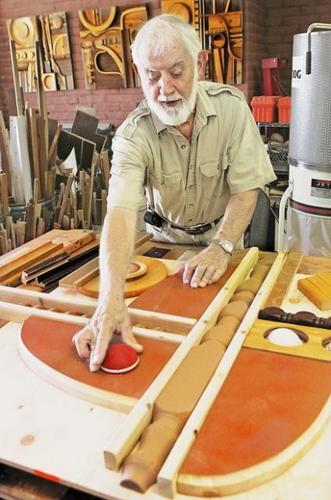
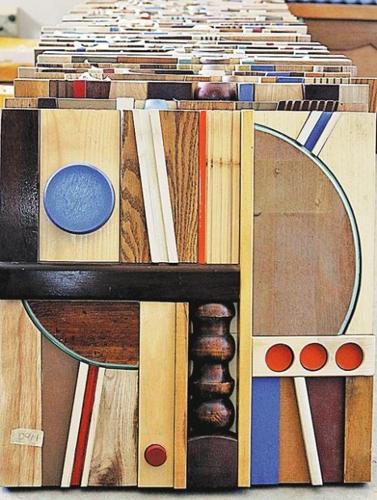
His garage is used for all of his wood art. Nooks and crannies are full of wood scraps — tables, furniture legs, croquet balls — destined for artwork. Machines and tables also crowd the garage. They help him shape and compile all of the wood pieces together. He usually picks wood of a dark color but sometimes introduces color to them. "I add color because I'm a colorist and it seems better to me," he explained.
The pieces are broken up and then affixed to the canvas. He screws in a coffee table leg, a bowl or anything else that seems to fit — he has multiple choices; he has been collecting the wood since the 1970s. He will screw in the wood through a background to make sure it doesn't fall off — he doesn't want a bowl to roll off or the leg to become unattached, which may happen if he just used glue, said Heldt.
He uses texture, volume and line in his woodwork to give the art the nuance he wants.
Art surrounds and shapes Heldt's life.
Even in his retirement he spends many long nights in the barn and the garage, working on his wood art and painting abstract.
"I've just been so blessed to be able to do this," he said.
Where to see Heldt's work
• Carl Heldt Gallery. Only by appointment, 743-0205.
• "Knuckle Bones" on view at University of Arizona Museum of Art, in the UA Fine Arts Complex at North Park Avenue and East Speedway.


