

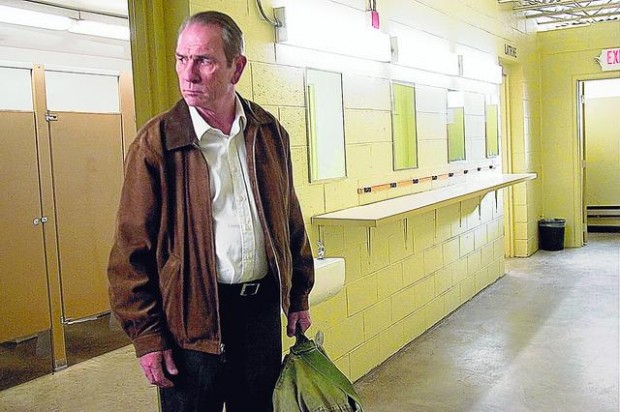
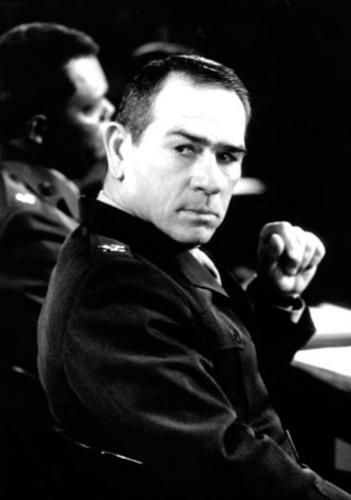
Tommy Lee Jones is one ornery son of a gun. In a phone interview from his Texas ranch in support of his film "In the Valley of Elah," he pauses a bit after hearing each question, as if judging its validity before spitting out a response in as few words as possible.
Sometimes he doesn't answer altogether, but just remains silent until the reporter says something else — a phone conversation staring contest — or questions the question itself, then tosses out an insult, calling you "lazy" if you ask him about his reputation as a tough interview or "pretending to be an intellectual" if you ask him if "In the Valley of Elah" is really a Western.
Midway through the interview, he pauses to resume cooking his gumbo, then finds someone else to watch his pot, rattling off orders ("When vegetables are tender, turn that off. Keep simmering until the meat falls off bone") before he returns to what he later describes as his "contractual obligation to support the film."
People are also reading…
Speaking to Jones, 61, is like trying to make conversation with a shotgun-wielding daddy of some girl you're about to take on a date. He'll keep you on your toes if you're lucky; push you on your backside if you're not.
Yet in a way, speaking to such a gruff man is a burst of fresh air when compared to talking with the usual canned-and-polished Hollywood types.
Jones is just like the sandpaper-tough characters he plays in the movies, including his obsessive lawman Marshal Samuel Gerard in "The Fugitive" (1993), for which he won an Oscar for best supporting actor.
In "Elah," he plays retired military policeman Hank Deerfield, who doggedly investigates the murder of his son, who has recently returned from war in Iraq. Jones is garnering Oscar attention for that role, as well as for his part as a hunter who stumbles onto drugs, dead bodies and cash in "No Country for Old Men" (due out Nov. 21).
Occasionally Jones lets down his guard and releases a cogent thought, for instance dismissing the notion that "In the Valley of Elah" is against the war in Iraq.
"I see it as more as a pro-human film," Jones said. "Of course there are questions that come up, and those are healthy questions to consider. They weigh on every American's shoulders today, about the rightness and wrongness of that war and how we treat the children who are asked to go into harm's way."
Jones pauses often as he speaks, but never to formulate a more politically correct response. When asked about the meaning of the film's loopy title, which is a reference to Biblical the story of David and Goliath, he says "I don't have a clue."
"I never thought about it," Jones said. "I really don't see the usefulness in trying to figure that one out."
Jones also tosses in his two cents on the immigration debate. A proponent of more open borders and humane treatment of illegal crossers, he jokingly asks, "You guys have your fence built yet?"
"It gets headlines," Jones said, referring to politicians' insistence on tightened border security. "People make hasty, foolish decisions in the heat of scrutiny, from press to politicians, who are quick to make drastic proposals so they can be famous and get campaign contributions."
Jones addressed border issues in his only feature directorial effort, "The Three Burials of Melquiades Estrada" (2005), about a ranch hand who hauls his friend's corpse to Mexico for burial.
"To some degree, I look upon far west Texas and deep south Texas and extreme northern parts of Mexico as the same country."
Since some of the more vocal proponents of a locked-down border are ranchers like Jones — he considers himself a full-time rancher as well as a full-time actor — he feels entitled to opine about his colleagues.
"To a certain degree it's racism and narrow-minded, simple-minded paranoia. They say guys with bathrobes on are coming across the river to blow up buildings. . . . I've never seen 'em."
Jones said he lived at the Arizona Inn during the filming of "Fire Birds" (1990), an action film he made with Nicolas Cage.
"I really like the Arizona Inn," Jones said. "Every time I go through (the state) in the car I spend some time there. I don't have much experience with the countryside as it gets into the mountains. Arizona looks somewhat like far west Texas."
Just when you think you've got Jones talking, he reverses course. When asked about the awards buzz surrounding his films this year, he declares he knows nothing about it because he doesn't watch TV, read magazines or log onto the Internet.
Both of Jones' new films can be classified as Westerns, but don't try to ask him if the genre is making a comeback.
He says such a question comes from someone "pretending to be an intellectual and a film scholar."
"What does 'Western' mean?" Jones said. "I don't know what that is. I think it means big hats and horses maybe. . . . "
Do you not like the term "Western"?
"Sure, I like it," Jones said dismissively. "Sounds good to me. Any label you want is just fine."
And then Jones dropped his sarcasm and talked about how he really feels about labels.
"Categories and classifications are what people in your profession often do instead of thinking," Jones continued, before concluding, "I'm not comfortable with this line of questioning."
So why would anyone consider Jones a tough interview? Certainly not because you are a tough interview, right, Tommy?
"I think it's because reporters talk to each other and like to do that," Jones said. "Especially print reporters. They share rumors and get excited. They tend to write about each other."


