


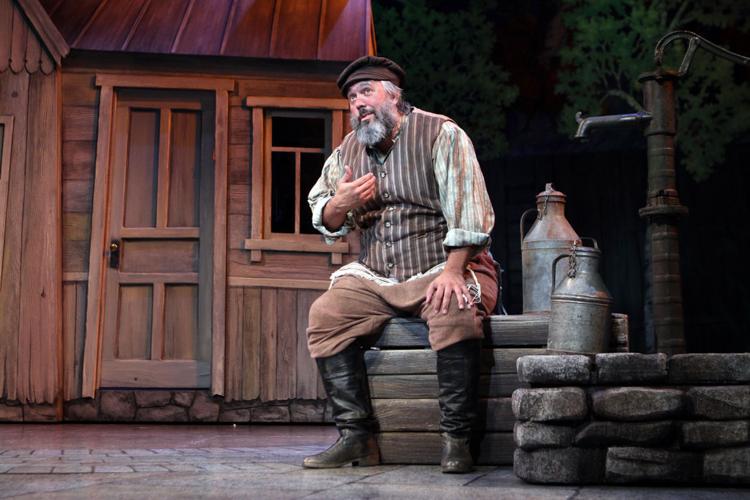
When David Ira Goldstein was a boy, “Fiddler on the Roof” was the musical.
“The cast album was played in every Jewish household in America,” says Goldstein, who is directing the Arizona Theatre Company production of the play, which opens in previews Saturday, Dec. 3.
Both sets of his grandparents had immigrated from Russia, where they lived in shtetls. “It’s my heritage,” he says of the musical, which opened on Broadway in 1964.
But it became much more than a story about Jewish life and immigration — so much more that it has been translated into 20 languages, including Japanese, where audiences seemed surprised that it wasn’t written about the Japanese.
“It’s really the first Jewish musical that became so universal,” says Goldstein. “You don’t have to be Jewish to love ‘Fiddler.’ It transcends and speaks to all traditions.”
People are also reading…
Especially today, he added.
“I don’t think it could be any more relevant than it is right now. When you think about what’s going on in Syria, and all the talk of deportations, banning Muslims — the end of this play is about a community made to leave its home. … ‘Fiddler’ is a particularly human, emotional way to say what it means to leave, what a diaspora means.”
The background
“Fiddler on the Roof,” by Joseph Stein, Jerry Bock and Sheldon Harnick, is based on short stories by the Yiddish writer Sholem Aleichem. Written in the late part of the 19th century and early part of the 20th, they are about the milkman Tevye, who narrates tales about his village and family and a life salted with hardship and love with tenderness, humor and irony.
“They are touching and bitter and funny and sad all at the same time,” says Alisa Solomon in a phone interview. Solomon wrote the definitive book about the musical, “Wonder of Wonders: A Cultural History of Fiddler on the Roof.”
Bock, Harnick and Stein harbored doubts while they created the musical.
“Who would be interested in producing a show about a shtetl?” Stein said in Solomon’s book. But they kept at it, spurred on by their love of the material.
Solomon reported in her book that producers weren’t jumping enthusiastically on board.
“What will we do when we’ve run out of Hadassah groups?” asked one, who turned them down.
Eventually, the well-respected Harold Prince signed on as producer, and the choreographer/director Jerome Robbins agreed to direct, giving the musical a boost as it headed to Broadway.
The story
“Fiddler” is set in 1905 Russia. Tevye, a Jewish milkman, has five daughters and he and his wife are anxious to find matches for the three of marrying age. Meanwhile, their faith and their traditions are challenged by the increasingly oppressive actions of the czar, whose edict eventually forces Tevye’s family and the other Jews in the shtetl to leave the community they know and love.
The story, Solomon said in a phone interview from Chicago, takes place almost entirely in the village, but it has become a story of immigrants.
“It has come to represent the origin story for American Jews and, by extension, of American immigrants — people who have left some kind of persecution to come to the U.S.,” Solomon said. “No matter how you slice it — whether it’s religious or economic persecution — people come here looking for better opportunities, for more freedom, which is what Tevye is doing at the end of the show.”
The music
“The music is glorious,” says Goldstein. “Every song is a beautiful song.”
Few would argue with him. “Sunrise Sunset” is often sung at weddings, and in 2011, Harnick wrote a second version of the song for same-sex weddings. “Tradition” is a rousing anthem to a way of life; “Matchmaker, Matchmaker” is flirty and joyous; “If I Were a Rich Man” is a klezmer-ish song full of humor and gives a full look into the character of Tevye, who sings it.
The score, said a New York Times review of the 2015 Broadway revival, “enters your bloodstream, indelibly, upon a single hearing, so rousing are its songs of celebration, so beautiful the melodies of its songs of love and loss — two sides, for Tevye, of the same coin.”
The dance
Jerome Robbins was a big name in dance when he signed on to choreograph and direct “Fiddler.” His choreography on such shows as “West Side Story” and “The King and I” made his talent clear and his reputation wide.
And you’ll see much of his work in the ATC production of “Fiddler.”
“There’s a choreography bible that comes with the show,” says choreographer Kathryn Van Meter, a lifelong fan of Robbins. “It’s a series of written-out instructions combined with stick figures and formation shapes. That is the original choreography.”
She and Goldstein kept several of those dances, such as the opening number, “Tradition,” and the “Bottle Dance,” which ends the first act.
“I think Robbins was so successful because he figured out how to theatricalize movements from daily life,” she said. “The movement itself feels universal.”
Van Meter re-envisioned some of the original dances, but felt she had strong guideposts.
“For me, it always comes back to the story being told,” she says.
“Robbins has been one of my personal influences, so staying inside his style is a natural fit for me.”
Tevye
This is the second time Eric Polani Jensen has played the iconic role of Tevye, the humble milkman who has an ongoing dialogue with God and is constantly challenged by daughters who want to break traditions.
“To me, he’s a bit of an everyman,” he says about the character. “A dreamer. Hard worker. Like all of us, he wants more for himself and his children. He has a great love for his wife and family and community. And tradition.”
Jensen loves the music, but he is particularly moved by the closing number, “Anatevka.”
“It’s an anthem about home, no matter how good or bad,” he says. “That speaks to refugees today — that home isn’t always the brick and mortar we live in; it’s the heart we share with each other.”
Contact reporter Kathleen Allen at kallen@tucson.com or 573-4128. On Twitter: @kallenStar

Kathleen Allen
Reporter


