

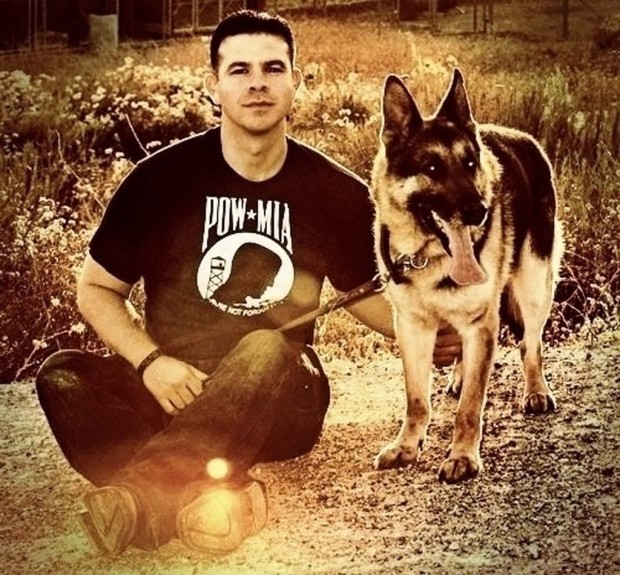
Large-caliber machine gun slugs slammed into their Humvee as their 60-vehicle Marine convoy was ambushed approaching Fallujah, the bloody center of insurgence in Iraq.
Landing just yards away, the chest-pounding explosions made so much noise that Rex, a Marine MWD (military working dog), couldn't hear the reassuring words handler Marine Cpl. Mike Dowling was yelling.
"He looked at me like, 'Tell me what I need to be doing. I have no … idea what's happening out there. What do I need to do?' " recalled Dowling, who had just finished a year and a half of intense training with the German shepherd.
"Sergeant Rex: The Unbreakable Bond Between a Marine and his Military Working Dog" tells the story of one of the first K-9 teams deployed for front-line duty, trained to detect the improvised explosive devices that have been devastating during the wars in Iraq and Afghanistan.
People are also reading…
Dog teams had served early on in Iraq and Afghanistan, Dowling said, but the majority did base security patrols. Some worked checkpoints.
But with the rising IED threat, Dowling said, the Marine Corps wanted a deployment of dog teams that spent the majority of their time with the infantry units operating on patrols, missions and operations to hopefully counter the IED threat and find caches full of weapons and explosives.
It was the first time an entire deployment of dog teams was sent to either Iraq or Afghanistan with this purpose. Unlike teams sent today, they hadn't trained with any infantry units before deploying.
The pair's first firefight came in early 2004. They had been in Iraq about a month.
The incoming fire was so thick they couldn't even look up to pinpoint where it was originating, Dowling recalled. Above them, a .50-caliber machine gunner blasted away, returning fire from the Humvee's turret.
Dog handlers say that emotions run up leash and down leash - meaning, Dowling said, "If I go crazy in a combat situation, the dog is going to read that off of me and go crazy, too. If I stay calm, he is going to stay calm."
In battle, there was nothing for them to do but survive so they could do their job.
At the time, Dowling was a 25-year-old corporal who had joined the Marines after a brief stint at the University of California Santa Cruz. He had entered the military working dog handler's course after graduating top in his class at military-police school.
Military working dogs go to a school at Lackland Air Force Base near San Antonio to become basically trained and certified. Then they are sent to military bases, where each dog is paired with a handler. It is that handler's job, Dowling said, to help that dog reach his or her potential as a working dog.
Before meeting Rex, Dowling had completed a handlers course at Lackland and then was sent to Camp Pendleton near San Diego.
Rex was unofficially called a sergeant because Marine dog handlers are trained to treat their dogs with respect, as if the dogs outranked them by one rank, Dowling said.
Handlers protect their dogs at all costs.
"I know it sounds dramatic, over the top," Dowling said, but "I can protect the guy to the left and right of me, but (the dog) can go on to save so many more lives. It's not like they trained us (to think that way), but everyone understands we are our dogs."
Dowling later learned that he and Rex were likely targets in that intense first attack in Iraq. "Those guys wanted to kill you and your dog," Dowling said some of the battle-tested Marines in that unit told him.
He would also learn that the insurgents who made, placed and detonated the devastating IEDs often watched the K-9 teams and bomb squad specialists.
There is virtually no ruminating in "Sgt. Rex" on why Dowling and thousands of other young Americans were in Iraq.
Dowling, who describes himself as apolitical, instead concentrates on the primal nuts and bolts anecdotes of staying alive when people you don't know are trying to kill you.
The book intercuts stories of Iraq missions, from flop-sweat tense to truly terrifying, with Dowling's dispassionate description of his youthful civilian life and the stateside Marine training. It's clear that his decision to join the Marines when his life was stalled has provided him with the passion and urgency he craved.
Besides surviving, Dowling and Rex were successful in their specific mission. Rex uncovered huge stores of enemy weapons and, most important, IED-making components.
In some cases, Dowling writes, they discovered so much weaponry that it was impractical to move and had to be blown up in place.
About the writing
Dowling co-authored the book with British writer and broadcast journalist Damien Lewis. Released by Atria Books in mid-December, "Sgt. Rex" topped the dog's category on Amazon.com for a time. "It's still selling really well," Dowling said.
Dowling said he's been especially gratified by readers' reviews. "I'm happy that people enjoy the story and fall in love with Rex," he said, and that the book has brought awareness to military dogs and their value.
The book doesn't read like a typical "as-told-to," possibly because it was Lewis who came to Dowling, trying to convince him that there was a book in his and Rex's experiences in Iraq.
"I felt uncomfortable about it just being about me and Rex," said Dowling, who tried to talk Lewis into doing the book about all of the MWD teams that pioneered the specialty work in Iraq.
But Lewis, who has collaborated on several personalized stories from war zones and disaster areas in Africa and the Middle East, won out.
They conversed via Skype every weekday morning for a couple of hours, and for long stretches on the weekends, discussing the story, sending revisions and comments back and forth for months. They finally met in Ireland to finish the book. Lewis was living there, and Dowling had "dozens of cousins" all over the place.
More about Rex
By the time the book came out, five years had passed since Dowling and Rex last worked together.
"It was extremely hard," Dowling said of leaving Rex. "But that's the military," he said. "You understand that day's coming someday."
Rex returned to Iraq on two combat deployments - in 2005 and 2006 - with Cpl. Megan Leavey.
They would be his last. The pair were working in the Anbar province in Iraq when Rex detected a buried bomb that exploded, wounding them both.
After the 2006 blast, Rex was "diagnosed with a little PTSD" and won't ever again return to front lines, Dowling said.
Rex's nose for explosives is still valued. Rex has been serving out his active-duty days at Camp Pendleton, doing gate duty and responding to bomb detection calls in the area.
Last year, Rex was flown to Tucson on a special detail to sweep the University of Arizona campus for explosives prior to President Obama's appearance there after the deadly shooting spree that wounded former U.S. Rep. Gabrielle Giffords.
Rex is now officially going through the process to retire from the Marine Corps. In the meantime, he stays at Camp Pendleton and does not work but gets plenty of exercise.
He will be adopted out to Leavey, who is out of the Marines and has the space for a big dog and knows how to take care of him in retirement. Dowling said there is talk of a sequel to the book with Rex and Leavey.
"He was asked to do a lot," Dowling said.
How to help dogs like Rex
Leavey was awarded a Purple Heart after that 2006 blast, but Mike Dowling said no awards are given to the dogs because they are considered "equipment" by the Department of Defense.
That's a wrong Dowling says he is trying to correct with his MWD-dedicated website, K9pride.com
Dowling is optimistic, noting that last week Sen. Richard Blumenthal, D-Conn., introduced the Canine Members of the Armed Forces Act, which would streamline the adoption of the military working dogs after they retire and improve veterinary care for them at no expense to taxpayers.
Those issues are some of the things Dowling plans to talk about Sunday at the Tucson Festival of Books.
About the author
Mike Dowling never dreamed of joining the military when he was growing up.
One of six kids in a middle-class family north of Berkeley, he was a decent athlete and a good enough student to attend the University of California Santa Cruz.
But it didn't stir his soul.
"I fell into a dark mind-set," he writes. "I surrounded myself with negative people, and I started to smoke and drink too much. I was at a beautiful college surrounded by these beautiful young people, but I felt the lowest I'd ever been."
He quit school and went to work at a Bay Area frozen meat distribution plant loading trucks. The companionship and raw work experience made him feel good.
He started thinking about a friend who joined the Marines after high school and used to drive up from Camp Pendleton with a bunch of his Marine friends to visit Dowling during his first year at UC Santa Cruz.
Soon, Dowling walked into the Marine recruiting office and said he wanted to join. That was before 9/11, and he writes he was surprised that the recruiter told him they were full up on recruits, but that he could go on a waiting list - that is, if he qualified. He did and he did, and even got his induction date moved up when another recruit backed out.
Now 32, Dowling is out of the military, though still involved with the Wounded Warrior programs.
Dowling has also been doing some film, television and media work in Los Angeles, and recently co-founded a not-for-profit networking organization for veterans working in entertainment media, Veterans in Film & Television www.vftla.org
Among his credits is a commercial for the combat video game "Call of Duty." He's the guy on the right side of the screen in the camou face paint yelling "Elite!" in the YouTube video for "Call of Duty."
If you go
Meet Mike Dowling, who inspired and co-authored "Sergeant Rex: The Unbreakable Bond Between a Marine and His Military Working Dog." He will speak at 1 p.m Sunday at the Arizona Daily Star Pavilion.
Dan Sorenson is a Tucson-based freelance writer. Contact him at d.sorenson@cox.net


