

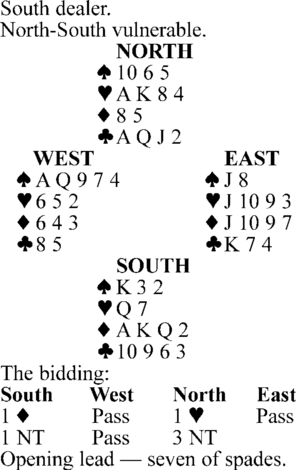
There is a play in bridge called a suicide squeeze, and it can be highly effective on the rare occasions when it may arise. Declarer arranges matters so that one opponent squeezes the other.
Consider this deal, where West leads a spade. Declarer wins East's jack with the king and can count only eight sure tricks. It appears that South's only chance is to try a club finesse, hoping to find West with the king. But if South attempts the finesse, he goes down, losing a club and four spade tricks.
Declarer has a better method of play available, however. His best chance lies in returning a spade at trick two.
If West declines to cash his spades, he never scores them, and South makes the contract after losing a club to East's king. Let's assume, therefore, that West continues with a third and fourth spade, declarer discarding a diamond from dummy and a club from his hand.
People are also reading…
On the third spade, East can part with a club, but on the fourth spade he is unremittingly squeezed. He cannot spare a heart, a diamond or a club, because whatever he discards, South gains his ninth trick in that suit. Furthermore, East's position gets even worse if West cashes his last spade.
Declarer reasons from the start that if West turns up with only four spades originally, a club finesse can eventually be taken in safety. But if West started with five spades to the A-Q, he is unlikely to also have the king of clubs, because he would probably have overcalled South's opening diamond bid with one spade. In that case, returning a spade at trick two offers the only real chance to salvage the contract.


