

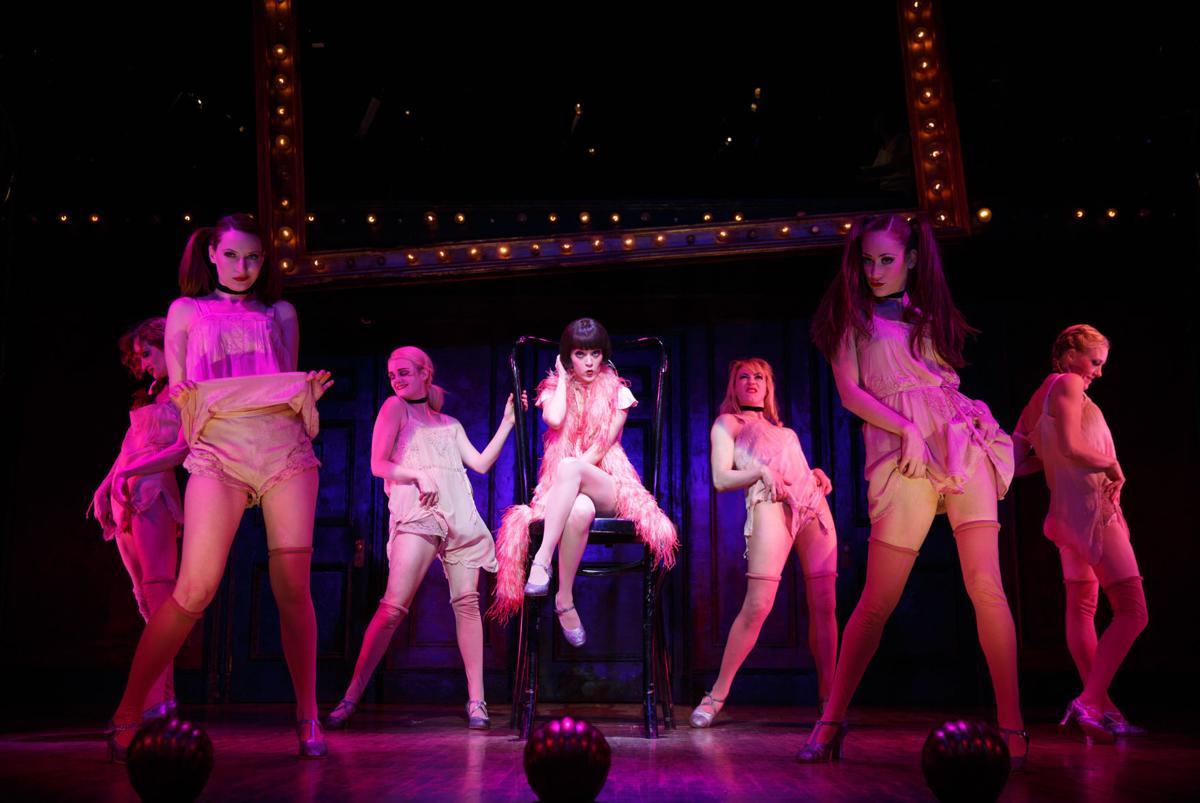
Here’s the thing about Kander and Ebb’s “Cabaret:”
It drips with horror.
Today, the rising threat from hate speech, bigotry and intolerance echo pre-World War II Germany, when the Nazis began to take power and the time period of the play.
“Cabaret” reminds us of the dangers of allowing the venom to flow freely.
The Roundabout Theatre Company’s production of the now-50-year-old play is on the Centennial Hall stage, courtesy of Broadway in Tucson.
This roadshow is a revival of a revival of a revival. In 1993, Sam Mendes directed a bold new version of the musical in London, brought it to Broadway in 1998, and staged it again in 2014.
His ’93 version was dark and decadent and underscored the story of 1930’s Berlin, when debauchery was a way of life and the Nazis were beginning to assert themselves. Mendes’ subsequent productions of “Cabaret” did the same.
People are also reading…
The musical has the limber Kit Kat girls twisting and back-bending across the nightclub stage where Sally Bowles, a London gal who has little talent but lots of ambition, croons her tunes.
Watching over it all, directing it, really, while serving as a sort of Greek chorus, is the Emcee. He guides us through the sex and slime, as well as the passivity and ignorance that made it so easy for the Nazis to take power and kill six million Jews.
Randy Harrison steps into the Emcee role. He is leering, lusting, lecherous. We love him. We are repelled by him. While Harrison seems confined by having to mimic the role that made Alan Cumming famous in Mendes’ earlier versions, he still fascinates and disturbs.
Sally Bowles is a character that can’t, won’t, drop her cheery front, but who has rivers running just under the surface. Andrea Goss didn’t give us much of that undercurrent until late in the second act. But when she finally showed us that Sally knows what she has lost while she searched for fame, for a purpose, it was powerful. Watch her sing “Cabaret” in the second act and you see her jolt of waking up, and the realization that it’s too late.
The most moving moments in this “Cabaret” came from Mary Gordon Murray in the role of Fräulein Schneider, an older woman who has a chance for love but recognizes the obstacles a romance with a Jewish man presents. Her rendition of “What Would You Do?” the song that tries to explain why she can’t take the chance on love, is heartbreaking.
There at times when this production feels tired, as though the actors were walking through the play, rather than living it.
Nevertheless, it packs a punch.
When Mendes’ version of the musical first opened in ’93, it made it clear that we are all culpable; that our inaction can allow something like the Nazis and their genocide to happen.
Seeing it again in 2016, it’s hard not to think of the Islamophobia that becomes more pervasive each day. And you can’t help but wonder if history is about to repeat itself, with our own country playing the role that Germany did in the 1930s and ’40s.
And that is the real horror.
Contact reporter Kathleen Allen at kallen@tucson.com or 573-4128. On Twitter: @kallenStar

Kathleen Allen
Reporter


