

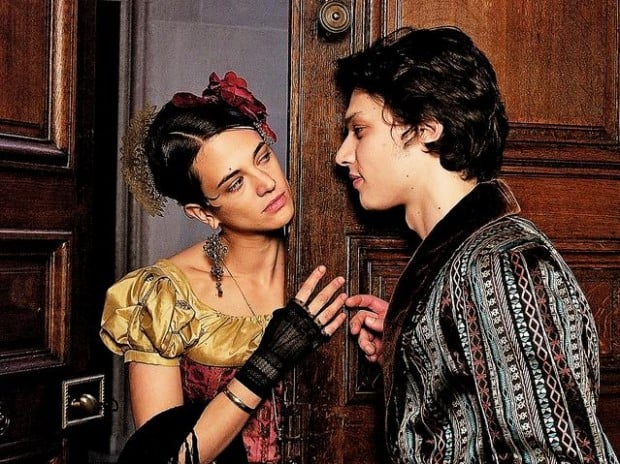
The first time you see the courtesan called La Vellini, she's stretched out on a divan and wearing a smile, or perhaps a scowl. It's hard to tell with this woman, whose lips tremble and twist with rage and pleasure. She's dressed like the supine subject of Goya's painting "The Clothed Maja," which was condemned as indecent by the Spanish Inquisition. To look at the figure on screen writhing like a pampered cat is to understand why that painting made some observers uneasy.
"The Last Mistress" is unlikely to make anyone truly uneasy, aside from the casting of Asia Argento as La Vellini. Written and directed by Catherine Breillat, it relates the unhinged affair between La Vellini and Ryno de Marigny (Fu'ad Aït Aattou, a luscious newcomer), a penniless nobleman and libertine somewhat her junior. Opening in 1835 and based on a novel by Jules Barbey d'Aurevilly from 1851, the story is cruel and enthralling.
People are also reading…
Much of it transpires in flashbacks, sometimes in bed or the equivalent: a tiger-skin rug, a patch of desert sand. Like all of Breillat's films, it is also an emotional, often raw inquiry into troubling, cursed desire.
La Vellini, a Spaniard living in Paris with her decrepit though titled husband, Sir Reginald (Nicholas Hawtrey), is already well seasoned when she meets Ryno, who has recently returned from licentious doings abroad. The future lovers become aware of each other when a mutual friend points out La Vellini enjoying some ice cream in a park. Ryno loudly mocks her as "an ugly mutt," earning him a dark look. From the violence with which she began licking her ice cream in his direction — Breillat abhors subtlety — he should have known what he was in for.
A passion is born, followed by rivulets of blood, near and decisive death, a torrent of words, carnality. The story opens on the eve of Ryno's wedding to a delectable moneyed aristocrat, Hermangarde (Roxane Mesquida). He's ready to settle down, or maybe just settle. One evening, Hermangarde's grandmother, the Marquise de Flers (Claude Sarraute, wonderfully sly and twinkling), confronts Ryno about his scandalous reputation. Confessing all, he relates the highs and bitter lows of his affair with La Vellini, which unfolds as a series of overheated, assaultive (rarely tender) encounters between erotic equals.
Breillat's explorations of desire and pleasure are so far from the antiseptic world of most screen depictions as to seem far out. "The Last Mistress" isn't as graphic as some of her other films, notably "Romance," which features full-frontal and then some. What's most explicit here is ravenous passion and the depiction of desire as a creating, destroying force that invades the very flesh. It's terribly French.
Set amid the rarefied realm of the French aristocracy — Louis-Philippe, the last king to rule France, sits on the throne — the film has many of the trappings of a conventional costume drama. Everything from the costumes to the cinematography works to advance the story. Everything, that is, except La Vellini, who, like Goya's Maja, rocks her world by the public spectacle of her desire.
Like all the unruly women who populate Breillat's films, La Vellini rubs hard against the grain. It's her howls, her spit and her fury that keep everything off kilter, disturbing the peace, its keepers and the narrative flow. Argento hurtles into her scenes, at times literally, gobbling up a lot of space. She's playing a woman whom others deride as a creature. In truth, La Vellini is a woman of pleasure, and Breillat makes certain her cup runneth over, furiously.
The Last Mistress
***
• Rated: Not rated.
• Cast: Asia Argento.
• Director: Catherine Breillat.
• Family call: Intended for adults.
• Language: In French, with subtitles.
• Running time: 104 minutes.


