

* * *
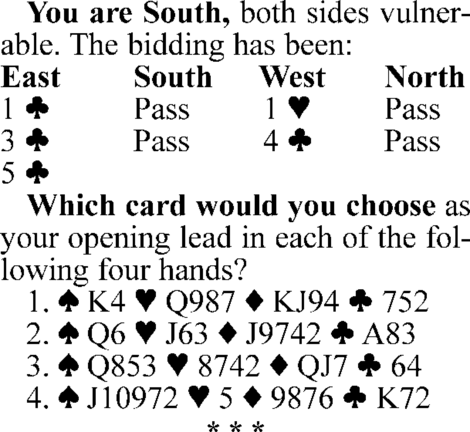
1. Two (or five) of clubs. Generally speaking, defense is either active or passive. In some hands you attack to try to achieve the best result; in others you play possum.
Here, the danger of losing a trick by leading anything but a trump is self-evident. Partner cannot have many high cards, so your best chance of defeating the contract lies in letting declarer work out his own salvation.
2. Queen of spades. Here aggressive action is called for. True, the queen of spades appears to be an unorthodox lead, since it is not in combination with the king or jack. Nevertheless, it offers the best prospect of beating the contract.
Basically, your hope is that partner has the king and you can capture three tricks by scoring a spade, a club and a spade ruff. Perhaps the chance of this materializing will prove to be only a pipe dream, but the fact is that no other defense is more attractive. Holding the ace of trumps, which assures that you will regain the lead before trumps can be drawn, it seems sensible to attack boldly in an effort to acquire two more tricks.
People are also reading…
3. Queen of diamonds. This time you must depend on partner for tricks, and your best chance is to try to develop a trick or two in diamonds. If partner has the king or ace, you are well on the way to exploiting declarer's most likely weak spot.
The heart situation looks especially bad, and your prime effort should be devoted to establishing your side's diamond tricks before declarer can develop and run dummy's hearts.
4. Five of hearts. There is not much chance of stopping the contract unless you can get a heart ruff. Your main hope —not unlikely on the bidding — is that partner has a quick entry of some kind. If so, a heart ruff might easily become the setting trick after you have gained the lead with the king of clubs.
Leading the top card of a sequence is ordinarily very desirable, but in this case, holding the K-x-x of trumps behind declarer, the singleton lead is more likely to succeed.


