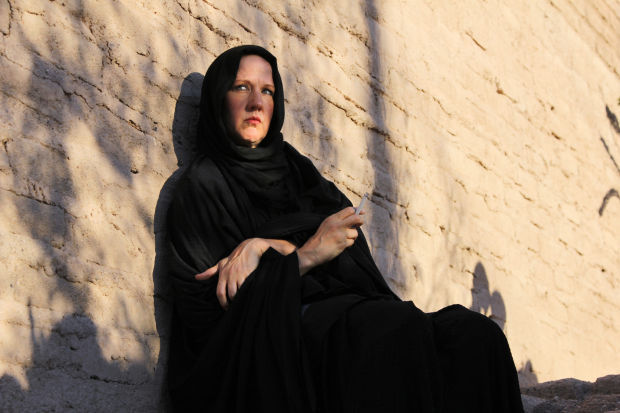
Shock and awe.
The play “9 Parts of Desire,” which Live Theatre Workshop opened Saturday, is equal parts both.
The piece is based on interviews playwright Heather Raffo conducted over the decade between the two wars in Iraq. Like the women she interviewed, Raffo traces her roots to Iraq, and she weaves monologues of nine women into a play that stuns with its horror, its passion and its power.
There is genuine humor there, too, and thank goodness — the relief is necessary.
The shock is delivered through the stories — women who were raped, forced to be sex slaves, and then beheaded when branded prostitutes.
A baby placed in a bag with starving cats that quickly devour the child while her mother sits helplessly by. Bombs. Dead civilians — women, children, elderly, all innocent. Cruel soldiers. Senseless violence. Deep, deep sorrow. Anger. And great love.
People are also reading…
The awe comes courtesy of the script, written with a poet’s sensibilities, a woman’s perspective, and a strong sense of rhythm and storytelling.
But there was also awe in Lori Hunt’s performance in this one-woman show.
She silkily slipped from one character to another with such distinction that the confusion one might have had with a lesser actor was never there.
She moved with grace, spoke with power, or pain, or fury, or love. We knew each of these women; saw their strengths at times, their weaknesses at others. For 80 intermission-less minutes, Hunt kept the audience spellbound as she brought these women to vivid, aching life.
Co-directors Glen Coffman and Sabian Trout didn’t clunk the play up with unnecessary movement or distractions — they wisely let the play, and Hunt, simply and eloquently rule the stage.
The only quibble is that the text was sometimes rushed. And that definitely is a quibble — it didn’t detract from the play’s punch.
“9 Parts” is not an easy piece to watch. Raffo, the child of an American mother and Iraqi father, did not soften the tragedy of the war, the cruelty of the Iraqi regime, and the heartlessness of the Americans who killed civilians with impunity.
But she has also given us a full portrait of Iraqi women, who suffer and love and laugh and cry and pray and curse the heavens as war sweeps through their homeland. They are, in short, everywomen.