

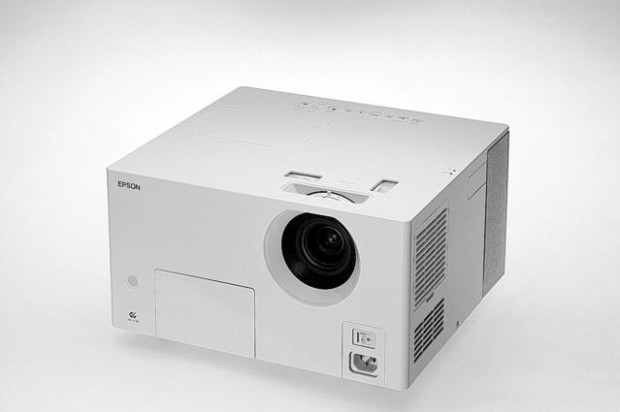
This is the year of the flat-panel TV, but an overlooked category may be a big-screen lover's more affordable alternative: the projector.
What else offers a 100-inch screen for $1,000?
"(Projectors) used to be so big, 30 pounds. Now they're miniaturized. . . . The price has come down drastically," said Po Su, product manager for projectors at BenQ USA in Irvine, Calif.
Projectors have long been a choice for big-screen lovers, but selection was limited to expensive systems for home theaters or business models for the office. Then companies began noticing the crossover market.
Toshiba revamped the projector to appeal to home users. Its shiny black ET20 projector has a built-in DVD player, a wide- screen display, surround-sound speakers and ports to plug in a cable box, Xbox or other video source. The projector also uses a technology called Extreme Short Projection, or ESP, which Toshiba developed with Texas Instruments. An ESP projector needs to be only 4 feet from a screen or wall to project a 100-inch-diagonal image.
People are also reading…
Interest in home projectors is growing as consumers discover how much better a movie can look in high definition. Users will have to invest in a screen, which can cost hundreds to thousands of dollars. But technically, all you need is a blank wall, making projectors more affordable than most flat-screen TVs.
But moving into the home market hasn't been easy. When people walk into an electronics store, they're greeted by sexy plasmas.
The projector is unlikely to replace a TV because they aren't bright for the daytime. Some do offer day and night modes.
But projectors could replace today's more affordable but bulkier alternatives: the rear-projection TVs and cathode-ray tubes that have been around for generations.
"I believe there's only going to be two types of TVs: flat panel and projector for anything under 100 inches," said Sean McBride of Sharp Electronics, which specializes in LCD TVs and projectors. "If you want a plasma over 100 inches, that's going to be $25,000 to $30,000. A projector for $2,000 can get you a 300-inch image."
Culled from experts who live and breathe projectors, here is shared knowledge on what to look for in a projector:
• 1. Minimum features:
1000 lumens for home projectors. The more lumens, the brighter the picture will be if there is light in the room.
Widescreen format, where the size of the picture has a 16-by-9 aspect ratio. Standard TV is 4-by-3.
Video/audio inputs, such as HDMI for high-definition, RGB for a computer, DVI for DVD players, component for most video sources.
• 2. Consider an all-in-one projector so you don't need to spend extra on speakers or a DVD player. Also check whether the projector includes other accessories to get started, like a screen and cables.
• 3. Just like TVs and computer monitors, projectors have a native resolution. Not all are high definition. If HD is a must, make sure the projector offers 720p or 1080p resolution. The higher, the better.
• 4. Check the life expectancy of the light bulb, which can cost upwards of $300 to replace.
Also, see if you can replace the bulb yourself instead of having to send it in to a repair center.


