

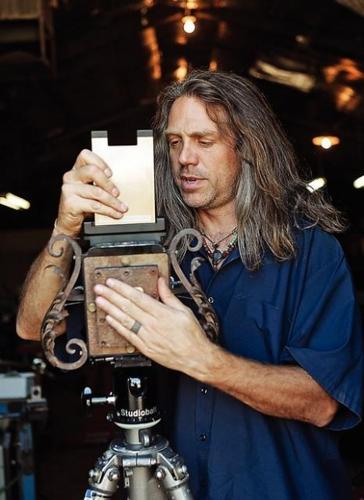
In Wayne Martin Belger's world, art begets art.
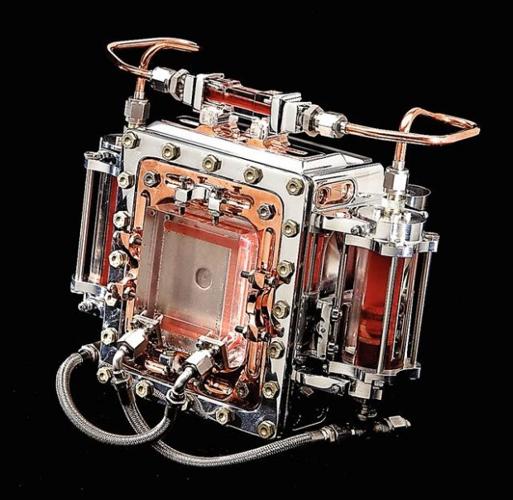
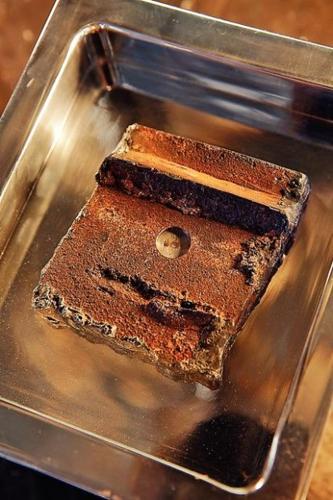
He captures arresting images through the lenses of his handcrafted 4-by-5-inch pinhole cameras — cameras that are themselves works of art.
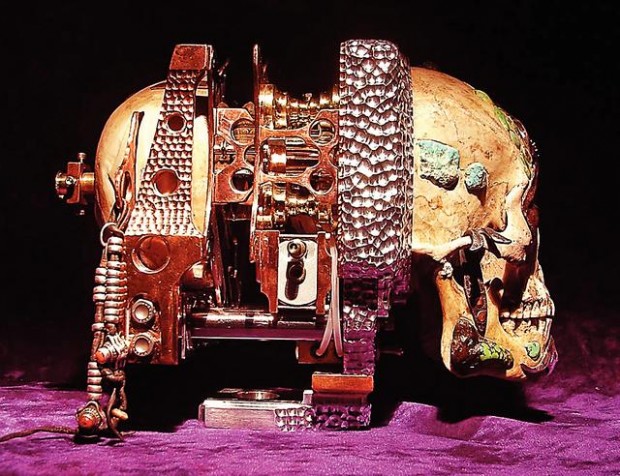
Belger decorates the cameras with gems, jewels and historic artifacts. And HIV-infected blood, a baby's heart, human skulls, sea creatures and, coming soon, Eva Braun's authentic and ornate Third Reich-era crucifix.
"I think they're pretty amazing. Each camera has a story about it," says Mary Findysz, owner of ArtsEye Gallery, where Belger's photographs and one of his cameras — Dragonfly — are currently on view in the gallery's "Curious Camera" exhibit.
"There's a little creepy, eerie part of it all. There's work of his that is whimsical and fun, like the Dragonfly camera. And then there's the whole other side that's off-putting and puts you on edge. He appeals to the two psyches of your brain."
People are also reading…
"I don't believe there's anything strange about it," Belger says, then cites Heart, a camera that has raised a few eyebrows since he crafted it a few years ago.
The camera has a human baby's heart from the 1920s encased on the back. The heart was donated by a man who found it in a garage where it had been stored in jar. Before that, it was part of an anatomy lab.
Heart is made of aircraft-quality aluminum, like most of the 13 cameras Belger has made in the past 10 years. The baby heart is sealed in formaldehyde on the back of the camera.
"My perception is the heart has its own shrine," he explains. "It depends on what your personal belief systems are. With mine, there really isn't a creep factor."
An accidental tourist becomes the tour guide
Belger, 45, began making cameras by accident. He was working in a machine shop in Los Angeles that made laminating machines, with which Belger was very familiar. In the 1960s, his father invented the first laminating machine while working for a company that retained the copyright. In 1993, he followed up with an industrial version that he copyrighted and that is still in use today.
When a photographer friend wanted to make a pinhole camera about 10 years ago, Belger helped him and discovered an outlet for his artistic and mechanical sides, creating works of art that also were functional.
For the first two years, he did it as a passing hobby. About eight years ago, as word started getting out through media coverage and word of mouth, he began building cameras full time. He set up a Web site and started selling his dreamy landscapes, portraits and art photos for $1,200 to $2,800. Until last July, when the economy took its initial nose dive, he was averaging several photo sales a month. He says he's sold nothing in months, although his Web site had 17 million hits last year. So far this year, it's had 10 million hits.
Belger also started selling the cameras to collectors for $8,000 to tens of thousands of dollars; he is currently negotiating an offer of $240,000 for Yama, made from a 500-year-old Tibetan skull and decorated with rubies, sapphires, turquoise and opals, many of them bought at Tucson's gem show.
The cameras are sold with strings attached: the buyer must give Belger exclusive borrow-back privileges. In return, the owners get the second print from Belger's photo shoot. They can keep it, sell it, whatever.
The arrangement can prove to be a boon for the buyer. Belger points to the man who bought his Yemaya underwater camera for about $25,000. To date, Belger has borrowed back the camera for a series of aquarium shoots; he has 17 more aquariums lined up.
"With those 17 aquariums, he's going to get up to 17 photos," says Belger, who lives in Catalina, a community north of Tucson.
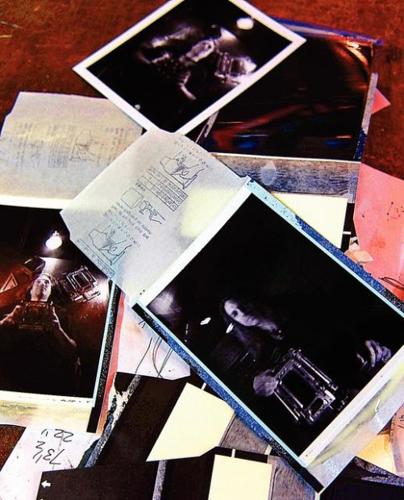
Belger sits among a collection of his cameras and stacks of his photographs spread out on a heavy wooden table in the workroom of his sprawling ranch house. A window that takes up most of the wall frames a breathtaking view of the distant mountain ranges and unfettered desert. That natural beauty and calm is what lured Belger away from Los Angeles.
"I just love Tucson, because the skies are epic," he says as the sun glistens off the water in a fountain outside the window. "It's a perfect place to shoot."
It is here, surrounded by cottonwoods, chollas and other cacti, that he conceives the ideas for his cameras. He takes a concept and runs with it, seeing no need for sketches. If the construction requires a special tool, he'll make it.
"I come from a long line of inventors," he explains, pushing back a shock of his nearly gray, below-the-shoulder hair that is tied in a ponytail. "I will work on a camera for days and days, and I won't sleep. I design every piece in my head.
"I think of it more as a painting," he explains, holding the heavy aluminum skeleton of a camera in its early stages. "You don't draw out a sketch; the painting evolves. Same thing with the camera."
Belger, who grew up in Los Angeles and once taught scuba diving and rock climbing, moved to Catalina a year ago. He shares the home with his five-year-old daughter, Tara. Her mother (Belger's ex-wife) is a surgeon in the Phoenix area.
On a tour of the house, with its panoramic windows, oak doors and door frames, and tile floors, he steps into Tara's room and picks up her gold Holga camera. He holds it up and points out the trinkets she has glued to the plastic frame. She gets her artistic bent from her father and is following him into photography, he says, smiling. One of her pictures is on display alongside Dad's in "Curious Camera."
Every camera has a story
Belger has a story behind every one of his cameras. They start with a flicker of inspiration that comes into focus after he crafts the heavy aluminum frame. From there, the cameras take on a life of their own.
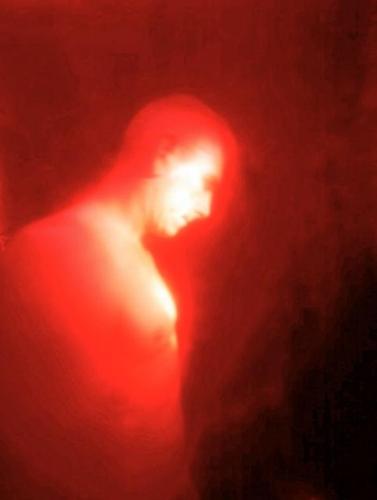
A friend who was HIV-positive inspired him to create Untouchable, a camera that pumps HIV-positive blood through two tubes mounted on the sides. The blood is deposited in a space in front of the lens, creating a red filter over the image.
"All the reds that you see are from the blood itself," he says of the photographs he has taken of HIV-infected men in San Francisco.
He plans to shoot a series of HIV-positive subjects in the United States, India and South Africa to showcase the social disparities of the disease. In America, HIV is not a hindrance to living, and those infected often are outwardly healthy, he explains. In India and South Africa, HIV is a social death sentence; those infected are viewed as untouchable — hence the camera's name.
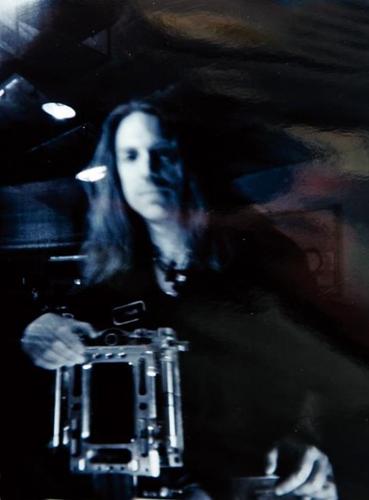
Belger has never been trained as a photographer, although his images — wonderfully composed and hued in graceful shadows — have been praised in photography magazines worldwide. He was listed in the third edition of Photographic Possibilities, released in late 2008, which highlights nearly 150 established and emerging artists and their techniques.
"It's going down a rabbit hole," Belger explains of his photographs and his cameras. "It's uninterrupted time and space and light. Uninterrupted energy coming off the subject. No lenses to change, modify or distort. With digital cameras, it's all binary code. With pinhole, the same air that touches my subject touches the film. There's nothing there. It's all space and time."
Bio file
Los Angeles native Wayne Martin Belger has been crafting artistic 4-by-5 pinhole cameras for 10 years. He moved to Tucson six years ago and lives in Catalina with his 5-year-old daughter. Before he made cameras, he worked as a machinist, a scuba-diving teacher and a climbing instructor. He has been written up in dozens of magazines worldwide and will be featured this summer in Dave Navarro's online TV show "Deep"; no air date has been set.
Belger's works and cameras are exhibited in galleries throughout North America, including in Toronto and Vancouver. His works will be shown in Germany in October. Check out his Web site (www.boyofblue.com) to see examples of his photographs and cameras.


